


Performance, resilience and recovery
Decide whether RAID 0, RAID 1, parity, Storage Spaces or independent 990 PRO volumes fit the workload while accounting for Samsung Magician limitations, firmware visibility and backup.
Use RAID only for a measured throughput, capacity or availability requirement
A single 990 PRO is already fast. RAID 0 increases failure exposure, RAID 1 improves availability but not backup, and controller abstraction can hide Samsung management functions.
Creating or changing an array can erase every member
Back up and test restoration before changing RAID, VMD, Storage Spaces or motherboard controller settings. Record disk order, controller mode and recovery keys.
990 PRO RAID suitability checker
Select the goal, drive count, layout, controller, workload and backup. The result identifies whether RAID adds value or merely adds failure and management complexity.
Common multi-SSD layouts
| Layout | Usable capacity with two equal drives | Failure protection | Best use |
|---|---|---|---|
| Independent volumes | 200% across separate volumes | None across devices | Workload separation and simple recovery |
| RAID 0 / stripe | 200% | None; either device loss breaks array | Temporary high-throughput data |
| RAID 1 / mirror | 100% | One-device failure | Availability for important working data |
| Storage Spaces mirror | 100% | One-device failure with supported setup | Windows-managed resilience |
| Parity | Depends on drive count | One or more failures by design | Sequential, capacity-efficient storage—not ideal two-drive setup |
Current exact-product and professional-workload offers

Samsung SSD 9100 PRO 2TB, PCIe 5.0x4 M.2 2280, Up to 14,700MB/s | NVMe Internal Solid State Hard Drive best for AI Computing, Gaming, and Heavy Duty Workstations (MZ VAP2T0B/AM)
New · PCIe 5.0 x4 NVMe · Heatsink · MBM Sales

Samsung SSD 990 PRO 2TB, PCIe 4.0 M.2 2280, Up to 7,450 MB/s | NVMe Internal Solid State Hard Drive for High End Computing, Gaming, and Heavy Duty Workstations, (MZ-V9P2T0B/AM)
New · PCIe 4.0 x4 NVMe · Bare or not stated · Amazon.com

Samsung 990 PRO 2TB PCIe Gen 4.0 x4 (Maximum Transfer Rate 7,450MB/s) NVMe M.2 (2280) Internal SSD MZ-V9P2T0B-IT/EC
New · PCIe 4.0 x4 NVMe · Bare or not stated · All About Office

Samsung 990 PRO Heatsink Model, 2TB PS5 Operation Verified, PCIe 4.0 (Max Transfer Rate 7,450 MB/s), NVMe M.2 MZ-V9P2T0G-IT/EC
New · PCIe 4.0 x4 NVMe · Heatsink · SiliconValleySeller (SN# Recorded)

Samsung SSD 9100 PRO w/Heatsink 2TB, PCIe 5.0x4 M.2 2280, Up to 14,700MB/s | NVMe Internal Solid State Hard Drive best for AI Computing, Gaming, and Heavy Duty Workstations (MZ-VAP2T0CW)
New · PCIe 5.0 x4 NVMe · Heatsink · Tech on Time (SN RECORDED)

Samsung 2TB 990 PRO with Heatsink PCIe Gen4 NVMe M.2 2280 Up to 7450 MB/s, 6900 MB/s
New · PCIe 4.0 x4 NVMe · Heatsink · SiliconValleySeller (SN# Recorded)
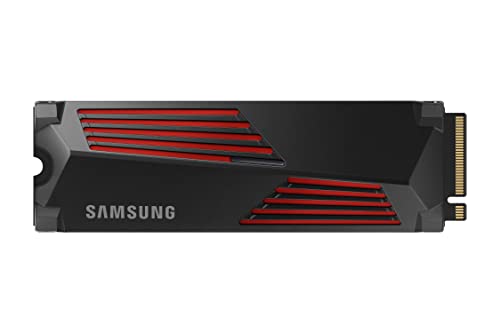
SAMSUNG 990 PRO w/ Heatsink SSD 2TB, PCIe Gen4 M.2 2280 Internal Solid State Hard Drive, Seq. Read Speeds Up To 7,450MB/s for High End Computing, Workstations, Compatible w/ PlayStation 5, MZ-V9P2T0CW
New · PCIe 4.0 x4 NVMe · Heatsink · Amazon.com
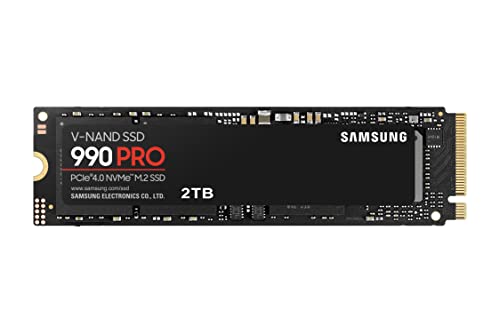
Samsung 990 PRO NVMe M.2 SSD, 2 TB, PCIe 4.0, 7,450 MB/s Read, 6,900 MB/s Write, Internal SSD, for Gaming and Video Editing, MZ-V9P2T0BW
New · PCIe 4.0 x4 NVMe · Bare or not stated · Stavvy Sales

Samsung SSD 990 PRO 4TB, PCIe 4.0 M.2 2280, Up to 7,450 MB/s | NVMe Internal Solid State Hard Drive for High End Computing, Gaming, and Heavy Duty Workstations (MZ-V9P4T0B/AM)
New · PCIe 4.0 x4 NVMe · Bare or not stated · Amazon.com

Samsung SSD 990 PRO with Heatsink 4TB, NVMe M.2, Up to 7,450MB/s | NVMe Internal Solid State Hard Drive best for PlayStation 5 (PS5 SSD) Console Expansion (MZ-V9P4T0CW)
New · PCIe 4.0 x4 NVMe · Heatsink · eKings

Samsung 990 PRO 4TB PCIe Gen 4.0 x4 (Maximum Transfer Rate 7,450MB/s) NVMe M.2 (2280) Internal SSD MZ-V9P4T0B-IT/EC
New · PCIe 4.0 x4 NVMe · Bare or not stated · SiliconValleySeller (SN# Recorded)

SAMSUNG - SOLID STATE DRIVES (SS SSD 4TB 990 PRO PCIE 4.0 X4 NVME 2.0 M.2 2280
New · PCIe 4.0 x4 NVMe · Bare or not stated · SiliconValleySeller (SN# Recorded)
Amazon prices shown are retained for up to 24 hours. Latest price refresh: 2026-10-22 00:37:40 UTC. Price and availability may change; Amazon at purchase time controls.
Why a single 990 PRO is often enough
One 990 PRO already approaches the practical ceiling of PCIe 4.0 x4 sequential bandwidth and delivers strong random I/O. Gaming, Windows and many creative workloads do not saturate it continuously. Adding RAID can improve aggregate throughput in a benchmark without improving the real task.
Start by measuring disk queue, throughput and latency during the workload. If the SSD is not the bottleneck, spend the budget on capacity, memory, GPU, backup or a second independent volume. RAID is justified by a specific requirement, not by the availability of two M.2 slots.
- Measure before combining drives
- Single-drive simplicity has real value
RAID is not backup
RAID can keep a volume online after selected hardware failures, but it does not protect against deletion, ransomware, file corruption, controller mistakes, theft, fire or a bad application write. RAID 0 has no redundancy at all.
Maintain an independent backup that is not permanently exposed to the same system. Test restoration. For creator and AI work, preserve source media, projects, datasets and unique checkpoints outside the array. Availability and recoverability are separate design goals.
- Availability is not historical recovery
- Keep a tested independent copy
RAID 0: speed with multiplied risk
RAID 0 stripes data across drives, combining capacity and potential throughput. If either SSD, slot, controller metadata or motherboard path fails, the complete volume can become inaccessible. The array may also complicate firmware and health visibility.
Use RAID 0 only for temporary or reproducible data where measured sequential or parallel I/O benefits the task. It is a poor choice for irreplaceable game saves, projects or datasets. A single Gen5 SSD may provide similar sequential ambition with simpler management on a supported platform.
- Any member loss breaks the stripe
- Use only for reproducible high-throughput data
RAID 1 and mirrored availability
RAID 1 keeps copies on two drives and can continue after one member fails when the controller and operating system handle the event correctly. Usable capacity is approximately one drive. Reads may improve in some implementations, while writes must reach both members.
A mirror does not preserve old versions or protect against logical corruption. Match capacity and preferably model and firmware. Monitor both members because a silently degraded mirror offers no redundancy. Practice replacing a failed device and rebuilding before trusting the design for important work.
- Two copies remain one logical failure domain
- Monitor and rehearse rebuilds
Windows Storage Spaces
Storage Spaces can aggregate drives and create simple, mirror or parity virtual disks. Microsoft describes mirror as a general high-performance resilient option and parity as more capacity-efficient with slower random writes. The exact behavior depends on Windows edition and deployment.
Storage Spaces is separate from Samsung Magician. The physical SSDs may be visible differently, and firmware management should be planned before pooling them. Document pool metadata, resiliency, provisioning and recovery commands. Do not remove a member from the pool because a retail utility labels it unexpectedly.
- Choose resiliency from workload
- Document the pool before failure
Intel VMD and motherboard RAID
Intel VMD and motherboard RAID can make multiple NVMe drives appear behind a controller. This can be required for bootable arrays on some platforms, but changing the setting can make an existing Windows installation unbootable. Driver loading during Windows setup may also be required.
Samsung states that Magician does not officially support SSDs configured in RAID mode. Firmware, health, authentication and performance controls may be limited even while the array works. Decide whether array booting is worth losing simple per-drive management.
- Controller mode is part of the boot path
- RAID can hide Samsung management features
Firmware and drive symmetry
Use the same capacity and preferably the same exact model and firmware for array members. Mixed performance can cause the array to behave like the slower device, while capacity differences may leave space unused. Record each serial number before the controller hides it.
Apply firmware updates before creating the array when possible, one drive at a time through a supported direct path. After deployment, follow the controller and Samsung guidance rather than dismantling the array casually. Keep backups current before every firmware or BIOS operation.
- Match model, capacity and firmware
- Record serials before pooling
TRIM, SMART and health visibility
Modern RAID and Storage Spaces implementations may pass or coordinate TRIM, but support depends on controller, driver, layout and operating system. Do not assume a benchmark proves maintenance commands and health data are visible.
Monitor controller health, Windows event logs and any per-drive telemetry the stack exposes. When Samsung Magician cannot see array members, use controller-supported tools and schedule direct inspection during maintenance if the design permits. A drive can fail without a consumer dashboard warning.
- Verify TRIM and telemetry in the exact stack
- Use controller-supported monitoring
Video editing and creator workloads
A two-drive setup often performs better operationally as independent volumes: one for media and one for cache or exports. This separates queues and failure domains without combining both devices into an array. RAID 0 is justified only when a measured multicamera or uncompressed workflow exceeds one SSD.
RAID 1 can improve availability for active project data, but original footage still needs backup. Adobe’s storage-role guidance supports separating system, media and cache when workload demands it. Architecture can matter more than one oversized synthetic volume.
- Independent drives can separate workloads cleanly
- Mirror active data only with backup
Local AI, VMs and databases
Local AI model loading rarely needs RAID 0 after the model reaches memory. Dataset processing, many virtual machines or databases can create parallel I/O that benefits from multiple devices, but software and memory design should be measured first.
Independent volumes can place models, datasets, checkpoints and temporary caches on separate devices. A mirror can protect availability of important working data. For databases, use application-supported backup and recovery rather than relying on block-level RAID alone.
- Parallel workloads may benefit from separation
- Application recovery remains essential
Encryption and array recovery
BitLocker can protect a logical RAID or Storage Spaces volume, but recovery now depends on encryption keys, controller configuration and array metadata. Save all three classes of information outside the system. A motherboard replacement can require both BitLocker recovery and array migration.
Do not enable encryption until the array is stable and recovery is documented. Do not clear a TPM or reset a controller during troubleshooting without keys and backups. For decommissioning, sanitize each physical member through a supported process after the array is no longer needed.
- Protect keys and array metadata
- Plan motherboard and controller replacement
A practical recommendation
For gaming and mixed PC use, keep one 990 PRO as the primary drive and use the second as an independent library, project or backup-staging volume. For creator work, separate media and cache. Use RAID 1 or Storage Spaces mirror when continued operation after one SSD failure has measurable value.
Use RAID 0 only for temporary, reproducible, storage-bound workloads with tested backup. Compare the cost and complexity with one larger 4TB 990 PRO or a Gen5 SSD. The best design is the one you can monitor, update and recover under pressure.
- Independent volumes are the default
- RAID needs a documented recovery reason
Official references and methodology
Cloudzat separates manufacturer specifications from buying analysis. Live offers appear only when this plugin’s dedicated catalogue accepts the exact family and capacity, rejects accessories and conflicting variants, and preserves condition and cooling distinctions. Prices are not invented when Amazon exposes only buying options.
Frequently asked questions
Can I put two Samsung 990 PRO drives in RAID 0?
Yes on a supported controller, but either member failure can destroy the whole array and Samsung Magician support may be limited.
Does RAID 0 double gaming speed?
Usually not. Games rarely scale with aggregate sequential bandwidth that way.
Is RAID 1 a backup?
No. It improves availability after selected hardware failures but mirrors deletion and corruption.
Can Samsung Magician see RAID members?
Samsung states that Magician does not officially support SSDs configured in RAID mode.
Should RAID members use the same firmware?
Prefer identical model, capacity and firmware, and record serials before creating the array.
Is Storage Spaces better than motherboard RAID?
It offers Windows-managed resiliency and portability advantages in some deployments, but the right choice depends on boot, performance and recovery requirements.
Can BitLocker encrypt a RAID volume?
Yes, it can protect the logical Windows volume, but recovery also depends on array metadata and controller configuration.
Should video editors use RAID 0?
Only when measured throughput needs exceed one SSD. Independent media and cache drives are often simpler.
Does RAID protect against ransomware?
No. Maintain independent, versioned and preferably offline backups.
Would one 4TB 990 PRO be simpler than two 2TB drives?
Yes. It provides one large volume with simpler firmware and recovery, though it does not provide redundancy.
Affiliate disclosure: Cloudzat may earn a commission from qualifying Amazon purchases. The checkout page controls the final price, condition, seller, warranty and availability.