


Models, datasets and checkpoints
Plan 2TB or 4TB NVMe storage for local LLMs, image models, embeddings, vector indexes, datasets and checkpoints while separating storage throughput from GPU-memory and compute limits.
The 990 PRO is strong local-AI storage, but capacity usually matters more than peak Gen4 speed
Use 2TB for a curated inference library. Use 4TB for many models, datasets, embeddings or active checkpoints. GPU VRAM and compute often dominate runtime after loading.
Models and datasets need backup and provenance
Keep original datasets, fine-tunes, prompts, indexes and irreplaceable checkpoints on independent storage. Downloaded base models may be replaceable; your derived work may not be.
Local AI model and dataset capacity planner
Enter model library, datasets, embeddings, checkpoints and cache multipliers. The result estimates total working capacity and whether 2TB or 4TB is realistic.
Local-AI storage components
| Component | Typical behavior | Capacity pattern | 990 PRO role |
|---|---|---|---|
| Quantized LLM models | Large sequential reads at load | Several GB to hundreds of GB | Fast local model library |
| Diffusion models and assets | Read-heavy with caches | Multiple checkpoints and LoRAs | Fast asset library |
| RAG documents and vector index | Many files and database I/O | Grows with corpus and embeddings | Responsive local index |
| Training/fine-tuning checkpoints | Repeated large writes | Several copies per run | High-write active workspace |
| Datasets and preprocessing cache | Mixed read/write | Can exceed model size | 2TB–4TB staging tier |
Current exact-product and professional-workload offers

Samsung SSD 9100 PRO 2TB, PCIe 5.0x4 M.2 2280, Up to 14,700MB/s | NVMe Internal Solid State Hard Drive best for AI Computing, Gaming, and Heavy Duty Workstations (MZ VAP2T0B/AM)
New · PCIe 5.0 x4 NVMe · Heatsink · MBM Sales

Samsung SSD 990 PRO 2TB, PCIe 4.0 M.2 2280, Up to 7,450 MB/s | NVMe Internal Solid State Hard Drive for High End Computing, Gaming, and Heavy Duty Workstations, (MZ-V9P2T0B/AM)
New · PCIe 4.0 x4 NVMe · Bare or not stated · Amazon.com

Samsung 990 PRO 2TB PCIe Gen 4.0 x4 (Maximum Transfer Rate 7,450MB/s) NVMe M.2 (2280) Internal SSD MZ-V9P2T0B-IT/EC
New · PCIe 4.0 x4 NVMe · Bare or not stated · All About Office

Samsung 990 PRO Heatsink Model, 2TB PS5 Operation Verified, PCIe 4.0 (Max Transfer Rate 7,450 MB/s), NVMe M.2 MZ-V9P2T0G-IT/EC
New · PCIe 4.0 x4 NVMe · Heatsink · SiliconValleySeller (SN# Recorded)

Samsung SSD 9100 PRO w/Heatsink 2TB, PCIe 5.0x4 M.2 2280, Up to 14,700MB/s | NVMe Internal Solid State Hard Drive best for AI Computing, Gaming, and Heavy Duty Workstations (MZ-VAP2T0CW)
New · PCIe 5.0 x4 NVMe · Heatsink · Tech on Time (SN RECORDED)

Samsung 2TB 990 PRO with Heatsink PCIe Gen4 NVMe M.2 2280 Up to 7450 MB/s, 6900 MB/s
New · PCIe 4.0 x4 NVMe · Heatsink · SiliconValleySeller (SN# Recorded)
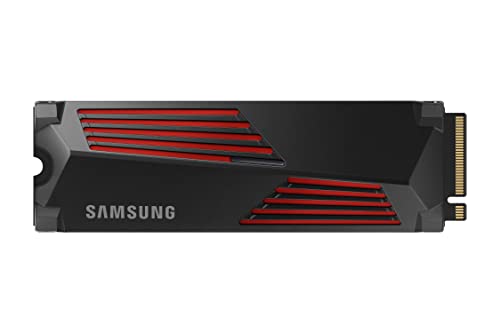
SAMSUNG 990 PRO w/ Heatsink SSD 2TB, PCIe Gen4 M.2 2280 Internal Solid State Hard Drive, Seq. Read Speeds Up To 7,450MB/s for High End Computing, Workstations, Compatible w/ PlayStation 5, MZ-V9P2T0CW
New · PCIe 4.0 x4 NVMe · Heatsink · Amazon.com
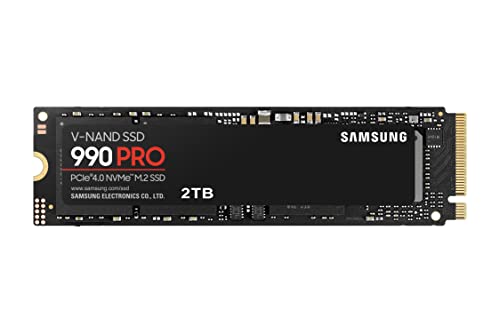
Samsung 990 PRO NVMe M.2 SSD, 2 TB, PCIe 4.0, 7,450 MB/s Read, 6,900 MB/s Write, Internal SSD, for Gaming and Video Editing, MZ-V9P2T0BW
New · PCIe 4.0 x4 NVMe · Bare or not stated · Stavvy Sales

Western Digital WDS400T2X0E-EC Western Digital SN850X 4TB M.2-2280 PCIe Gen4 x 4 NVMe (Read Up to 7,300MB/sec) Internal SSD
New · PCIe 4.0 x4 NVMe · Bare or not stated · Woot

WD_BLACK SN850X 4TB NVMe SSD - M.2 2280, Up to 7,300 MB/s Read speeds, Up to 6,300 MB/s write speeds, Gaming Expansion, High Performance Internal Solid State Drive - WDS400T2X0E
New · PCIe 4.0 x4 NVMe · Bare or not stated · vCloudTech

Samsung SSD 990 PRO 4TB, PCIe 4.0 M.2 2280, Up to 7,450 MB/s | NVMe Internal Solid State Hard Drive for High End Computing, Gaming, and Heavy Duty Workstations (MZ-V9P4T0B/AM)
New · PCIe 4.0 x4 NVMe · Bare or not stated · Amazon.com

Samsung SSD 990 PRO with Heatsink 4TB, NVMe M.2, Up to 7,450MB/s | NVMe Internal Solid State Hard Drive best for PlayStation 5 (PS5 SSD) Console Expansion (MZ-V9P4T0CW)
New · PCIe 4.0 x4 NVMe · Heatsink · eKings
Amazon prices shown are retained for up to 24 hours. Latest price refresh: 2026-10-22 00:38:03 UTC. Price and availability may change; Amazon at purchase time controls.
What the SSD changes in a local-AI system
The SSD determines how quickly models, datasets, embeddings and caches can be read into system memory or GPU memory and how fast checkpoints or preprocessing outputs are written. The 990 PRO offers near-ceiling PCIe 4.0 throughput and strong random performance for mixed files.
Once a model is resident in VRAM or RAM, inference speed is usually controlled by GPU compute, memory bandwidth, CPU offload and software. A faster Gen5 SSD may shorten loading without increasing tokens per second. Storage planning should begin with capacity and workflow, then interface speed.
- Storage accelerates load and staging
- It does not replace GPU VRAM or compute
Model-library capacity grows quickly
A single quantized language model may use a few gigabytes, while larger parameter counts, higher precision variants and several quantization levels multiply the library. Image-generation checkpoints, VAEs, ControlNet models, LoRAs and upscalers add many smaller but cumulative files.
Keep only active variants on the performance SSD and archive replaceable downloads elsewhere. Record model source, license, hash and configuration. The calculator treats every retained model as capacity because a library built from experiments often grows faster than expected.
- Count every quantization and checkpoint
- Track source and license metadata
2TB for curated inference
The 2TB 990 PRO is a strong choice for a curated local inference system with selected LLMs, image models and a moderate document corpus. It can host Windows or Linux, tools and hundreds of gigabytes of models while retaining adequate free space.
It becomes cramped when the same drive also holds game libraries, raw datasets, vector indexes and multiple training checkpoints. Separate replaceable models from unique work, and move cold assets to a NAS or larger SSD. A fast 2TB drive near full is less useful than a well-managed tiered system.
- Best for selected active models
- Tier cold and replaceable assets elsewhere
4TB for datasets and experimentation
The 4TB model offers roughly double the capacity and 4GB of DRAM, making it practical for several model families, larger RAG corpora, image assets, package caches and checkpoint retention. It is especially valuable in workstations with one available M.2 slot.
Choose it from measured need, not the assumption that AI always requires the largest SSD. If the GPU has limited VRAM and the workflow uses only a few quantized models, 2TB may be enough. If preprocessing creates multiple copies of a terabyte dataset, even 4TB needs an archive plan.
- 4TB reduces constant model shuffling
- Dataset copies can still exceed it
RAG documents, embeddings and vector indexes
Retrieval-augmented generation adds source documents, normalized text, chunk metadata, embeddings and a vector database. Index size depends on document count, embedding dimensions, metadata and replication. Rebuilding an index can create temporary copies or write amplification.
The 990 PRO’s random I/O helps local databases, but software design, memory caching and database configuration remain important. Back up the original corpus and any irreplaceable annotations. The vector index may be recreated, but regeneration time can justify a backup when the corpus is large.
- Budget for source plus index plus temporary copies
- Back up annotations and curated metadata
Fine-tuning and checkpoint workloads
Fine-tuning, LoRA training and experimentation can write checkpoints, optimizer state, logs and evaluation outputs repeatedly. Several checkpoints may each approach the size of the model state. Retention policies are therefore as important as SSD capacity.
Use sufficient free space and monitor TBW when the system performs frequent training or dataset transformation. A larger 4TB drive spreads writes across more NAND and carries a higher published endurance limit. Still, a client SSD should not be presented as an enterprise training appliance without workload analysis.
- Define checkpoint retention
- Monitor writes on automated training systems
Gen4 versus Gen5 for local AI
The 990 PRO can read up to 7,450MB/s under Samsung’s test conditions. A 9100 PRO on a true PCIe 5.0 x4 platform offers much higher sequential throughput. The benefit appears when loading or copying large contiguous model files and when the rest of the path can consume that bandwidth.
Many local-AI tasks load a model once and then run for hours. In that case, paying for more capacity or VRAM can outperform a Gen5 storage premium. Compare live prices and motherboard support. A 9100 PRO installed in a Gen4 slot cannot deliver its Gen5 headline.
- Gen5 helps repeated large loads
- Capacity or VRAM may produce more value
Memory mapping, offload and system RAM
Some inference tools memory-map model files or offload layers between storage, system RAM and GPU memory. Faster storage can reduce stalls, but insufficient RAM or a heavily shared system can still cause paging and inconsistent performance.
Allocate enough system memory for the chosen model and context. Avoid using the SSD as a substitute for required RAM through constant paging. Track actual disk queue, read throughput and cache behavior during inference. The tool should not claim that any SSD makes an oversized model fit efficiently.
- Storage is not a replacement for RAM
- Observe the real offload path
Thermals in long AI sessions
Model loading is brief, but preprocessing, embeddings and checkpoint writes can keep the SSD active for long periods. Use a proper M.2 heatsink and airflow. The factory-heatsink model is suitable where the chassis supports it; otherwise use the motherboard’s shield with correct pad contact.
Monitor temperature throughout the longest dataset or embedding job. A drive that throttles after several minutes may look excellent in a short benchmark and underperform in production. Keep firmware current and avoid placing the module directly under trapped GPU exhaust when another slot is available.
- Test sustained preprocessing jobs
- Use one compatible heatsink solution
File-system and project organization
Separate base models, unique fine-tunes, datasets, indexes, caches and outputs into clear directories or volumes. Mark which items are downloadable, reproducible or irreplaceable. This makes capacity cleanup safer and lets backup policy focus on unique work.
For Windows, use a modern file system and avoid unsupported exotic partitions if Samsung Magician management is required. For Linux, remember that internal SSD management and firmware workflows may differ. Do not create RAID or encryption layers without documenting how to access health and recover the environment.
- Classify replaceable versus unique files
- Document platform and management dependencies
Backup and archive tiers
Downloaded public models can often be restored from their source, but links, licenses and exact revisions can disappear. Fine-tunes, private datasets, prompt libraries, evaluation results and RAG annotations may be unique. Keep independent copies and test restoration.
A NAS or high-capacity HDD tier can store cold models and datasets, while the 990 PRO holds the active set. Use checksums for large model files and version metadata for reproducibility. RAID can improve availability but does not replace backup against deletion or corruption.
- Back up unique derived work
- Use checksums and version metadata
Buying recommendation
Choose a 2TB 990 PRO for a curated inference workstation or a secondary active-model drive. Choose 4TB when the calculator shows several model families, datasets, indexes and checkpoints exceeding about 1.5TB before growth and free-space reserve.
Compare the 9100 PRO only on a true Gen5 platform with repeated large loading or preprocessing demand. Compare lower-cost Gen4 alternatives when capacity and seller quality matter more than Samsung ecosystem features. Buy the exact bare or heatsink configuration that fits the chassis.
- 2TB for curated inference
- 4TB for experimentation and datasets
Official references and methodology
Cloudzat separates manufacturer specifications from buying analysis. Live offers appear only when this plugin’s dedicated catalogue accepts the exact family and capacity, rejects accessories and conflicting variants, and preserves condition and cooling distinctions. Prices are not invented when Amazon exposes only buying options.
Frequently asked questions
Is the Samsung 990 PRO good for local LLMs?
Yes. It is fast local storage for models, datasets and indexes, though GPU memory and compute usually control inference speed.
Does an SSD increase tokens per second?
Usually only when the workflow is storage-bound or offloading heavily. Once resident in memory, compute dominates.
Is 2TB enough for local AI?
It is enough for a curated model library and moderate datasets, but experimentation can outgrow it quickly.
When should I buy 4TB?
When models, datasets, indexes, checkpoints, caches and growth exceed the safe 2TB working set.
Is the 9100 PRO much faster for AI?
It can load large files faster on a Gen5 platform, but many inference sessions load once and then become compute-bound.
Should I store vector indexes on NVMe?
Yes, especially for responsive local RAG, but database design and RAM caching still matter.
Do checkpoints wear out the SSD?
Repeated large writes contribute to TBW. Monitor actual writes and use retention policies.
Can I keep all models only on the 990 PRO?
Do not keep unique fine-tunes or private datasets only on one SSD. Maintain independent backups.
Does the heatsink version fit every workstation?
No. Confirm physical clearance and do not stack it under a motherboard shield.
Is RAID useful for local AI models?
It can provide throughput or availability, but adds management complexity and is not a backup.
Affiliate disclosure: Cloudzat may earn a commission from qualifying Amazon purchases. The checkout page controls the final price, condition, seller, warranty and availability.