


Data protection and recovery
Understand the 990 PRO’s AES 256-bit, TCG Opal and IEEE1667 capabilities, how Windows BitLocker actually protects a volume, and why supported hardware does not prove encryption is active.
Use BitLocker with verified recovery-key management for most Windows users
The 990 PRO supports hardware security standards, but Windows policy, controller presentation and deployment determine whether hardware encryption is used. Software BitLocker remains the normal manageable choice for many systems.
Encryption without a recoverable key can become permanent data loss
Store recovery information outside the encrypted PC and test the recovery process before changing TPM, BIOS, Secure Boot, storage-controller or motherboard settings.
990 PRO encryption readiness planner
Choose the drive role, Windows edition, TPM status and recovery-key plan. The tool identifies the protection route and the checks required before deployment.
990 PRO and Windows encryption layers
| Layer | What it provides | What must be verified | Main risk |
|---|---|---|---|
| 990 PRO hardware capability | AES 256-bit, TCG Opal v2.0, IEEE1667 support | Host and policy compatibility | Assuming capability means enabled |
| BitLocker software encryption | Windows-managed full-volume protection | Recovery key and protection status | Lost recovery information |
| TPM and Secure Boot | Platform integrity and key release | Firmware and boot configuration | Recovery prompt after changes |
| Password or Opal management | Pre-boot or enterprise drive locking | Supported management platform | Vendor and interoperability complexity |
| Secure Erase or cryptographic retirement | Removes or invalidates data access | Approved process and verification | Erasing the wrong drive |
Current exact-product and professional-workload offers

Samsung SSD 990 PRO 2TB, PCIe 4.0 M.2 2280, Up to 7,450 MB/s | NVMe Internal Solid State Hard Drive for High End Computing, Gaming, and Heavy Duty Workstations, (MZ-V9P2T0B/AM)
New · PCIe 4.0 x4 NVMe · Bare or not stated · Amazon.com

Samsung 990 PRO 2TB PCIe Gen 4.0 x4 (Maximum Transfer Rate 7,450MB/s) NVMe M.2 (2280) Internal SSD MZ-V9P2T0B-IT/EC
New · PCIe 4.0 x4 NVMe · Bare or not stated · All About Office

Samsung 990 PRO Heatsink Model, 2TB PS5 Operation Verified, PCIe 4.0 (Max Transfer Rate 7,450 MB/s), NVMe M.2 MZ-V9P2T0G-IT/EC
New · PCIe 4.0 x4 NVMe · Heatsink · SiliconValleySeller (SN# Recorded)

Samsung 2TB 990 PRO with Heatsink PCIe Gen4 NVMe M.2 2280 Up to 7450 MB/s, 6900 MB/s
New · PCIe 4.0 x4 NVMe · Heatsink · SiliconValleySeller (SN# Recorded)
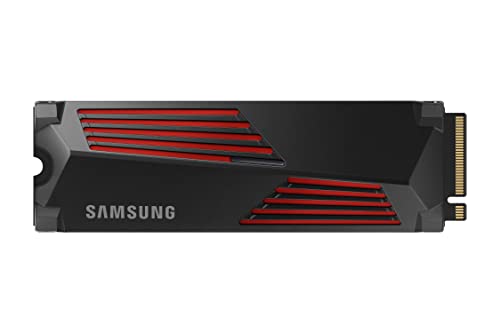
SAMSUNG 990 PRO w/ Heatsink SSD 2TB, PCIe Gen4 M.2 2280 Internal Solid State Hard Drive, Seq. Read Speeds Up To 7,450MB/s for High End Computing, Workstations, Compatible w/ PlayStation 5, MZ-V9P2T0CW
New · PCIe 4.0 x4 NVMe · Heatsink · Amazon.com
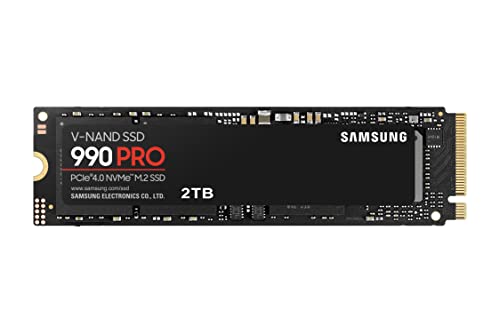
Samsung 990 PRO NVMe M.2 SSD, 2 TB, PCIe 4.0, 7,450 MB/s Read, 6,900 MB/s Write, Internal SSD, for Gaming and Video Editing, MZ-V9P2T0BW
New · PCIe 4.0 x4 NVMe · Bare or not stated · Stavvy Sales

Samsung SSD 990 PRO 4TB, PCIe 4.0 M.2 2280, Up to 7,450 MB/s | NVMe Internal Solid State Hard Drive for High End Computing, Gaming, and Heavy Duty Workstations (MZ-V9P4T0B/AM)
New · PCIe 4.0 x4 NVMe · Bare or not stated · Amazon.com

Samsung SSD 990 PRO with Heatsink 4TB, NVMe M.2, Up to 7,450MB/s | NVMe Internal Solid State Hard Drive best for PlayStation 5 (PS5 SSD) Console Expansion (MZ-V9P4T0CW)
New · PCIe 4.0 x4 NVMe · Heatsink · eKings

Samsung 990 PRO 4TB PCIe Gen 4.0 x4 (Maximum Transfer Rate 7,450MB/s) NVMe M.2 (2280) Internal SSD MZ-V9P4T0B-IT/EC
New · PCIe 4.0 x4 NVMe · Bare or not stated · SiliconValleySeller (SN# Recorded)

SAMSUNG - SOLID STATE DRIVES (SS SSD 4TB 990 PRO PCIE 4.0 X4 NVME 2.0 M.2 2280
New · PCIe 4.0 x4 NVMe · Bare or not stated · SiliconValleySeller (SN# Recorded)

Samsung SSD 990 PRO 2TB, PCIe 4.0 M.2 2280, Up to 7,450 MB/s | NVMe Internal Solid State Hard Drive for High End Computing, Gaming, and Heavy Duty Workstations, (MZ-V9P2T0B/AM)
Renewed · PCIe 4.0 x4 NVMe · Bare or not stated · Amazon.com

Samsung 990 PRO 2TB PCIe Gen 4.0 x4 (Maximum Transfer Rate 7,450MB/s) NVMe M.2 (2280) Internal SSD MZ-V9P2T0B-IT/EC
Renewed · PCIe 4.0 x4 NVMe · Bare or not stated · All About Office
Amazon prices shown are retained for up to 24 hours. Latest price refresh: 2026-10-22 00:37:13 UTC. Price and availability may change; Amazon at purchase time controls.
The 990 PRO security specification
Samsung lists AES 256-bit full-disk encryption capability, TCG Opal v2.0 and IEEE1667 Encrypted Drive support for the 990 PRO. These specifications describe what the controller can support when paired with a compatible host, policy and management stack.
They do not show that a current Windows volume is encrypted or that keys are protected. Check Windows protection status, BitLocker configuration and recovery-key custody. Product-page encryption language should never be used as proof that a used or prebuilt system has active protection.
- Capability and active protection are different
- Verify the operating-system status
Why BitLocker is the practical Windows default
BitLocker protects offline data by encrypting the Windows or fixed-data volume and tying unlock to a TPM, user authentication or recovery method. It integrates with Windows management and can store recovery information in a Microsoft account, Microsoft Entra ID, Active Directory or another approved location.
For many users, software-based BitLocker is preferred because it is consistently managed by the operating system rather than relying on drive-firmware implementation. Microsoft policy settings determine whether hardware-based encryption is permitted. Do not force hardware encryption merely because the SSD advertises Opal support.
- BitLocker provides manageable volume protection
- Hardware offload requires explicit validation
Hardware encryption is not automatically better
A self-encrypting drive can perform cryptography in its controller, but Microsoft distinguishes generic self-encrypting drives from Windows Encrypted Hard Drives that meet specific protocol and IEEE1667 requirements. Deployment, firmware assurance, policy and audit needs determine whether hardware encryption is appropriate.
Organizations should test the exact model, firmware and platform before enabling hardware-based BitLocker policy. Consumers usually gain more from reliable recovery-key management, current firmware and a supported Windows configuration than from chasing a hidden hardware-offload status.
- Validate exact platform compliance
- Management quality matters more than the label
Recovery-key planning
Store at least two independent recovery-key copies for important systems. One may be in a Microsoft or organization account and another in a controlled offline record. Confirm that the identifier shown by Windows matches the stored key before performing BIOS, TPM, Secure Boot or storage-controller maintenance.
A key saved only on the encrypted drive is not a backup. A screenshot stored in the same Windows profile may be inaccessible during recovery. For business systems, define who is authorized to retrieve keys, how access is audited and how keys are removed when hardware changes ownership.
- Keep recovery outside the encrypted device
- Match the key identifier before maintenance
Boot-drive deployment
A clean Windows installation on a UEFI system provides the simplest partition and TPM path. Confirm firmware settings, enable protection, let initial encryption complete and save the recovery key before adding aggressive overclocking or firmware changes. Monitor BitLocker status with Windows tools rather than assuming the lock icon tells the whole story.
When cloning an existing installation, suspend protection as required by the migration workflow, verify the destination boots, then resume and confirm protection on the new 990 PRO. Do not erase the source until the new installation and recovery path have been tested.
- Clean deployment simplifies validation
- Cloning requires post-migration protection checks
Secondary data drives
BitLocker can encrypt fixed data volumes independently of the operating-system drive. Decide whether the volume should auto-unlock on one PC or require a password or recovery key when moved. Auto-unlock is convenient but ties access to the security of the system volume.
For project files, local AI datasets and client media, document where recovery information is held and how backups are encrypted. A mirrored or synchronized copy is not useful if every copy shares the same inaccessible key or if a ransomware event can reach all mounted volumes.
- Set an intentional unlock policy
- Encrypt and test backups too
TPM, BIOS and motherboard changes
Firmware updates, Secure Boot changes, TPM clearing and motherboard replacement can change the measurements used to release a BitLocker key. Windows may ask for recovery even when the SSD is healthy. Plan the change, suspend protection only when appropriate and keep the recovery key available on another device.
Do not clear a TPM as a casual troubleshooting step. Confirm the correct account, key and managed-device policy first. After maintenance, resume protection and verify that a normal reboot succeeds before assuming the encryption configuration is complete.
- Hardware changes can trigger recovery
- Never clear TPM without verified keys
VMD, RAID and controller presentation
Samsung Magician has limited or unsupported functionality for RAID-configured SSDs. BitLocker can protect the logical Windows volume even when the physical 990 PRO devices are hidden behind Intel VMD, motherboard RAID or another controller, but firmware, health and hardware-encryption management may be less visible.
Design the storage and encryption layers together. Record the controller configuration, array metadata, recovery keys and replacement procedure. Changing from RAID to direct NVMe can make the system unbootable or destroy an array, so it must not be suggested merely to expose a Samsung security feature.
- Logical volume protection can outlive device visibility
- Document controller and recovery dependencies
Encryption and performance
Modern software BitLocker on supported processors often has a small practical impact, but the result depends on CPU, workload and policy. Measure a real copy, build or editing task instead of relying on a single synthetic score. Do not disable encryption on sensitive data solely to improve a benchmark.
The 990 PRO’s high throughput can expose other limits such as CPU encryption speed, PCIe link width or file-system overhead. If an encrypted workload is genuinely constrained, review policy and hardware with security stakeholders rather than silently weakening protection.
- Benchmark the protected workload
- Security requirements set the boundary
Secure Erase, resale and decommissioning
BitLocker protects data while keys are controlled. When a drive is sold or retired, follow a supported sanitization process. A volume that was encrypted only after sensitive files had existed unencrypted may still require full-drive sanitization because old sectors could contain remnants.
Samsung Secure Erase is destructive and should be planned separately. For managed environments, use the organization’s media-retirement standard and record the serial, method and result. Never assume deleting the BitLocker protector or formatting a partition proves all historical data is gone.
- Encryption and sanitization are separate controls
- Use an approved retirement process
How to verify active protection
Use Windows BitLocker or Device Encryption status, command-line management tools and organization policy reports to confirm the volume is protected. Record the encryption method, percentage, protector types and recovery-key location. For hardware encryption, validate policy and device compliance rather than inferring it from the product specification.
After major updates, confirm protection is resumed and that recovery information remains current. Test access to an independent backup. Samsung Magician can report SSD identity and health but should not be treated as the authoritative record of Windows BitLocker deployment.
- Verify with Windows management tools
- Recheck after firmware and hardware changes
Recommended deployment
For most Windows 11 users, keep the 990 PRO on current firmware, enable Device Encryption or BitLocker through Windows, save two independent recovery-key copies and use supported TPM and Secure Boot settings. Choose software BitLocker unless a managed environment has validated hardware-based encryption.
For data drives, define unlock and backup behavior. For RAID or VMD, document the controller layer. Before resale, use the Secure Erase guide. The strongest configuration is not the most complicated one; it is the one the owner can recover, audit and maintain.
- Software BitLocker is the practical default
- Recovery and documentation make protection usable
Official references and methodology
Cloudzat separates manufacturer specifications from buying analysis. Live offers appear only when this plugin’s dedicated catalogue accepts the exact family and capacity, rejects accessories and conflicting variants, and preserves condition and cooling distinctions. Prices are not invented when Amazon exposes only buying options.
Frequently asked questions
Does the Samsung 990 PRO support hardware encryption?
Samsung lists AES 256-bit, TCG Opal v2.0 and IEEE1667 capabilities.
Is encryption enabled automatically?
Not because the drive supports it. Windows or another management system must configure and verify protection.
Should I use hardware or software BitLocker?
Software BitLocker is the practical default unless an organization has validated the exact hardware-encryption deployment.
Where should I save the recovery key?
Keep at least two independent copies outside the encrypted PC.
Will a BIOS update trigger BitLocker recovery?
It can. Verify the recovery key and plan firmware changes.
Can BitLocker protect a RAID volume?
It can protect the logical Windows volume, but device management and recovery become more complex.
Does encryption reduce 990 PRO speed?
The impact depends on CPU, policy and workload. Measure the real protected task.
Is Secure Erase the same as deleting a BitLocker key?
No. Encryption and media sanitization are separate decisions.
Does Samsung Magician show BitLocker status?
Use Windows BitLocker management as the authoritative protection status.
Is a password-protected Windows account enough?
No. An account password alone does not provide full-volume offline encryption.
Affiliate disclosure: Cloudzat may earn a commission from qualifying Amazon purchases. The checkout page controls the final price, condition, seller, warranty and availability.