


Power, heat and responsiveness
Choose between available Samsung Magician performance and efficiency profiles based on desktop cooling, laptop battery life, sustained workloads and measured temperatures—not benchmark ambition alone.
Use the balanced/default profile unless a measured workload justifies another mode
Full-power behavior can help sustained responsiveness on a cooled desktop. Power-efficiency behavior is usually the better laptop choice. Mode availability depends on the SSD and Magician version.
Performance profiles cannot fix poor cooling
A more aggressive power setting can increase heat and energy use. Confirm the heatsink, airflow, firmware and slot configuration before interpreting temperature or benchmark changes.
990 PRO performance-mode selector
Select the system, workload, cooling and observed temperature. The tool recommends a mode objective and the checks to complete before changing it.
Performance-profile decision table
| Profile goal | Responsiveness | Power and heat | Recommended environment |
|---|---|---|---|
| Full power / performance | Prioritizes immediate availability | Highest potential heat and energy use | Cooled desktop and sustained work |
| Balanced / standard | Balances response and efficiency | Moderate | Most gaming and mixed systems |
| Power efficiency | Reduces power emphasis | Lower potential heat and battery drain | Laptop, mini PC or light use |
| Unsupported or unavailable | No selectable profile | Controller manages power normally | External, RAID or limited Magician path |
Current exact-product and professional-workload offers

Samsung SSD 990 PRO 2TB, PCIe 4.0 M.2 2280, Up to 7,450 MB/s | NVMe Internal Solid State Hard Drive for High End Computing, Gaming, and Heavy Duty Workstations, (MZ-V9P2T0B/AM)
New · PCIe 4.0 x4 NVMe · Bare or not stated · Amazon.com

Samsung 990 PRO 2TB PCIe Gen 4.0 x4 (Maximum Transfer Rate 7,450MB/s) NVMe M.2 (2280) Internal SSD MZ-V9P2T0B-IT/EC
New · PCIe 4.0 x4 NVMe · Bare or not stated · All About Office

Samsung 990 PRO Heatsink Model, 2TB PS5 Operation Verified, PCIe 4.0 (Max Transfer Rate 7,450 MB/s), NVMe M.2 MZ-V9P2T0G-IT/EC
New · PCIe 4.0 x4 NVMe · Heatsink · SiliconValleySeller (SN# Recorded)

Samsung 2TB 990 PRO with Heatsink PCIe Gen4 NVMe M.2 2280 Up to 7450 MB/s, 6900 MB/s
New · PCIe 4.0 x4 NVMe · Heatsink · SiliconValleySeller (SN# Recorded)
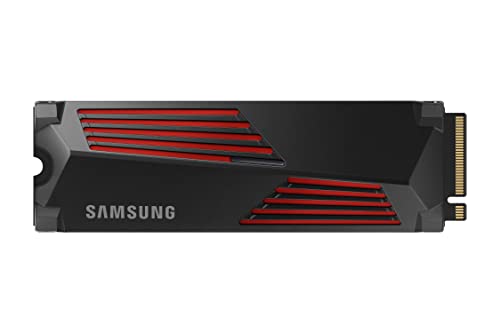
SAMSUNG 990 PRO w/ Heatsink SSD 2TB, PCIe Gen4 M.2 2280 Internal Solid State Hard Drive, Seq. Read Speeds Up To 7,450MB/s for High End Computing, Workstations, Compatible w/ PlayStation 5, MZ-V9P2T0CW
New · PCIe 4.0 x4 NVMe · Heatsink · Amazon.com
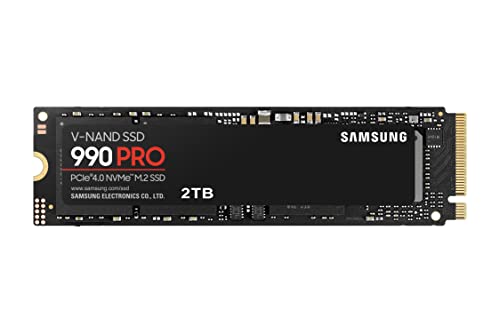
Samsung 990 PRO NVMe M.2 SSD, 2 TB, PCIe 4.0, 7,450 MB/s Read, 6,900 MB/s Write, Internal SSD, for Gaming and Video Editing, MZ-V9P2T0BW
New · PCIe 4.0 x4 NVMe · Bare or not stated · Stavvy Sales

Samsung SSD 990 PRO 4TB, PCIe 4.0 M.2 2280, Up to 7,450 MB/s | NVMe Internal Solid State Hard Drive for High End Computing, Gaming, and Heavy Duty Workstations (MZ-V9P4T0B/AM)
New · PCIe 4.0 x4 NVMe · Bare or not stated · Amazon.com

Samsung SSD 990 PRO with Heatsink 4TB, NVMe M.2, Up to 7,450MB/s | NVMe Internal Solid State Hard Drive best for PlayStation 5 (PS5 SSD) Console Expansion (MZ-V9P4T0CW)
New · PCIe 4.0 x4 NVMe · Heatsink · eKings

Samsung 990 PRO 4TB PCIe Gen 4.0 x4 (Maximum Transfer Rate 7,450MB/s) NVMe M.2 (2280) Internal SSD MZ-V9P4T0B-IT/EC
New · PCIe 4.0 x4 NVMe · Bare or not stated · SiliconValleySeller (SN# Recorded)

SAMSUNG - SOLID STATE DRIVES (SS SSD 4TB 990 PRO PCIE 4.0 X4 NVME 2.0 M.2 2280
New · PCIe 4.0 x4 NVMe · Bare or not stated · SiliconValleySeller (SN# Recorded)

Samsung SSD 990 PRO 2TB, PCIe 4.0 M.2 2280, Up to 7,450 MB/s | NVMe Internal Solid State Hard Drive for High End Computing, Gaming, and Heavy Duty Workstations, (MZ-V9P2T0B/AM)
Renewed · PCIe 4.0 x4 NVMe · Bare or not stated · Amazon.com

Samsung 990 PRO 2TB PCIe Gen 4.0 x4 (Maximum Transfer Rate 7,450MB/s) NVMe M.2 (2280) Internal SSD MZ-V9P2T0B-IT/EC
Renewed · PCIe 4.0 x4 NVMe · Bare or not stated · All About Office
Amazon prices shown are retained for up to 24 hours. Latest price refresh: 2026-10-22 00:37:13 UTC. Price and availability may change; Amazon at purchase time controls.
What Samsung Magician performance optimization controls
Samsung Magician 9.0 describes customizable Performance Optimization with full-power and power-efficiency choices, while the exact options vary by model and platform. The profile influences how aggressively the SSD and operating system favor responsiveness versus lower power states.
It does not change the PCIe generation, create more lanes or bypass a chipset bottleneck. A 990 PRO in a PCIe 3.0 x4 slot remains limited by that link. A drive behind an unsupported controller may not expose profile controls at all. Treat the setting as one layer of system tuning.
- Modes vary by model and connection
- Profiles do not change physical interface limits
Why balanced or default is the correct baseline
The default profile is intended to deliver high performance without holding the device in an unnecessarily aggressive state. For ordinary gaming, Windows, browsing and mixed application use, storage requests arrive in bursts and the user may see little benefit from keeping the SSD at maximum readiness continuously.
Begin from the default, record temperature and repeatable workload results, then change one variable. A benchmark-only improvement that does not shorten exports, builds, transfers or game loading is not a reason to accept more heat or battery drain. The baseline also makes troubleshooting easier because it matches the supported normal configuration.
- Start from a known default
- Measure the real task, not only a headline score
When full-power behavior can help
A cooled desktop performing repeated large transfers, compiling, high-resolution media work, virtual machines or dataset preparation may benefit from reduced power-state transition latency and more consistent sustained response. The value is strongest when the SSD is actually the bottleneck and the workload occurs often enough to matter.
Use a motherboard M.2 heatsink or Samsung’s integrated-heatsink model with airflow. Monitor the controller temperature during the full task, not only at idle. If a mode change pushes the drive toward throttling, the apparent optimization defeats itself and cooling or workload placement must be corrected.
- Best for sustained measured workloads
- Thermal throttling can erase the benefit
Power-efficiency mode for laptops and compact systems
Laptops and mini PCs have tighter thermal budgets and share cooling capacity with the CPU and GPU. A power-efficiency profile can reduce unnecessary SSD activity and heat during light workloads, helping the complete system maintain battery life and quieter fan behavior.
The effect depends on firmware, platform power management, workload and sleep-state support. Do not assume the SSD profile alone controls battery runtime. Measure the whole system during a representative session. For heavy transfers on AC power, a balanced profile may offer a better compromise than permanently forcing either extreme.
- Optimize the complete laptop, not one component
- Retest on battery and AC power
Gaming: loading versus frame rate
A 990 PRO already offers very low latency and high throughput on a proper Gen4 system. Changing Magician’s profile rarely creates a meaningful GPU-rendered frame-rate increase. The relevant measurements are game start, level transition, shader or asset streaming stutter and install or patch time.
Use balanced mode for most gaming PCs. Consider full power only when repeated testing in a compatible game shows a storage-sensitive improvement and the SSD stays cool. DirectStorage support is game-specific; a profile cannot add it to a title that does not implement the technology.
- Do not promise FPS gains
- Test storage-sensitive events and patches
Video editing and content creation
Editing applications can hit the SSD with concurrent media reads, cache writes, previews and exports. Full-power behavior may help a dedicated cache or active-project drive when the system is cooled and the workload remains storage-bound. A separate media and cache layout can matter more than the profile.
Adobe recommends fast SSD or NVMe storage and often benefits from a dedicated media-cache drive. Keep enough free space, manage cache growth and monitor sustained performance after the write cache is exceeded. A mode cannot compensate for a nearly full volume, an underpowered external bridge or thermal saturation.
- Storage layout can outweigh the profile
- Measure a full export or cache rebuild
Local AI and development workloads
Model loading is generally read-heavy, while dataset preprocessing, embeddings, package caches and checkpoints can produce large mixed I/O. Full-power mode may reduce latency during repeated jobs, but GPU memory, CPU processing and software pipelines often dominate the total runtime.
Use performance mode only after task monitoring shows the disk queue and throughput are limiting progress. For a static model library or occasional inference, balanced or efficiency mode can deliver the same practical outcome with less heat. Capacity and reliable backups usually matter more than a few percent of storage benchmark variation.
- Confirm storage is the bottleneck
- Capacity and workflow design come first
Temperature interpretation
Samsung specifies an operating range up to 70°C for the 990 PRO, but a single sensor number does not explain airflow, controller hotspots or whether throttling occurred. Compare idle, sustained-load peak and recovery behavior under the same room temperature and workload.
If the drive approaches its thermal ceiling or performance drops during a long transfer, improve the thermal pad contact, heatsink mounting and case airflow before forcing a higher-power profile. Unexpectedly high readings also justify checking current firmware because Samsung has released firmware related to temperature reporting.
- Use repeatable load testing
- Fix cooling before increasing power
Controller paths and Magician limitations
Samsung notes that Magician does not officially support SSDs configured in RAID mode and can have limited behavior through SCSI or custom controller paths. Intel VMD, motherboard RAID, USB enclosures and some adapters may prevent profile controls even when Windows can use the drive normally.
Do not dismantle a working boot configuration merely to expose a profile button. The risk of an unbootable system or array outweighs a small tuning benefit. Keep the current controller, chipset and NVMe drivers supported, and use a direct internal slot when full Samsung management functionality is a genuine requirement.
- Windows visibility does not guarantee full Magician support
- Do not risk the boot path for a minor profile change
A clean testing method
Record firmware, Magician version, profile, room temperature, SSD temperature, free space and the exact task. Run the workload after a similar idle period and compare multiple passes. Avoid changing fan curves, BIOS settings and the SSD profile at the same time.
Use a real task alongside a benchmark. Benchmarks can reveal link width and sequential ceilings, but a short test may remain inside cache and never show sustained thermal or power behavior. The useful result is repeatable improvement without instability, throttling or an unacceptable power cost.
- Change one variable at a time
- Include a sustained real-world test
Troubleshooting after a mode change
If the drive disappears, blue-screens, logs errors or becomes substantially hotter after tuning, return to the default profile and verify firmware, BIOS, chipset drivers, slot seating and cooling. A stable SSD should not be sacrificed for a higher score.
When the issue continues at default settings, use the existing Cloudzat health and disappearance guides. Performance optimization is not a repair tool for media errors, counterfeit hardware, unsupported adapters or failing motherboards. Preserve important data before extended diagnostics.
- Return to default after instability
- Escalate persistent errors to health troubleshooting
Final recommendation by system type
Use balanced/default for most desktops and gaming systems. Consider full power for a well-cooled workstation with a repeated storage-bound task. Prefer efficiency or balanced behavior in laptops and mini PCs, especially on battery. PS5 owners do not manage the SSD through Windows Magician profiles.
Revisit the choice after firmware, system or workload changes. The correct profile is not the most aggressive label; it is the setting that delivers consistent task performance while maintaining safe temperature, stability and reasonable power consumption.
- Desktop workstation: measured full-power case
- Laptop: efficiency or balanced default
Official references and methodology
Cloudzat separates manufacturer specifications from buying analysis. Live offers appear only when this plugin’s dedicated catalogue accepts the exact family and capacity, rejects accessories and conflicting variants, and preserves condition and cooling distinctions. Prices are not invented when Amazon exposes only buying options.
Frequently asked questions
What is the best 990 PRO mode for gaming?
Balanced or default is the best starting point. Full power should be justified by repeatable loading or transfer gains.
Does full power increase FPS?
Usually not. GPU-rendered frame rate is generally limited elsewhere.
Should a laptop use power-efficiency mode?
Often yes when battery life and thermals matter, but measure the complete system.
Can performance mode fix PCIe 3.0 speeds?
No. The link remains PCIe 3.0.
Why is the mode option missing?
The model, Magician version, RAID/VMD presentation, USB bridge or controller path may limit the feature.
Is 70°C normal?
Samsung lists 0–70°C as the operating range, but sustained near-limit temperatures should prompt cooling checks.
Does full power harm the SSD?
It is a supported profile where available, but may increase power and heat. Cooling and stability still matter.
Should I benchmark after changing modes?
Yes, but include a sustained real task and keep other variables unchanged.
Can I use Magician performance modes on PS5?
No. The SSD is managed by the console environment rather than Windows Magician.
What should I do after instability?
Return to default, protect data and check firmware, drivers, slot, cooling and health.
Affiliate disclosure: Cloudzat may earn a commission from qualifying Amazon purchases. The checkout page controls the final price, condition, seller, warranty and availability.