


WD RED PLUS 12TB PRICE INTELLIGENCE
WD Red Plus 12TB Price
Live WD120EFGX price intelligence for 12TB CMR NAS storage.
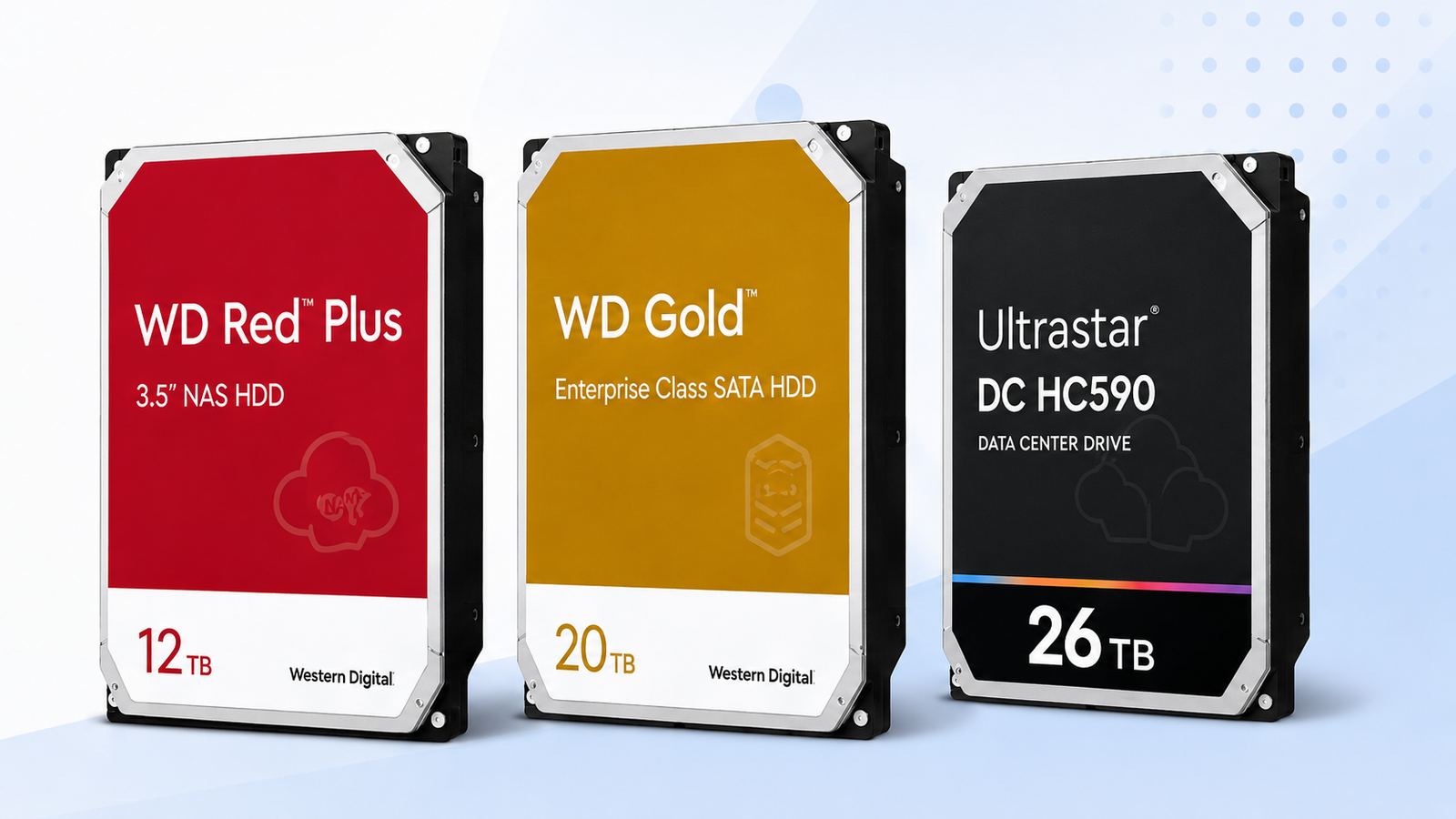
Check WD120EFGX before buying. Compare today’s price with its recent price history, price per TB and nearby NAS-drive alternatives before choosing Red Plus 12TB.
Price Trend
90-Day Price History
WD Deal Score
Live value by model or family
| Family / model | Capacity | $/TB | 30-Day | Historical position | Deal Score | Signal |
|---|---|---|---|---|---|---|
| WD Red Plus 12TB | — | — | — | History in progress | —Early history | WATCH |
| WD Purple Pro 22TBWD221PURP | 22TB | $43.14 | — | History in progress | 81Early history | WATCH |
| WD Red Pro 18TBWD181KFGX | 18TB | $44.11 | -11.5% | 38th percentile | 63Medium history | WATCH |
| Ultrastar DC 24TBWUH722424ALE604 | 24TB | $46.58 | 0.0% | 0th percentile | 98Medium history | BUY |
Historical position compares today’s price per TB with recent tracked prices for new drives. Renewed, recertified, refurbished and used offers are kept separate.
Is this a good price?
WD Price Check Calculator
Amazon Live
Current WD Red Plus 12TB offers
See the model on Amazon, or compare the closest WD drives that currently have a price below.
See this model on AmazonOther WD options
Closest alternatives available now


As an Amazon Associate, Cloudzat may earn from qualifying purchases. Prices, seller, selected variation and availability can change after the last check. Confirm the exact model, capacity and New condition before checkout.
Capacity Economics
20TB vs 24TB vs 26TB acquisition cost
| Capacity | 20TB | 24TB | 26TB |
|---|---|---|---|
| Best current $/TB | — | — | — |
| 4-drive raw cost | — | — | — |
| 8-drive raw cost | — | — | — |
| Current model | — | — | — |
Raw acquisition cost only. Apply your RAID, RAIDZ, SHR, erasure coding, tax, shipping, spare and chassis costs separately.
Smart Alternatives
Better-value WD options to check


Decision table
What to compare before buying
| Decision factor | WD Red Plus 12TB (WD120EFGX / WD120EFBX) | WD Red Pro 12TB | WD Red Plus 10TB |
|---|---|---|---|
| Primary reason to buy | 12TB target capacity with exact-model tracking | Compare if current $/TB is lower | Compare when another capacity or class fits better |
| Price check | Current new-drive price and price history | Current price | Current price |
| Best timing input | Deal Score + price history | Relative $/TB and compatibility | Relative $/TB and capacity plan |
| Before checkout | Model, condition, seller, warranty | Exact alternative model and host support | Exact alternative model and total array cost |
WD120EFGX is the current 12TB Red Plus model this page watches first
The primary target for this page is WD120EFGX, a 12TB WD Red Plus model. Cloudzat’s price tracker can also recognize the older or alternate WD120EFBX identity where appropriate, but it does not combine random 12TB drives into the comparison. A current listing must still match Red Plus, the expected capacity and New condition. That protects the price per terabyte calculation from renewed enterprise drives, external enclosures and other products that happen to mention 12TB.
For a NAS buyer, the model string is the best way to resolve specification ambiguity. Family names can persist across revisions, and marketplace titles are not always precise. Checking the exact part number on the listing and physical label gives you a reliable bridge between Western Digital documentation, NAS compatibility information and the price you are considering.
Why 12TB Red Plus can be a practical small-NAS capacity
Twelve terabytes offers enough density to build substantial storage without jumping straight into the premium high-capacity Red Pro tiers. In a two-bay or four-bay NAS, that can be a useful balance between total budget and the amount of data each slot can hold. The right comparison is not simply “12TB versus 20TB.” It is how much usable capacity your specific redundancy layout needs and how much cash you want tied up in each drive.
The 12TB price page therefore focuses on current $/TB, historical position and alternatives around the same NAS use case. If 10TB Red Plus is heavily discounted, it may be a better value for a system with spare bays. If 12TB is close to a Red Pro price, a buyer with higher workload expectations may decide to compare the families more closely. Live economics keep those decisions current.
WD120EFGX and WD120EFBX should not be treated as invisible revisions
Western Digital has sold more than one 12TB Red Plus model identity. A marketplace page can therefore create confusion if a buyer looks only at the family and capacity. Cloudzat surfaces the exact model when available so you can verify which revision is being offered and compare it with the specification source that applies to that part number. That is more useful than assuming every “Red Plus 12TB” listing has identical secondary specifications.
For price history, the safest comparison is still model-aware. When the page has enough exact inventory, buyers can see which model is setting the current price. If an older revision is unusually cheap, that can be investigated rather than silently blended into the newer model’s value story. Clear identity is a feature, not a nuisance, on a long-lived storage family.
Use price per TB to compare 10TB and 12TB without losing the bay context
A 10TB drive may have a lower checkout price but a higher cost per terabyte. A 12TB drive may reverse that relationship. Compare both metrics, then multiply the capacity difference across the number of bays in the NAS. Four 12TB drives hold eight terabytes more raw capacity than four 10TB drives. If the premium is modest, the larger model can be an efficient way to buy expansion headroom.
If the NAS has empty slots and the 10TB discount is deep, lower density can still win. The point is to put the price difference next to the capacity difference. A generic “bigger is better” rule is no more useful than a generic “cheapest drive wins” rule. The best capacity depends on today’s price curve and your enclosure.
Red Plus versus Red Pro at 12TB is a workload and budget decision
A 12TB Red Pro offer can sit close enough to Red Plus that buyers start asking whether the upgrade is worth it. Begin with the live price gap, but do not stop there. The families are positioned for different workload and NAS requirements, and the correct choice depends on the environment. If Red Plus meets the system’s needs, paying more for Red Pro may not create useful value. If the deployment requires the Pro family, a temporary price premium should be judged against that requirement rather than against a consumer use case.
Cloudzat’s alternative card gives the economic comparison without collapsing the two families into one. Check the exact models, warranty terms and NAS compatibility information before using the price gap to make the final choice. A small premium can be attractive when it buys features you need and irrelevant when it buys features you do not.
A good Red Plus 12TB price needs its own history
Online discussions often repeat a “good price per TB” threshold long after the storage market has changed. This page avoids a permanent magic number. Once real daily price history grows, the present WD Red Plus 12TB offer is compared with the range Cloudzat has actually recorded. That makes the Deal Score responsive to market conditions instead of anchored to an old forum post or a one-day sale from another year.
If the 12TB price history is still short, use today’s $/TB and the current alternatives as the main comparison. As the trend gains depth, the 90-day median and historical position become more useful for judging whether a promotion is genuinely strong or just looks cheap beside one unusually high listing.
Two-bay NAS buyers should think in mirrored usable capacity
A common two-bay NAS configuration mirrors one drive to the other, so two 12TB drives do not normally produce twenty-four terabytes of protected usable space. Price the pair as a pair and evaluate the usable capacity produced by the protection scheme you intend to use. That changes the budget conversation because the relevant purchase is often two identical drives at once rather than one standalone disk.
The same principle applies to four-bay RAID layouts. Start with Cloudzat’s raw acquisition price, then use the NAS vendor’s capacity calculator or your chosen RAID formula to estimate protected capacity. Keeping acquisition cost and usable capacity as separate steps prevents the low headline $/TB from being mistaken for the cost of a redundant usable terabyte.
Noise, power and home-office priorities can outweigh a tiny price difference
Small and medium NAS systems are often installed in homes or offices rather than racks. In that setting, buyers may care about acoustic behavior, power use and the NAS vendor’s drive recommendations in addition to acquisition cost. Cloudzat’s Deal Score does not attempt to compress all of those operational factors into one number. It tells you whether the price looks attractive after you have already decided the model class is suitable.
That separation is useful when Red Plus and a more enterprise-oriented alternative are close in price. The cheaper drive is not automatically the better living-room or office choice. Use the price page to time the purchase, then let the environment determine which family belongs in the enclosure.
Check Amazon capacity selection carefully on Red Plus listings
Red Plus product pages frequently group several capacities under one listing. Before checkout, confirm that the selected variation still shows 12TB and the expected model number, and verify New condition and seller. A price copied from a different capacity can make the displayed deal look impossible. If the marketplace title or variation is ambiguous, verify the live Amazon selection carefully before buying. Quantity, capacity, model and seller should all match the drive you intend to purchase.
When the drives arrive, check the label before initializing the NAS. If you ordered a pair, verify both units and keep the invoices and serial numbers. Resolving a mismatch before the array is built is far easier than discovering it after data has been copied and the return window is closing.
Use the tracker again when the NAS is ready for its next expansion
A 12TB purchase today may be followed by another pair or another NAS later. The page becomes more useful as history accumulates because the second purchase can be compared with the same comparison basis rather than with memory. If the current price is high relative to the recorded range and the expansion is optional, waiting can be justified. If the price is historically strong, buying the planned capacity early can make sense.
Over time, also compare whether the family’s value center has moved upward. If 14TB or larger NAS drives become close in $/TB, the next system may not need to repeat the 12TB choice. Price intelligence should preserve the ability to change strategy as capacities mature.
Create a two-drive or four-drive budget before watching the 12TB sale price
Red Plus purchases are commonly made as pairs or small sets, so the useful target is often the total NAS fill cost rather than the cheapest individual unit. Decide whether you need two drives for a mirror, four drives for a larger array, or an additional spare, then set the complete hardware budget. Divide that number by the planned quantity and compare the resulting ceiling with WD120EFGX’s tracked range. This keeps a small per-drive discount in perspective and helps you recognize when a promotion is large enough to matter across the whole build.
Also decide what would make you change capacity. If 10TB falls far enough below 12TB, calculate whether the lost raw capacity is acceptable. If 12TB Red Pro comes close enough in price, check whether its product positioning and warranty are useful for the workload. A purchase threshold should therefore include both price and a small set of acceptable alternatives. That way a sale on the wrong product does not distract from the actual NAS requirement, and a genuinely better neighboring option is not ignored simply because the first plan said “12TB Red Plus.”
Questions people ask
WD Red Plus 12TB FAQs
What model number is the WD Red Plus 12TB (WD120EFGX / WD120EFBX)?
This page targets WD120EFGX. Verify that exact model on the Amazon variation and the physical label before treating another 12TB listing as equivalent.
How is the WD Red Plus 12TB (WD120EFGX / WD120EFBX) price per TB calculated?
Cloudzat divides the current new-drive price by 12. The $/TB figure appears only when a current price is available.
What does an Early Deal Score mean?
It means the price history is still short, so the BUY/WATCH/WAIT signal is intentionally cautious. Use today’s $/TB and nearby WD alternatives alongside the score until the trend becomes deeper.
Can a matching drive appear when no current price is available?
Yes. If a positive Amazon price was previously verified, Cloudzat keeps that last verified price visible with its verification age and keeps the Buy on Amazon CTA. A failed or overdue refresh does not erase it.
Does the historical low include renewed or used drives?
No. The main Deal Score compares new-drive prices. Renewed, recertified, refurbished and used offers are kept separate from the new-drive history.
Should I wait for the lowest possible price?
Not necessarily. If the purchase is urgent, exact availability can matter more. If it is discretionary, a mature WATCH or WAIT signal gives you a reason to delay and compare alternatives.
Price methodology & sources
How Cloudzat compares WD prices
Cloudzat matches WD offers by family, capacity and model number before including them. Price per TB is the current new-drive price divided by capacity. Price history uses the prices Cloudzat has tracked over time, while renewed, recertified, refurbished and used drives are kept separate from new-drive comparisons.
The Deal Score combines current price per TB with the available price history. When history is limited, the signal stays conservative. The score is a purchase-timing aid, not a reliability rating or compatibility guarantee.
If a newer Amazon check does not return a replacement price, Cloudzat can keep the last successfully verified price visible with its age for reference. Always confirm the live checkout price, selected model, capacity, seller and condition before ordering.