


RUGGED SSD PRICE INTELLIGENCE
LaCie Rugged SSD Prices: SSD4, Pro5 & Classic
Compare classic Rugged SSD, SSD4, Pro and Pro5 without mixing solid-state value with LaCie hard-drive pricing.
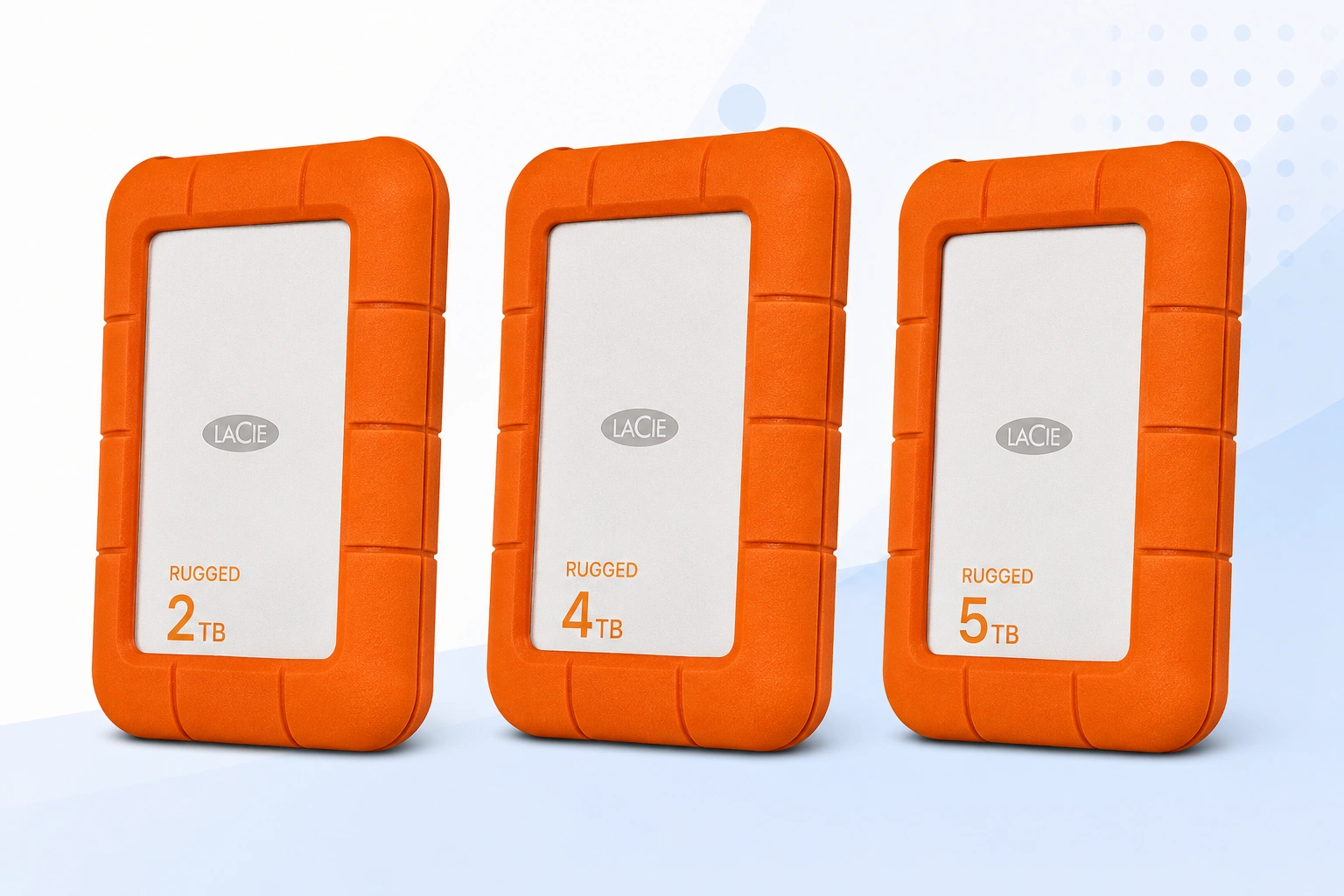
Pick the SSD performance tier your computer and workflow can actually use, then compare current price, capacity and history inside the portable-SSD class. Price Gap shows the current premium between related LaCie SSD generations at the same capacity.
Price Trend
90-Day Price History
Price history is building
We’ll show the 90-day trend here as more daily price checks are recorded.
LaCie Deal Score
Live value by family or capacity
| Drive | Current | $/TB | 30-Day | Deal | Sale | Signal |
|---|---|---|---|---|---|---|
| Rugged SSD 1TBSTHR1000800 | $584.34 | $584.34 | — | 70 | — | WATCH |
| Rugged SSD 2TB | — | — | — | — | — | WATCH |
| Rugged SSD4 2TB | — | — | — | — | — | WATCH |
| Rugged SSD4 4TB | — | — | — | — | — | WATCH |
| Rugged SSD Pro5 2TB | — | — | — | — | — | WATCH |
| Rugged SSD Pro5 4TB | — | — | — | — | — | WATCH |
Each row is evaluated inside its own family and media class. A Rugged HDD is not scored against a Rugged SSD simply because both carry the LaCie name.
Is this a good price?
LaCie Price Check
Amazon Live
Current LaCie Rugged SSD Prices offers
| Drive | Model | Capacity | Amazon price | $/TB | Checked | |
|---|---|---|---|---|---|---|
 LaCie Rugged SSD4New · Skoodooh LaCie Rugged SSD4New · Skoodooh | STND1000400 | 1TB | $549.00 | $549.00 | Checked 14h ago | Buy on Amazon |
 LaCie Rugged SSDNew · B-JPN (Duty Prepaid U.S.) LaCie Rugged SSDNew · B-JPN (Duty Prepaid U.S.) | STHR1000800 | 1TB | $584.34 | $584.34 | Checked 14h ago | Buy on Amazon |
 LaCie Rugged SSD ProNew · Omikuji JP LaCie Rugged SSD ProNew · Omikuji JP | STHZ1000800 | 1TB | $587.25 | $587.25 | Checked 14h ago | Buy on Amazon |
As an Amazon Associate, Cloudzat may earn from qualifying purchases. Prices, seller, selected variation and availability can change. Confirm the LaCie family, capacity, model and New condition before checkout.
Capacity Economics
1TB vs 2TB vs 4TB purchase cost
| Capacity | 1TB | 2TB | 4TB |
|---|---|---|---|
| Best current $/TB | $549.00 | — | — |
| One drive | $549.00 | — | — |
| Two copies | $1,098.00 | — | — |
| Current model | STND1000400 | — | — |
This table stays inside the media class of this page. The main LaCie hub defaults to Rugged HDD capacity economics rather than treating SSD and HDD storage as interchangeable.
Smart Alternatives
Other current LaCie options
LaCie Rugged SSD pricing needs a solid-state-only benchmark
LaCie now has several portable SSD families, and their prices should be compared with each other before any HDD $/TB number enters the conversation. Classic Rugged SSD, Rugged SSD Pro, SSD4 and Pro5 occupy different interface and generation positions, but they all belong to a solid-state purchase where transfer performance matters. This page therefore filters the live catalogue to portable SSD families and keeps the Deal Score separate from Rugged HDD and Mobile Drive economics.
That separation prevents a predictable mistake: declaring every SSD “bad value” because hard drives provide more terabytes for the money. A creative professional may be purchasing time saved during ingest, editing or transfer rather than the cheapest archive capacity. Price intelligence should help answer whether the selected SSD is expensive for its own class, not whether magnetic storage exists.
Classic Rugged SSD remains an important price anchor
The STHR Rugged SSD family provides a useful baseline across 1TB, 2TB and 4TB. When a current qualifying offer exists, it can act as a reference for newer SSD4 or Pro5 products at the same capacity. The Price Gap then makes the generational premium visible in dollars and percentages. This helps a buyer see whether the newer product is only modestly more expensive or whether it commands a premium large enough to require a clear workflow benefit.
The comparison does not assume the products are interchangeable. Interface capability, host support and performance tier remain separate technical questions. The price gap is deliberately narrower: how much more money does the newer LaCie option require today? That answer is useful even before the buyer decides whether the feature difference is worthwhile.
SSD4 adds a new performance tier that must be matched to the host
Rugged SSD4 belongs to a higher-bandwidth USB class and should be evaluated as such. Paying for that tier makes the most sense when the computer, cable and workload can use it. If the host is limited to a slower USB connection, a large current premium over classic Rugged SSD may buy little practical benefit. The dashboard cannot infer the user’s exact workstation, so it keeps price and interface visible instead of converting technical potential into a fake universal score.
For buyers with compatible modern systems and repeated large transfers, the calculation can look very different. Time saved can justify a higher purchase price. That is why the page separates Deal Score, which measures current price value, from workflow fit, which remains a technical decision outside the score.
Pro5 is a premium workflow choice, not a cheapest-per-terabyte target
Rugged SSD Pro5 sits at the premium end of the current LaCie portable SSD range. Its price should be interpreted against other professional SSD options and the actual Thunderbolt-class workflow a buyer intends to run. If the host cannot exploit the interface, the premium can be difficult to justify. If the drive is supporting time-sensitive production work, raw $/TB may be a secondary metric behind transfer performance and project turnaround.
Cloudzat therefore does not let a Pro5 offer distort the main HDD market or vice versa. The page can show its current price, exact capacity, history and same-class alternatives while leaving the performance decision explicit. A high price can still be a good buy for the right workload if it is competitive for that exact product and the feature tier is genuinely needed.
Price history is especially useful for premium SSD generations
High-ticket portable SSD prices can move sharply with promotions, inventory changes and model transitions. A buyer comparing a classic Rugged SSD with SSD4 or Pro5 may see several hundred dollars of difference at 4TB. The 90-day history helps determine whether that gap is a persistent market relationship or a temporary promotion. Sale Score only appears after enough daily observations exist so the timing signal is based on an actual record.
This matters because a premium that looks excessive today can shrink during a sale, and an older family can become poor value if remaining stock is priced unusually high. A static review cannot capture those movements. Price intelligence gives the buyer a current financial layer to place beside the technical review.
Capacity affects SSD economics differently from HDD economics
The 1TB, 2TB and 4TB SSD tiers can have very different price curves. A 4TB drive may carry a meaningful capacity premium even when it has the best $/TB, simply because the absolute checkout cost is high. Buyers should calculate how much fast working storage they truly need and avoid paying for cold archive capacity on a premium SSD when slower storage can handle that role.
At the same time, undersizing working storage can create constant file shuffling and reduce the value of the fast drive. The capacity table helps show the current financial penalty for moving upward. The right capacity is the smallest tier that comfortably holds the active workload with reasonable headroom, not automatically the cheapest or largest option.
Do not confuse family names on marketplace listings
LaCie Rugged is used across both hard-drive and SSD products, and newer names such as SSD4 and Pro5 make exact family recognition even more important. The catalogue looks for model and family evidence before it accepts a listing into the SSD benchmark. A Rugged HDD should never appear as the cheapest Rugged SSD merely because the word Rugged is present, and an accessory should never become a false low-price storage device.
This strict separation protects current Deal Score and future history. A single wrongly classified HDD price can slash the apparent $/TB of an SSD family and make every genuine SSD look expensive. Product identity therefore comes before price calculation.
Seller, condition and selected capacity still matter on premium SSDs
The more expensive the drive, the more important it is to confirm what the checkout page actually shows. A New 4TB Pro5 is not comparable with a renewed 2TB classic Rugged SSD, even if the search results place them near each other. Cloudzat keeps the main benchmark on New-condition products and exact capacities so the financial signal represents a coherent transaction.
If Amazon does not return a replacement featured price, the page keeps the last verified price and its verification age while the Buy on Amazon link remains available. The visitor should still verify seller, variation and availability after clicking through because marketplace offers can change faster than any external comparison page.
Fast working storage still needs a slower independent backup
A portable SSD can be excellent primary working storage, but speed does not make it a backup by itself. Important projects still need an independent copy. In many workflows, the economical architecture is a fast LaCie SSD for active work plus a larger HDD, NAS or other destination for protection. The price table should therefore be read as the cost of the working device, not the total storage strategy.
This distinction can also improve SSD capacity choice. Instead of buying a very large premium SSD to hold every archived project, a buyer may fund a right-sized fast drive and put the remaining budget into redundant bulk storage. Price intelligence supports that split by making both current SSD cost and broader storage tools easy to reach.
Deal Score and Price Gap answer different SSD questions
Deal Score asks whether the selected SSD family looks competitively priced inside its current class. Price Gap asks how much more or less it costs than a closely related same-capacity LaCie reference. A strong Deal Score with a large positive Price Gap can still occur when the entire premium family is priced consistently. The buyer then has to decide whether the extra interface or generation value is worth paying for.
Sale Score adds a third dimension once history is deep enough: whether today is unusually favorable relative to the product’s own record. Separating these questions prevents one number from pretending to answer current market value, generational premium and timing all at once.
A practical LaCie SSD checkout sequence
Choose the SSD family and capacity based on the workload first. Confirm the exact model, New condition and selected capacity. Check whether the host has the interface required to benefit from the product tier. Then compare the current price, Deal Score, Sale Score when available and same-capacity Price Gap. If the newer family commands a large premium, make sure the workstation and workflow can convert that premium into real time savings.
Finally, decide where the independent backup will live. A fast external SSD is usually one layer of a storage system, not the only copy of the work. The strongest purchase is therefore not simply the fastest drive at the lowest observed price; it is the right fast drive at a fair current price inside a complete data plan.
Measure the performance premium in project time, not marketing numbers alone
A faster LaCie SSD can be worth more when it repeatedly shortens transfers that sit on the critical path of a project. The useful calculation is therefore not simply the advertised maximum speed divided by price. Consider how much data moves per job, how often the transfer occurs, whether the source storage is fast enough, and whether the host connection can sustain the chosen interface. A premium that saves meaningful time every day can be rational even when the drive has a weaker $/TB figure than an older family.
For occasional backups the same premium can be wasted because the workflow never reaches the point where the faster interface matters. This is why the page keeps the financial signal separate from the performance decision. Deal Score tells you whether the current offer is attractive for that LaCie SSD family; it does not pretend to know the economic value of your time. Buyers can combine the price result with the host and transfer calculators elsewhere on Cloudzat for a more complete decision.
Older Rugged SSD stock can become expensive instead of cheap
A previous-generation SSD is not automatically the value option. When stock becomes scarce, an older model can remain listed at a price that is higher than a newer product with better interface support. Price history and same-capacity alternatives help detect that situation. If classic Rugged SSD inventory is inflated while SSD4 is discounted, the newer generation may carry little or no effective premium. The reverse can happen during clearance events, making the older family exceptionally attractive for a host that does not need the newer interface.
That dynamic is one reason this plugin tracks several Rugged SSD families in one authority page while preserving their identity. The buyer can see the current financial relationship without collapsing technical differences. A legacy model with a great price can be a strong deal for the right computer; a legacy model at a scarcity premium should not receive special treatment merely because it used to be cheaper.
Capacity planning protects the SSD budget from archive creep
A premium portable SSD can gradually become an expensive archive if old projects are never moved elsewhere. Before selecting 4TB simply because it offers more headroom, separate active working data from cold material that can live on lower-cost storage. That distinction can reduce the SSD capacity required while preserving fast space for the files that benefit from it. Conversely, if the active set genuinely exceeds 2TB, undersizing can create constant transfers and wasted time. The best LaCie SSD capacity is therefore a workflow number first and a price number second.
Use the current live offer as the final financial input after that sizing decision. Compare the selected capacity with the same family and nearby LaCie alternatives, then include an independent backup destination in the total budget. That sequence keeps price intelligence tied to a practical storage architecture instead of optimizing a single device in isolation.
Decision table
What to compare before buying
| Question | Why it matters | What to verify |
|---|---|---|
| Capacity | Sets the total project headroom and purchase cost | Exact selected 1TB, 2TB or 4TB variation |
| Interface | Can limit the performance you actually receive | Host port, cable and exact LaCie family |
| Current price | A premium SSD can move sharply between sales | Live price, seller and condition |
| Price history | Shows whether today is ordinary or unusually expensive | Sale Score after enough daily observations |
| Workflow | Fast storage only helps when the workload can use it | Editing, ingest, transfer and backup needs |
Questions people ask
LaCie Rugged SSD Prices FAQs
What is a good price for LaCie Rugged SSD?
A good price is one that is competitive inside the same LaCie family and capacity, not merely low in absolute dollars. Cloudzat first converts the current offer to cost per terabyte, then uses the available family history and same-class alternatives. Confirm the exact SSD family because classic Rugged SSD, SSD4 and Pro5 can carry very different interface and price positions.
What does the Deal Score mean for LaCie Rugged SSD?
Deal Score is a current-value signal. It compares a qualifying New-condition offer with relevant current LaCie pricing in the same media class and family context. It is not a durability, performance, seller-quality or reliability score.
Why can the price of LaCie Rugged SSD change so much?
Storage prices move with promotions, inventory, seller mix, model transitions and the selected capacity. LaCie products can also carry a design, interface or ruggedization premium, so a broad market move does not always translate into the same percentage change for every LaCie family.
Does Cloudzat mix used or renewed LaCie Rugged SSD offers into the benchmark?
No. The principal benchmark is for qualifying New-condition products. Used, renewed, refurbished and recertified offers can have different warranty, seller and condition characteristics, so they should not define the New-product price signal.
How does Cloudzat prevent accessories from affecting LaCie Rugged SSD pricing?
The catalogue requires evidence that the listing is a complete LaCie storage device from the intended family. Cases, sleeves, replacement cables, power adapters, docks, empty enclosures and unrelated products are rejected before they can influence price-per-terabyte or Deal Score calculations.
Should I buy LaCie Rugged SSD as my only backup?
No single drive should be treated as the only copy of important data. Use the price tools to plan the cost of two or more independent copies where the data matters, and keep at least one backup physically or logically separate from the working drive.
Price methodology & sources
How Cloudzat evaluates LaCie prices
Current shopping offers are matched to the intended LaCie family, capacity and exact model when a model-specific page requires one. New-condition products establish the public benchmark. Cases, replacement cables, adapters, empty enclosures, unrelated storage families and non-new offers are excluded from the main price signal.
Portable HDD, desktop HDD and portable SSD benchmarks remain separate. Historical charts and Sale Scores appear only when enough daily observations exist. Price Gap is a transparent same-capacity comparison between closely related LaCie families; it does not claim that the compared products have equal speed, ruggedness, interface, warranty or workload suitability.
- LaCie Rugged SSD support and model information
- LaCie Rugged SSD4 product information
- LaCie Rugged SSD Pro5 product information
Always confirm the exact model, selected capacity, interface, seller, regional warranty terms and current checkout price. LaCie product lines can change by revision and market.