


LACIE PRICE INTELLIGENCE
LaCie Prices: HDD, SSD, Deal Scores & Price History
Current LaCie HDD and SSD prices with separate media benchmarks, price history, Deal Scores and transparent family premiums.
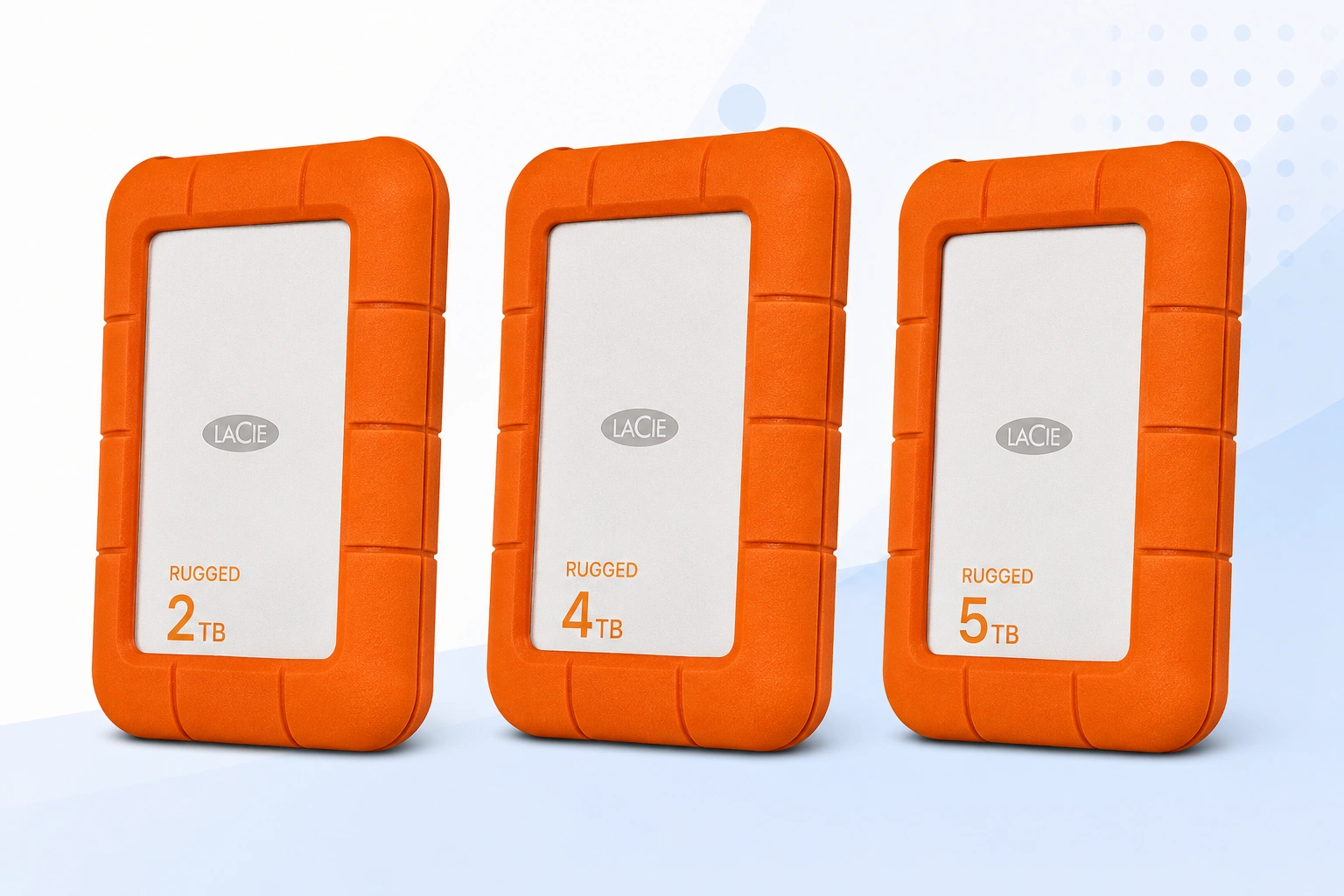
Choose the LaCie family that fits the job first, then use its current price, $/TB, history and same-class alternatives. Portable HDD and portable SSD prices stay in separate benchmarks so the cheapest media type does not distort the buying signal.
Price Trend
90-Day Price History
Price history is building
We’ll show the 90-day trend here as more daily price checks are recorded.
LaCie Deal Score
Live value by family or capacity
| Drive | Current | $/TB | 30-Day | Deal | Sale | Signal |
|---|---|---|---|---|---|---|
| Rugged HDD 2TBSTFR2000800 | $149.99 | $75.00 | — | 45 | — | WAIT |
| Rugged HDD 5TBSTFR5000800 | $239.99 | $48.00 | — | 80 | — | WATCH |
| Mobile Drive 5TBLaCie Mobile Drive | $235.97 | $47.19 | — | 85 | — | WATCH |
| d2 Professional 16TBLaCie d2 Professional | $659.00 | $41.19 | — | 71 | — | WATCH |
| Rugged SSD 2TB | — | — | — | — | — | WATCH |
| Rugged SSD4 2TB | — | — | — | — | — | WATCH |
| Rugged SSD Pro5 2TB | — | — | — | — | — | WATCH |
Each row is evaluated inside its own family and media class. A Rugged HDD is not scored against a Rugged SSD simply because both carry the LaCie name.
Is this a good price?
LaCie Price Check
Amazon Live
Current LaCie Prices offers
| Drive | Model | Capacity | Amazon price | $/TB | Checked | |
|---|---|---|---|---|---|---|
 LaCie d2 ProfessionalNew · Provantage LLC LaCie d2 ProfessionalNew · Provantage LLC | STHA30000800 | 30TB | $1,100.75 | $36.69 | Checked 14h ago | Buy on Amazon |
 LaCie d2 ProfessionalNew · Prime MegaStore LaCie d2 ProfessionalNew · Prime MegaStore | STHA10000800 | 10TB | $379.99 | $38.00 | Last verified 1d ago | Buy on Amazon |
 LaCie d2 ProfessionalNew · MegaRetailStore LaCie d2 ProfessionalNew · MegaRetailStore | Verify listing | 16TB | $659.00 | $41.19 | Checked 14h ago | Buy on Amazon |
 LaCie d2 ProfessionalNew · Computer Brain LaCie d2 ProfessionalNew · Computer Brain | STHA24000800 | 24TB | $999.99 | $41.67 | Checked 15h ago | Buy on Amazon |
 LaCie d2 ProfessionalNew · MegaRetailStore LaCie d2 ProfessionalNew · MegaRetailStore | STHA8000800 | 8TB | $349.99 | $43.75 | Last verified 3d ago | Buy on Amazon |
| LaCie d2 ProfessionalNew · Motion Media, LLC | STHA20000800 | 20TB | $899.99 | $45.00 | Last verified 8d ago | Buy on Amazon |
 LaCie Rugged HDDNew · InstaDeals LaCie Rugged HDDNew · InstaDeals | STFR5000800 | 5TB | $249.90 | $49.98 | Checked 14h ago | Buy on Amazon |
 LaCie Rugged HDDNew · Amazon.com LaCie Rugged HDDNew · Amazon.com | STFR4000800 | 4TB | $209.99 | $52.50 | Checked 14h ago | Buy on Amazon |
 LaCie Rugged SSD4New · Skoodooh LaCie Rugged SSD4New · Skoodooh | STND1000400 | 1TB | $549.00 | $549.00 | Checked 14h ago | Buy on Amazon |
 LaCie Rugged SSDNew · B-JPN (Duty Prepaid U.S.) LaCie Rugged SSDNew · B-JPN (Duty Prepaid U.S.) | STHR1000800 | 1TB | $584.34 | $584.34 | Checked 14h ago | Buy on Amazon |
 LaCie Rugged SSD ProNew · Omikuji JP LaCie Rugged SSD ProNew · Omikuji JP | STHZ1000800 | 1TB | $587.25 | $587.25 | Checked 14h ago | Buy on Amazon |
 LaCie Mobile DriveNew · Amazon buying options LaCie Mobile DriveNew · Amazon buying options | Verify listing | 5TB | $235.97 | $47.19 | Last verified 3d ago | Buy on Amazon |
 LaCie Rugged HDDNew · Amazon buying options LaCie Rugged HDDNew · Amazon buying options | STFR5000800 | 5TB | $239.99 | $48.00 | Last verified 3d ago | Buy on Amazon |
 LaCie Mobile DriveNew · Amazon buying options LaCie Mobile DriveNew · Amazon buying options | Verify listing | 4TB | $201.99 | $50.50 | Last verified 3d ago | Buy on Amazon |
| LaCie Rugged HDDNew · Amazon buying options | STFR2000800 | 2TB | $149.99 | $75.00 | Last verified 3d ago | Buy on Amazon |
| LaCie Rugged HDDNew · Amazon buying options | STFR2000800 | 2TB | $149.99 | $75.00 | Last verified 4d ago | Buy on Amazon |
 LaCie Mobile DriveNew · Amazon buying options LaCie Mobile DriveNew · Amazon buying options | STHG4000400 | 4TB | $299.99 | $75.00 | Last verified 3d ago | Buy on Amazon |
 LaCie Mobile DriveNew · Amazon buying options LaCie Mobile DriveNew · Amazon buying options | STHG2000400 | 2TB | $299.99 | $150.00 | Last verified 3d ago | Buy on Amazon |
| LaCie Rugged HDDNew · Amazon buying options | STFR1000800 | 1TB | Price options | — | Check current price | Buy on Amazon |
 LaCie Rugged HDDNew · Amazon buying options LaCie Rugged HDDNew · Amazon buying options | STFR5000800 | 5TB | Price options | — | Check current price | Buy on Amazon |
As an Amazon Associate, Cloudzat may earn from qualifying purchases. Prices, seller, selected variation and availability can change. Confirm the LaCie family, capacity, model and New condition before checkout.
Capacity Economics
1TB vs 2TB vs 4TB vs 5TB purchase cost
| Capacity | 1TB | 2TB | 4TB | 5TB |
|---|---|---|---|---|
| Best current $/TB | — | $75.00 | $52.50 | $48.00 |
| One drive | — | $149.99 | $209.99 | $239.99 |
| Two copies | — | $299.98 | $419.98 | $479.98 |
| Current model | — | STFR2000800 | STFR4000800 | STFR5000800 |
This table stays inside the media class of this page. The main LaCie hub defaults to Rugged HDD capacity economics rather than treating SSD and HDD storage as interchangeable.
Smart Alternatives
Other current LaCie options
LaCie pricing needs separate HDD and SSD benchmarks
LaCie spans portable hard drives, desktop professional hard drives and portable solid-state drives, so a single cheapest-per-terabyte leaderboard can give the wrong answer. A 5TB Rugged HDD is built around capacity and portability, while a Rugged SSD4 is purchased for a different performance class. This hub therefore keeps portable HDD, desktop HDD and portable SSD value signals separate. The useful question is not which LaCie product has the lowest raw $/TB across all technologies. The useful question is which product is priced well inside the class that fits the job you actually need to do.
That separation also makes the BUY, WATCH and WAIT signals more honest. An SSD should not receive a poor score merely because magnetic storage is cheaper per terabyte, and a portable HDD should not receive an inflated score because an SSD buyer values speed. The dashboard routes each offer through its own family and media class, then adds a same-capacity Price Gap when a sensible LaCie reference exists. This creates a pricing view that reflects real shopping decisions rather than a headline number that mixes fundamentally different products.
Start by deciding which LaCie family solves the job
Rugged HDD is the natural starting point when the priority is portable multi-terabyte capacity and physical travel use. Mobile Drive is a cleaner portable HDD alternative for buyers who care more about compact everyday storage than the Rugged family position. d2 Professional belongs on a desk and serves high-capacity external storage rather than backpack duty. Rugged SSD, SSD4 and Pro5 move into solid-state workflows where transfer speed and host-interface capability matter much more. Deciding the family first prevents price from pulling you toward a product that is cheap but wrong for the intended workflow.
Once the family is fixed, price intelligence becomes more powerful. You can compare 1TB against 2TB inside Rugged, or evaluate whether 4TB SSD4 costs enough more than a classic Rugged SSD to justify the newer interface class. You can also see whether a d2 capacity step is unusually expensive relative to nearby d2 sizes. Cloudzat deliberately treats that sequence as family first, capacity second, price third. It is a better buying order than selecting the lowest dollar figure and trying to justify the product afterward.
Use current price per terabyte as a starting point, not the verdict
Cost per terabyte is the fastest way to normalize different capacities, but it cannot describe the entire LaCie purchase. A larger portable HDD can look excellent on $/TB while costing much more cash than the capacity you actually need. Conversely, a small SSD can carry a high $/TB yet be the right purchase when your project is time-sensitive and the working set is compact. The dashboard surfaces $/TB because it is useful, then places it beside family, capacity, history and same-class alternatives so the number is not mistaken for a universal quality score.
For HDD families, $/TB is especially helpful when 1TB, 2TB, 4TB and 5TB offers are all active at once. For SSD families, the same metric helps expose capacity premiums, but the interface and generation still matter. The strongest decision is one where the current price is good for the correct family and the selected capacity leaves enough headroom for the intended files. That is why the page presents a Deal Score and Price Gap rather than reducing the entire LaCie range to one cheapest-product badge.
Price history answers the question a live listing cannot
A live Amazon price tells you what a product costs now. It does not tell you whether that number is normal, unusually low or far above the range buyers have recently seen. The 90-day history area is designed to add that missing timing context. When a family has enough daily observations, Cloudzat can show a Sale Score, recorded low, median position and change over time. When history is still young, the page says so instead of pretending that one or two observations form a meaningful trend.
This matters more for premium external storage than it does for a commodity item with a narrow price band. A LaCie model can move sharply around promotions, seller changes and product transitions. A buyer who does not need the drive today may rationally wait when the current price sits well above its own recent record. A buyer facing a deadline may still purchase, but at least the premium is visible. Price history therefore becomes a timing tool, not a promise that an old low price will return.
The LaCie Price Gap makes the premium visible
LaCie buyers frequently compare closely related products at the same capacity. Rugged HDD can be compared with Mobile Drive when both have a current price. A Rugged SSD4 can be compared with classic Rugged SSD, while Pro5 can be compared with another same-capacity Rugged SSD family. Cloudzat calls the difference the Price Gap. A positive percentage means the spotlight product currently costs more than its same-capacity reference; a negative number means it costs less. The calculation is intentionally transparent and does not invent a quality score from features that cannot be reduced to one number.
The key is interpretation. Paying more can be reasonable when the premium buys the interface, physical design or workflow fit you actually need. Paying more is harder to justify when the alternative already meets the job and the premium adds no practical value to your setup. The Price Gap turns that conversation into dollars and percentages. It does not claim that two families have equal speed, warranty, ruggedness or longevity. It simply shows how much extra money the choice currently requires.
Rugged HDD demand deserves model-level tracking
The Rugged USB-C family has durable search demand at exact capacities, especially 1TB, 2TB, 4TB and 5TB. That makes exact model identity important. Marketplace listings can combine multiple variations, accessory references and old titles, so a generic “LaCie Rugged” result is not enough for a trustworthy price history. The catalogue therefore recognizes the STFR capacity identities used by the current Rugged USB-C support family and rejects a listing when the requested capacity or model evidence conflicts with the page being evaluated.
This model-aware approach also protects the Deal Score from obvious contamination. A carrying case advertised as compatible with several Rugged capacities must never become the cheapest 5TB offer. A replacement cable must never establish a historical low. A genuine drive can still mention an included cable without being rejected because accessory detection focuses on product identity rather than blindly banning every feature bullet that contains the word cable. That distinction is essential for a price-intelligence system where one bad row can distort several calculations at once.
Mobile Drive is a useful control for portable HDD pricing
Mobile Drive gives the portable-HDD side of the dashboard an important reference point. At the same nominal capacity, it can show whether the Rugged premium is currently modest or unusually wide. The comparison is most useful when both listings are New, current and clearly mapped to the intended capacity. If the Mobile Drive is dramatically cheaper and the user does not require the Rugged family position, the price gap becomes actionable. If the prices converge, the Rugged option can become relatively more attractive without any change to its technical specifications.
The goal is not to declare one family universally better. The goal is to expose the cost of choosing one path over another. This is especially useful for buyers purchasing several drives, because a fifty-dollar gap per unit becomes a much larger budget decision across two working drives and an off-site copy. Capacity economics therefore shows multi-copy purchase cost rather than assuming that every visitor is buying a single drive and treating it as the entire backup plan.
d2 Professional belongs in the same brand hub but a different cost class
d2 Professional is a desktop external HDD family, not a portable Rugged substitute. It reaches much larger capacities and relies on external power, which changes the buying context. Including d2 in the LaCie hub is useful because many creative professionals shop the brand rather than a single form factor, but its Deal Score should remain inside desktop-HDD comparisons. A 16TB or 24TB d2 should not be praised for beating a 2TB SSD on $/TB; the two products solve different storage problems and sit in different physical environments.
Where d2 becomes interesting is capacity step-up value. Buyers can examine whether the next capacity tier costs a reasonable amount for each additional terabyte and whether the purchase still makes sense once a second backup copy is included. The brand hub surfaces d2 current offers, while a later dedicated professional sprint can go deeper into 10TB, 14TB, 16TB, 18TB, 20TB, 24TB and newer high-capacity options without forcing those desktop decisions into the portable Rugged pages.
Rugged SSD families need interface-aware price interpretation
The solid-state side of LaCie now spans several generations. Classic Rugged SSD, older Rugged SSD Pro, Rugged SSD4 and Rugged SSD Pro5 should not be collapsed into one anonymous “LaCie SSD” product. The current price can only be interpreted correctly after the exact family is known. A newer high-bandwidth model can justifiably carry a premium for a workstation that can use its interface, while the same premium can be wasted on a host whose port limits the drive far below its advertised potential.
For that reason the SSD page treats price per terabyte as one input and leaves room for interface and workflow fit. A photographer copying a modest archive once a week may prefer capacity value. A production workflow moving large project files repeatedly may care much more about transfer time. Cloudzat does not pretend that price history can resolve that technical tradeoff by itself. It tells you whether the selected LaCie SSD is priced well, then the buyer still has to match the drive to the host and workload.
Budget for copies, not just for one attractive drive
A price-intelligence page becomes more useful when it reflects how storage is actually purchased. Important data usually deserves more than one copy. If a 5TB Rugged looks affordable at the unit level, the practical budget might be two drives for rotation plus another independent destination. The capacity economics table therefore multiplies the current qualifying price so that the backup cost is visible before checkout. The same logic applies to a portable SSD used as working storage: the fast device does not eliminate the need for a separate backup destination.
This multi-copy view can change the capacity decision. One larger drive may have the best $/TB, but two of them may exceed the available budget. A smaller tier may be financially safer while still meeting the real data set. Conversely, buying the smallest capacity repeatedly can cost more over time if growth forces an early replacement. The page encourages buyers to combine current price, growth headroom and copy count instead of optimizing a single metric and discovering the total cost later.
A disciplined checkout check prevents expensive mistakes
Before buying, confirm the exact LaCie family, capacity, model when one is shown, selected variation, seller and New condition. Then compare the live price with the family page, look at the historical position when available and review the Price Gap against the closest same-capacity LaCie alternative. For portable SSDs, also confirm that the computer has an interface capable of supporting the class of drive you are paying for. For d2, confirm that a desktop externally powered product fits the intended environment.
Finally, treat the Amazon price as current shopping information rather than permanent historical truth. Availability can change after a refresh, a featured offer can disappear, and a variation selector can move to a different capacity. Cloudzat keeps the last successfully verified Amazon price visible with its verification age while the Control Center schedules the next check; a failed or overdue refresh does not erase that evidence. The result is a page designed to help a buyer make a better decision today while allowing the historical layer to become more informative over time.
Decision table
What to compare before buying
| Question | Why it matters | What to verify |
|---|---|---|
| Capacity | Changes both total cost and price per terabyte | Exact selected capacity on the listing |
| Family | Rugged, Mobile Drive and d2 solve different physical-use cases | Product family and exact model |
| Current price | LaCie pricing can move substantially around promotions | Live price, seller and New condition |
| Price history | Separates a normal price from a strong sale | 90-day position when enough history exists |
| Backup plan | One portable drive should not become the only copy | Second copy and off-site strategy |
Questions people ask
LaCie Prices FAQs
What is a good price for LaCie prices?
A good price is one that is competitive inside the same LaCie family and capacity, not merely low in absolute dollars. Cloudzat first converts the current offer to cost per terabyte, then uses the available family history and same-class alternatives. Confirm the intended family before comparing a current offer because LaCie spans portable HDD, desktop HDD and portable SSD products.
What does the Deal Score mean for LaCie prices?
Deal Score is a current-value signal. It compares a qualifying New-condition offer with relevant current LaCie pricing in the same media class and family context. It is not a durability, performance, seller-quality or reliability score.
Why can the price of LaCie prices change so much?
Storage prices move with promotions, inventory, seller mix, model transitions and the selected capacity. LaCie products can also carry a design, interface or ruggedization premium, so a broad market move does not always translate into the same percentage change for every LaCie family.
Does Cloudzat mix used or renewed LaCie prices offers into the benchmark?
No. The principal benchmark is for qualifying New-condition products. Used, renewed, refurbished and recertified offers can have different warranty, seller and condition characteristics, so they should not define the New-product price signal.
How does Cloudzat prevent accessories from affecting LaCie prices pricing?
The catalogue requires evidence that the listing is a complete LaCie storage device from the intended family. Cases, sleeves, replacement cables, power adapters, docks, empty enclosures and unrelated products are rejected before they can influence price-per-terabyte or Deal Score calculations.
Should I buy LaCie prices as my only backup?
No single drive should be treated as the only copy of important data. Use the price tools to plan the cost of two or more independent copies where the data matters, and keep at least one backup physically or logically separate from the working drive.
Price methodology & sources
How Cloudzat evaluates LaCie prices
Current shopping offers are matched to the intended LaCie family, capacity and exact model when a model-specific page requires one. New-condition products establish the public benchmark. Cases, replacement cables, adapters, empty enclosures, unrelated storage families and non-new offers are excluded from the main price signal.
Portable HDD, desktop HDD and portable SSD benchmarks remain separate. Historical charts and Sale Scores appear only when enough daily observations exist. Price Gap is a transparent same-capacity comparison between closely related LaCie families; it does not claim that the compared products have equal speed, ruggedness, interface, warranty or workload suitability.
- LaCie Rugged USB-C support and model information
- LaCie Mobile Drive support and model information
- LaCie d2 Professional product information
- LaCie Rugged SSD support and model information
- LaCie Rugged SSD4 product information
- LaCie Rugged SSD Pro5 product information
Always confirm the exact model, selected capacity, interface, seller, regional warranty terms and current checkout price. LaCie product lines can change by revision and market.