


RUGGED HDD PRICE INTELLIGENCE
LaCie Rugged Prices: 1TB to 5TB Deal Score
Track the current LaCie Rugged USB-C capacity ladder without mixing portable HDD value with SSD pricing.
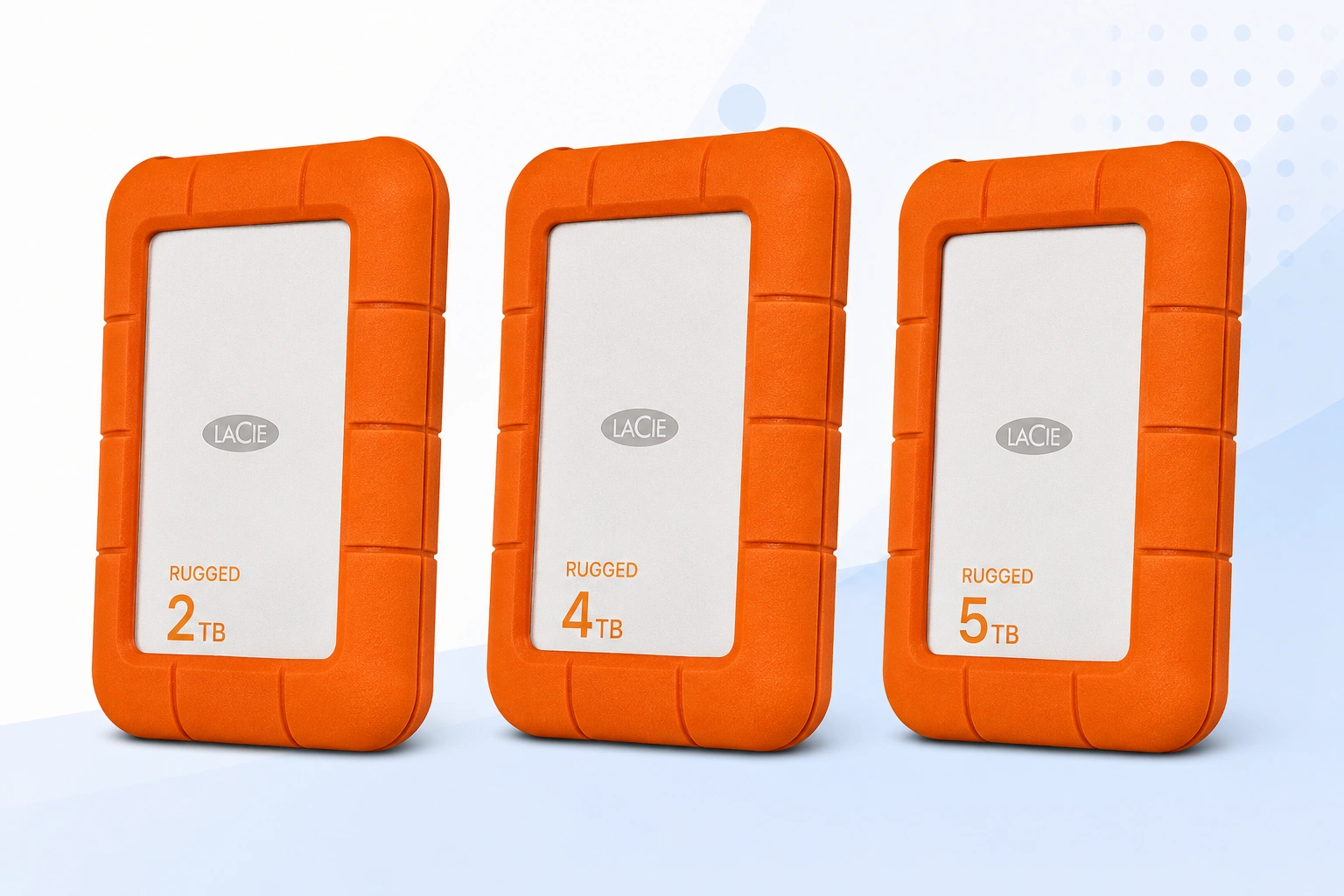
Start with the amount of portable HDD capacity you need, then compare 1TB, 2TB, 4TB and 5TB on current $/TB and multi-copy cost. Use Price Gap against Mobile Drive only as a premium check, not a durability score.
Price Trend
90-Day Price History
Price history is building
We’ll show the 90-day trend here as more daily price checks are recorded.
LaCie Deal Score
Live value by family or capacity
| Drive | Current | $/TB | 30-Day | Deal | Sale | Signal |
|---|---|---|---|---|---|---|
| Rugged 1TB | — | — | — | — | — | WATCH |
| Rugged 2TBSTFR2000800 | $149.99 | $75.00 | — | 45 | — | WAIT |
| Rugged 4TBSTFR4000800 | $209.99 | $52.50 | — | 70 | — | WATCH |
| Rugged 5TBSTFR5000800 | $239.99 | $48.00 | — | 80 | — | WATCH |
Each row is evaluated inside its own family and media class. A Rugged HDD is not scored against a Rugged SSD simply because both carry the LaCie name.
Is this a good price?
LaCie Price Check
Amazon Live
Current LaCie Rugged Prices offers
| Drive | Model | Capacity | Amazon price | $/TB | Checked | |
|---|---|---|---|---|---|---|
 LaCie Rugged HDDNew · InstaDeals LaCie Rugged HDDNew · InstaDeals | STFR5000800 | 5TB | $249.90 | $49.98 | Checked 14h ago | Buy on Amazon |
 LaCie Rugged HDDNew · Amazon.com LaCie Rugged HDDNew · Amazon.com | STFR4000800 | 4TB | $209.99 | $52.50 | Checked 14h ago | Buy on Amazon |
 LaCie Rugged HDDNew · Amazon buying options LaCie Rugged HDDNew · Amazon buying options | STFR5000800 | 5TB | $239.99 | $48.00 | Last verified 3d ago | Buy on Amazon |
| LaCie Rugged HDDNew · Amazon buying options | STFR2000800 | 2TB | $149.99 | $75.00 | Last verified 3d ago | Buy on Amazon |
| LaCie Rugged HDDNew · Amazon buying options | STFR2000800 | 2TB | $149.99 | $75.00 | Last verified 4d ago | Buy on Amazon |
| LaCie Rugged HDDNew · Amazon buying options | STFR1000800 | 1TB | Price options | — | Check current price | Buy on Amazon |
 LaCie Rugged HDDNew · Amazon buying options LaCie Rugged HDDNew · Amazon buying options | STFR5000800 | 5TB | Price options | — | Check current price | Buy on Amazon |
As an Amazon Associate, Cloudzat may earn from qualifying purchases. Prices, seller, selected variation and availability can change. Confirm the LaCie family, capacity, model and New condition before checkout.
Capacity Economics
1TB vs 2TB vs 4TB vs 5TB purchase cost
| Capacity | 1TB | 2TB | 4TB | 5TB |
|---|---|---|---|---|
| Best current $/TB | — | $75.00 | $52.50 | $48.00 |
| One drive | — | $149.99 | $209.99 | $239.99 |
| Two copies | — | $299.98 | $419.98 | $479.98 |
| Current model | — | STFR2000800 | STFR4000800 | STFR5000800 |
This table stays inside the media class of this page. The main LaCie hub defaults to Rugged HDD capacity economics rather than treating SSD and HDD storage as interchangeable.
Smart Alternatives
Other current LaCie options


Rugged USB-C prices should be compared inside the Rugged family
LaCie Rugged USB-C is bought for portable hard-drive capacity in a physically distinctive enclosure, so its pricing should be judged against other Rugged capacities before it is compared with SSDs or desktop storage. The family page starts with New-condition Rugged HDD offers and calculates current $/TB across 1TB, 2TB, 4TB and 5TB. This reveals whether the larger capacities are delivering their normal value advantage or whether a promotion has temporarily made a smaller drive more attractive. It also keeps a slow but capacious HDD from being scored against a much faster SSD that solves a different problem.
The family view is particularly useful when a buyer knows they want Rugged but has not settled on capacity. A 2TB drive may have the lowest checkout price, while 5TB may deliver much better storage value. The correct answer depends on how much data will be carried, how fast it will grow and whether the purchase needs a second copy. Cloudzat presents those dimensions together so “cheapest” does not automatically become “best.”
Exact STFR identities keep the capacity ladder clean
The current Rugged USB-C support family uses distinct STFR model identities for the main capacities covered by this plugin. Exact capacity pages use those model numbers as strong evidence, while the broader Rugged page can accept a qualifying family listing when the capacity is unambiguous. This matters because marketplace results sometimes expose parent listings, multiple capacity variants or accessory products containing the same family name. A price tracker that relies only on the word Rugged can easily store a price that belongs to the wrong variation.
Model-aware filtering reduces that risk. The system checks title, model and capacity evidence together and rejects a capacity-specific result when the requested model is contradicted. It also filters carrying cases, sleeves, replacement cables and other accessories before those rows can influence the Deal Score. Genuine drives may mention included cables in their feature text, so the filter focuses on what the product actually is rather than banning every listing that contains an accessory word somewhere on the page.
The 1TB to 5TB ladder exposes marginal capacity cost
A simple price-per-terabyte table tells you which capacity is cheapest per unit of storage, but it does not show how much money the next step requires. Rugged buyers should also look at marginal capacity cost. If moving from 2TB to 4TB costs a modest amount, the extra headroom can be attractive even when the larger drive is not the absolute $/TB winner. If moving from 4TB to 5TB carries a large premium, the final terabyte may be poor value unless the buyer specifically needs the capacity in one portable device.
This becomes even more important with multiple copies. A forty-dollar step-up is eighty dollars across two drives and one hundred twenty dollars across three. Capacity economics therefore shows unit price and multi-copy cost together. The result makes it easier to choose a capacity that is large enough without silently doubling or tripling a premium across a backup plan.
Price history separates a real Rugged sale from a normal price
Rugged prices can move around promotions, seller changes and inventory transitions. A banner saying “deal” does not establish that the price is historically attractive. The 90-day chart is designed to answer that question with the observations Cloudzat actually has. Once enough daily history exists, Sale Score reflects how low the current price sits in that record. Until then, the page keeps the timing signal conservative rather than manufacturing a trend from insufficient data.
The history layer is especially useful for a non-urgent backup purchase. If the current offer is far above the recent median and the buyer has time, waiting can be rational. If the price sits near a recorded low and the exact model and seller check out, the timing case becomes stronger. None of this guarantees that the old low will return, but it gives the buyer a factual reference point that a single live price cannot provide.
Rugged versus Mobile Drive is a price-premium question
At the same capacity, LaCie Mobile Drive provides a practical reference for the premium paid to stay in the Rugged family. Cloudzat labels the difference as Price Gap rather than inventing a “ruggedness score.” The number simply shows how much more or less the qualifying Rugged offer costs than a current same-capacity Mobile Drive. A buyer can then decide whether the physical-use case, design or workflow justifies the extra dollars.
That comparison can change from week to week. A promotion on Rugged may shrink the premium to almost nothing, while a sale on Mobile Drive can widen it dramatically. The products themselves have not necessarily changed, but the value decision has. This is exactly why current price intelligence is useful for premium storage: it exposes the cost of a preference at the moment the buyer is ready to purchase.
Portable HDD value is not the same as SSD value
A Rugged SSD can be compelling for repeated large transfers, but its higher $/TB does not make Rugged HDD a universal winner. Conversely, an SSD should not receive a bad Deal Score because magnetic storage is cheaper. The Rugged HDD page keeps its benchmark within portable hard drives and uses SSD pages for solid-state decisions. That prevents a technically meaningless comparison from dominating the shopping signal.
Buyers who are unsure which media type they need should first estimate the workload. If the drive will hold archives, backups or large collections that are moved occasionally, HDD capacity economics can be decisive. If it will serve as active working storage where transfer time has direct productivity value, the SSD premium can be rational. The correct price comparison begins only after that requirement is clear.
Check the selected capacity again at checkout
Amazon variation pages can switch between capacities while preserving much of the same product title and imagery. That creates a common price-tracking problem: a shopper sees a low number and assumes it applies to the capacity they searched. Cloudzat therefore requires capacity evidence for exact pages and still tells the visitor to confirm the selected variation before paying. The checkout page is the final authority for what is actually being purchased.
The same check applies to condition. Renewed or refurbished products can appear beside New offers at a lower price, but they are not used to establish the main New-product benchmark. Mixing them would make the dashboard look more attractive while hiding a material difference in the transaction. A fair comparison keeps condition consistent.
Use Rugged as part of a backup system, not the whole system
The physical convenience of a portable drive can tempt buyers to treat it as both working storage and backup. That is risky because one device can be lost, damaged, corrupted or simply unavailable at the wrong moment. A sensible purchase plan considers at least one additional independent copy. The capacity table helps translate that principle into money by showing the cost of two or three drives at the current qualifying price.
For travel, the independent copy should not always travel in the same bag. For office use, a second destination can be a different external drive, NAS or cloud tier depending on the data and recovery objective. Price intelligence does not replace backup design, but it can make the financial consequences of that design visible before the buyer commits to a capacity.
A higher capacity can be cheaper without being the right size
The 5TB Rugged can sometimes deliver the strongest $/TB, yet a buyer with a small data set may still prefer 2TB. Unused capacity has no value if it pushes the purchase outside budget or reduces money available for a second copy. Likewise, buying 1TB solely because it has the lowest ticket price can be false economy if the drive fills quickly and must be replaced. The family page is designed to show the tradeoff rather than dictate one capacity for everyone.
Growth rate is the missing variable. Estimate today’s data, expected additions during the useful life of the drive and the free-space margin you want to preserve. Then compare that capacity target with the current ladder. The best-value capacity is the one that meets the requirement at a strong current price, not necessarily the row with the smallest or largest number.
The Deal Score is deliberately conservative when history is young
When a Rugged capacity has little historical data, Cloudzat can still compare its current $/TB with current family pricing, but it should not pretend to know the long-term sale cycle. That is why early pages can show a Deal Score while Sale Score remains unavailable. The two signals answer different questions. Deal Score asks whether the offer looks competitive now; Sale Score asks whether the timing is historically attractive.
As the daily record grows, the historical percentile becomes more informative and the timing decision can carry more confidence. This gradual approach avoids a common price-tracker mistake where a tiny sample produces a precise-looking but fragile recommendation. The visitor can see when the record is still developing and decide how much weight to give the signal.
A final Rugged checkout routine takes less than a minute
Confirm the selected Rugged USB-C capacity, verify the exact model when the listing exposes it, check that condition is New, review the current seller and price, and compare the offer with the family $/TB ladder. If price history is mature, note the Sale Score and recorded position. If Mobile Drive has a same-capacity current price, look at the Price Gap and decide whether the Rugged premium is worthwhile for your use case.
Then budget the backup copy before completing the purchase. This sequence catches the most expensive mistakes without turning a straightforward drive purchase into a research project. The goal of the page is to make the relevant numbers easy to see and to leave technical or reliability claims to evidence appropriate for those questions rather than smuggling them into a price score.
Think in replacement cycles, not just today’s Rugged discount
Portable hard drives are often kept until either capacity or workflow changes, so the cheapest offer today should be viewed against the likely replacement cycle. A 2TB Rugged bought at an excellent discount can still be an expensive choice if the data set will exceed it soon. A 5TB model can be the better long-run purchase even with a higher ticket price when it postpones replacement and reduces the number of devices a traveler must manage. Price intelligence becomes more useful when the current sale is combined with realistic storage growth rather than treated as a one-day shopping contest.
At the same time, future growth should not be exaggerated just to justify the largest capacity. Forecast from actual photo, video, project or backup creation rates and include a sensible margin. Then use the Rugged capacity ladder to find the tier that meets that forecast at the strongest current value. This approach keeps capacity, price and replacement timing connected and makes the Deal Score one part of a practical ownership decision rather than the only reason to buy.
Decision table
What to compare before buying
| Question | Why it matters | What to verify |
|---|---|---|
| Capacity | Changes both total cost and price per terabyte | Exact selected capacity on the listing |
| Family | Rugged, Mobile Drive and d2 solve different physical-use cases | Product family and exact model |
| Current price | LaCie pricing can move substantially around promotions | Live price, seller and New condition |
| Price history | Separates a normal price from a strong sale | 90-day position when enough history exists |
| Backup plan | One portable drive should not become the only copy | Second copy and off-site strategy |
Questions people ask
LaCie Rugged Prices FAQs
What is a good price for LaCie Rugged USB-C?
A good price is one that is competitive inside the same LaCie family and capacity, not merely low in absolute dollars. Cloudzat first converts the current offer to cost per terabyte, then uses the available family history and same-class alternatives. Check the selected capacity and STFR identity when the model is shown.
What does the Deal Score mean for LaCie Rugged USB-C?
Deal Score is a current-value signal. It compares a qualifying New-condition offer with relevant current LaCie pricing in the same media class and family context. It is not a durability, performance, seller-quality or reliability score.
Why can the price of LaCie Rugged USB-C change so much?
Storage prices move with promotions, inventory, seller mix, model transitions and the selected capacity. LaCie products can also carry a design, interface or ruggedization premium, so a broad market move does not always translate into the same percentage change for every LaCie family.
Does Cloudzat mix used or renewed LaCie Rugged USB-C offers into the benchmark?
No. The principal benchmark is for qualifying New-condition products. Used, renewed, refurbished and recertified offers can have different warranty, seller and condition characteristics, so they should not define the New-product price signal.
How does Cloudzat prevent accessories from affecting LaCie Rugged USB-C pricing?
The catalogue requires evidence that the listing is a complete LaCie storage device from the intended family. Cases, sleeves, replacement cables, power adapters, docks, empty enclosures and unrelated products are rejected before they can influence price-per-terabyte or Deal Score calculations.
Should I buy LaCie Rugged USB-C as my only backup?
No single drive should be treated as the only copy of important data. Use the price tools to plan the cost of two or more independent copies where the data matters, and keep at least one backup physically or logically separate from the working drive.
Price methodology & sources
How Cloudzat evaluates LaCie prices
Current shopping offers are matched to the intended LaCie family, capacity and exact model when a model-specific page requires one. New-condition products establish the public benchmark. Cases, replacement cables, adapters, empty enclosures, unrelated storage families and non-new offers are excluded from the main price signal.
Portable HDD, desktop HDD and portable SSD benchmarks remain separate. Historical charts and Sale Scores appear only when enough daily observations exist. Price Gap is a transparent same-capacity comparison between closely related LaCie families; it does not claim that the compared products have equal speed, ruggedness, interface, warranty or workload suitability.
Always confirm the exact model, selected capacity, interface, seller, regional warranty terms and current checkout price. LaCie product lines can change by revision and market.