


EXACT CAPACITY PRICE INTELLIGENCE
LaCie Rugged 1TB Price History & Deal Score
Follow STFR1000800 pricing and compare today’s 1TB Rugged USB-C offer with nearby capacities and its own price record.
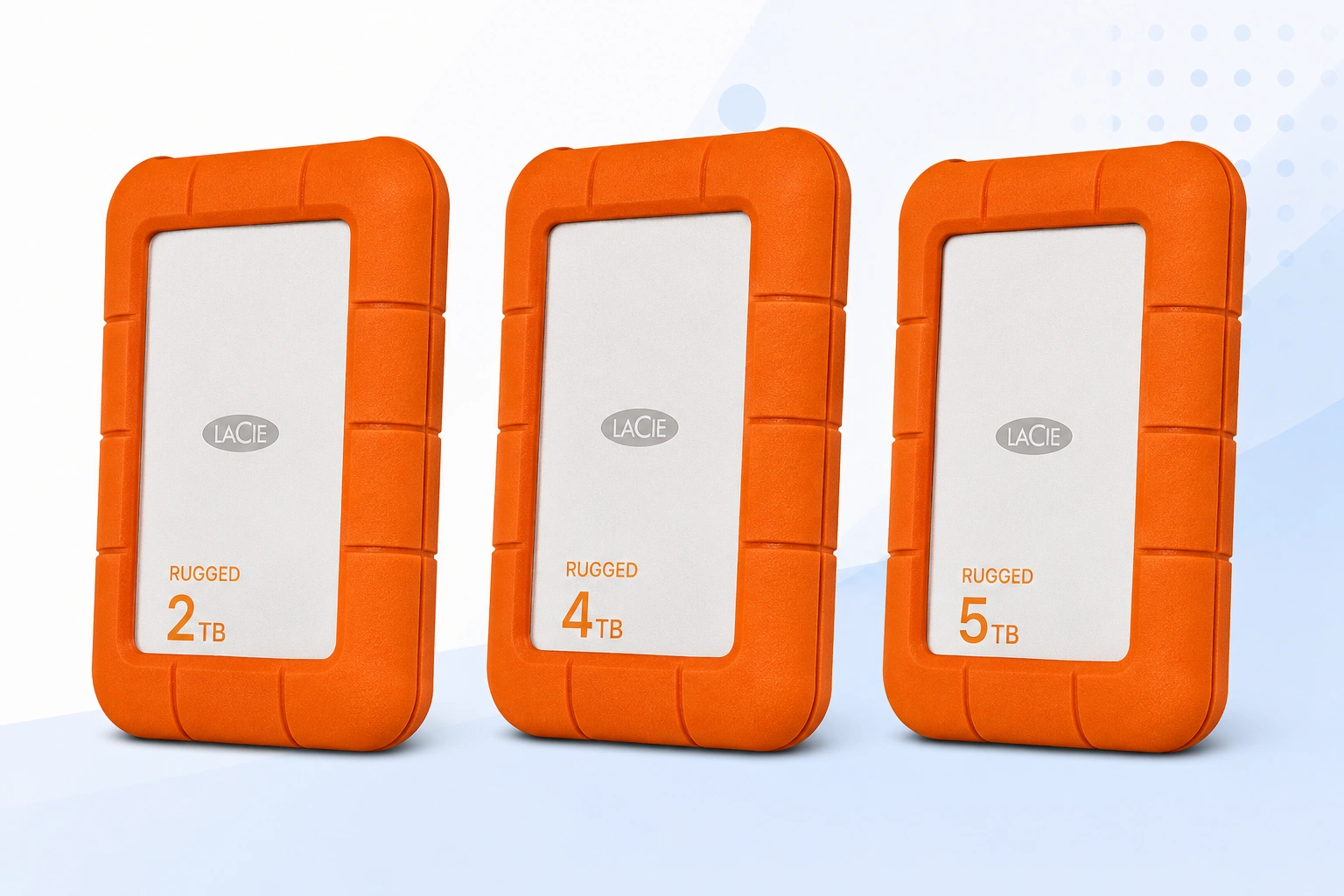
Treat STFR1000800 as a 1TB capacity decision first. Check current $/TB, the nearby Rugged capacity ladder and the same-capacity Mobile Drive price gap before using the historical timing signal.
Price Trend
90-Day Price History
Price history is building
We’ll show the 90-day trend here as more daily price checks are recorded.
LaCie Deal Score
Live value by family or capacity
| Drive | Current | $/TB | 30-Day | Deal | Sale | Signal |
|---|---|---|---|---|---|---|
| Rugged 1TB | — | — | — | — | — | WATCH |
| Rugged 2TBSTFR2000800 | $149.99 | $75.00 | — | 45 | — | WAIT |
| Rugged 4TBSTFR4000800 | $209.99 | $52.50 | — | 70 | — | WATCH |
| Rugged 5TBSTFR5000800 | $239.99 | $48.00 | — | 80 | — | WATCH |
Each row is evaluated inside its own family and media class. A Rugged HDD is not scored against a Rugged SSD simply because both carry the LaCie name.
Is this a good price?
LaCie Price Check
Amazon Live
Current LaCie Rugged 1TB offers
| Drive | Model | Capacity | Amazon price | $/TB | Checked | |
|---|---|---|---|---|---|---|
 LaCie Rugged HDDNew · Amazon buying options LaCie Rugged HDDNew · Amazon buying options | STFR1000800 | 1TB | Price options | — | Check current price | Buy on Amazon |
As an Amazon Associate, Cloudzat may earn from qualifying purchases. Prices, seller, selected variation and availability can change. Confirm the LaCie family, capacity, model and New condition before checkout.
Capacity Economics
1TB vs 2TB vs 4TB vs 5TB purchase cost
| Capacity | 1TB | 2TB | 4TB | 5TB |
|---|---|---|---|---|
| Best current $/TB | — | $75.00 | $52.50 | $48.00 |
| One drive | — | $149.99 | $209.99 | $239.99 |
| Two copies | — | $299.98 | $419.98 | $479.98 |
| Current model | — | STFR2000800 | STFR4000800 | STFR5000800 |
This table stays inside the media class of this page. The main LaCie hub defaults to Rugged HDD capacity economics rather than treating SSD and HDD storage as interchangeable.
Smart Alternatives
Other current LaCie options



1TB Rugged value starts with exact model identity
This page is centered on the LaCie Rugged USB-C 1TB capacity and the STFR1000800 identity used by the current support family. That exactness matters because marketplace pages can expose several capacities under one parent listing. A price captured from the wrong variation would corrupt the current $/TB figure, the recorded low and every later timing signal. The catalogue therefore asks for the requested capacity and model evidence before a result can establish the benchmark. It is intentionally stricter than a generic search-results page.
For a shopper, the practical check is simple: make sure the selected Amazon variation still says 1TB before checkout and compare the model field with STFR1000800 when it is visible. A case, sleeve, cable or replacement adapter may include the words LaCie Rugged and even list 1TB compatibility, but it is not a drive. Accessory rejection happens before the offer can influence the intelligence calculations.
The 1TB checkout price needs context, not just a dollar sign
A live price for 1TB tells you the immediate cash requirement, but it does not tell you whether the offer is attractive. Cloudzat converts the number to price per terabyte and compares it with current Rugged capacity economics. That makes it possible to see whether 1TB is receiving a meaningful discount or whether a nearby capacity currently offers more usable storage for each dollar. The page does not assume the lowest $/TB is automatically the correct purchase; it exposes the tradeoff.
For 1TB in particular, the lowest ticket price can be attractive for a compact archive, but buyers should compare the cost of outgrowing the drive against the modest step to 2TB. This matters because storage decisions are rarely made in isolation. A buyer may need two drives, a travel copy plus an office copy, or enough headroom to avoid replacing the drive in a year. The best current price is therefore the one that fits the real capacity plan and still leaves room in the budget for the rest of the backup system.
Compare 1TB with the next sensible capacity step
The most useful neighboring comparison for 1TB is not every product on Amazon. It is the next capacity that could realistically replace it in the same Rugged workflow. The capacity table shows how the current 1TB price compares with 2TB and the other Rugged tiers. Look at both total dollars and the marginal cost of extra storage. A larger drive can be more expensive while still delivering a better economic result for a growing data set.
The opposite can also happen. A temporary 1TB promotion may make this exact capacity the sweet spot even if a larger Rugged drive normally wins on $/TB. That is why the page uses current offers instead of a fixed “best capacity” recommendation. Capacity value is a market condition, not a permanent specification.
Price history tells you whether STFR1000800 is near a sale zone
Once enough daily observations accumulate for STFR1000800, the 90-day history can answer a question the product listing cannot: is today’s 1TB price unusually low, ordinary or expensive relative to its own recent record? The Sale Score uses that history rather than a generic drive-market average. This avoids declaring a premium LaCie product overpriced simply because a different brand sells a cheaper bare drive.
When the history is still young, the page says that the record is building. That is more useful than inventing a smooth chart or importing unrelated price points. A timing decision deserves enough observations to distinguish a real trend from one sale day, so Cloudzat keeps the early signal conservative.
The Rugged premium should be visible at 1TB
If a current LaCie Mobile Drive exists at 1TB, the Price Gap shows the dollar and percentage difference versus the Rugged offer. This is not a claim that Mobile Drive and Rugged are technically identical. It is a way to make the premium explicit. The buyer can then decide whether the Rugged family’s physical-use position and design are worth the additional amount for the way the drive will actually be carried and used.
For multiple copies, multiply the gap as well as the drive price. A seemingly modest premium on one 1TB unit can become a significant budget item across a pair or a three-copy rotation. If the alternative already satisfies the job, the difference may be better spent on redundancy. If Rugged is the reason you are buying LaCie, a small gap can make the decision easier.
1TB is a capacity decision before it is a brand decision
Estimate the data set first. If the working archive is already close to 1TB, this capacity may leave too little breathing room regardless of how attractive the sale looks. If the data set is much smaller, the capacity may be sufficient for years and the larger tiers may simply lock money into unused space. Growth headroom, not product enthusiasm, should define the minimum useful size.
The price dashboard supports that discipline by showing 1TB beside nearby Rugged capacities. It does not claim that every buyer should move upward whenever the larger drive has better $/TB. A capacity that meets the requirement and allows a second backup copy can be a better system decision than the largest drive that consumes the whole budget.
Portable hard-drive economics differ from portable SSD economics
This 1TB Rugged page benchmarks a portable hard drive, so its Deal Score remains inside the HDD class. A LaCie Rugged SSD may be much faster, but comparing its raw $/TB directly with STFR1000800 would answer the wrong question. HDD buyers are usually optimizing portable capacity cost, while SSD buyers often pay for transfer performance. The media choice should be made before interpreting the price score.
If the drive will mainly store backups, photos, project archives or large collections that do not need repeated high-speed editing, an HDD can be economically sensible. If the drive becomes active working storage for large video or production files, evaluate the Rugged SSD page instead and include host-interface capability in the decision.
Condition and seller can change the meaning of a low 1TB price
A suspiciously low 1TB listing can come from a different condition, an accessory, a wrong variation or a seller configuration that does not match the product you intended to buy. The main benchmark uses New-condition products and filters obvious mismatches. That keeps a renewed unit from creating an artificial historical low for STFR1000800. It also makes the Deal Score easier to interpret because the underlying offers share the same basic transaction condition.
Still, the final seller and checkout page matter. Marketplace availability can change after a refresh. Treat the live panel as a current comparison aid, click through to the exact listing and confirm what Amazon presents at the moment of purchase. The page never fills a missing featured price with an invented numeric value.
Two 1TB drives can be a better purchase than one larger single copy
Redundancy changes the capacity calculation. If important data must exist in more than one place, the relevant budget may be two 1TB drives rather than one larger drive. The capacity economics table makes that cost visible so a buyer can compare headroom with resilience. One bigger device holding the only copy can look efficient on $/TB while leaving the data exposed to a single failure, loss or accidental deletion event.
The exact backup pattern depends on the data, but the purchasing principle is simple: price the copies before choosing the capacity. If two 1TB drives fit the requirement comfortably, that can be a stronger plan than one premium higher-capacity unit with no independent backup.
Use the Deal Score and Sale Score for different 1TB questions
Deal Score asks whether the current 1TB offer looks competitive inside its current Rugged context. Sale Score asks whether the timing looks favorable relative to the price history recorded for this capacity. A product can have a respectable current Deal Score while its Sale Score remains unavailable because history is still developing. It can also be reasonably priced versus nearby capacities yet sit above its own historical median.
Keeping the two questions separate prevents false precision. Current market value and historical timing are related, but they are not the same thing. A buyer with an urgent need can use Deal Score even when the historical record is young, while a flexible buyer can place more weight on Sale Score once enough observations exist.
When waiting for a better 1TB price makes sense
Waiting is most defensible when the current 1TB offer is well above its recent historical range, a nearby Rugged capacity has clearly better economics and the purchase is not time-sensitive. The WAIT signal is not a forecast that the price will fall on a particular date. It is simply a warning that the current value is weak relative to the evidence available now.
Buying now becomes easier to justify when STFR1000800 is near a strong historical position, the capacity fits the real data plan and the seller/condition checks pass. The page is designed to make those facts visible without pretending to know the next promotion schedule.
A one-minute checklist for STFR1000800
Before checkout, confirm STFR1000800 or the intended Rugged 1TB identity, verify that 1TB is the selected variation, confirm New condition, review the seller, compare the current $/TB with nearby Rugged capacities, and look at the 90-day position if enough history exists. Then review the Price Gap against Mobile Drive when a same-capacity reference is available.
Finally, decide where the second copy will live and make sure the total purchase cost still fits the plan. That final step is easy to skip when the current offer looks attractive. Price intelligence is most useful when it improves the whole storage decision rather than merely helping the buyer save a few dollars on the first device.
A 1TB purchase should protect simplicity as well as price
One terabyte remains attractive when the data set is deliberately small: a curated photo library, a compact travel backup, documents, or a project handoff where portability matters more than maximum headroom. In that situation the 1TB model can be the cleanest purchase even when a larger drive posts a lower price per terabyte. The relevant waste is not paying a few dollars more per unit of storage; it is buying capacity that will not be used while leaving less money for a second independent copy. That is why this page keeps total purchase cost visible next to normalized value.
If growth is uncertain, compare the actual 1TB price with 2TB rather than relying on a general rule. A small premium for twice the capacity can be rational; a large premium may not be. The decision should also consider how easy it would be to move the entire data set to a replacement later. For a small archive, migration can be simple enough that buying precisely for today is reasonable. The page gives the current numbers needed to make that tradeoff without pretending every 1TB buyer has the same future.
Decision table
What to compare before buying
| Question | Why it matters | What to verify |
|---|---|---|
| Capacity | Changes both total cost and price per terabyte | Exact selected capacity on the listing |
| Family | Rugged, Mobile Drive and d2 solve different physical-use cases | Product family and exact model |
| Current price | LaCie pricing can move substantially around promotions | Live price, seller and New condition |
| Price history | Separates a normal price from a strong sale | 90-day position when enough history exists |
| Backup plan | One portable drive should not become the only copy | Second copy and off-site strategy |
Questions people ask
LaCie Rugged 1TB FAQs
What is a good price for LaCie Rugged 1TB?
A good price is one that is competitive inside the same LaCie family and capacity, not merely low in absolute dollars. Cloudzat first converts the current offer to cost per terabyte, then uses the available family history and same-class alternatives. This exact page targets STFR1000800; confirm that model or unambiguous 1TB Rugged USB-C identity before treating a price as comparable.
What does the Deal Score mean for LaCie Rugged 1TB?
Deal Score is a current-value signal. It compares a qualifying New-condition offer with relevant current LaCie pricing in the same media class and family context. It is not a durability, performance, seller-quality or reliability score.
Why can the price of LaCie Rugged 1TB change so much?
Storage prices move with promotions, inventory, seller mix, model transitions and the selected capacity. LaCie products can also carry a design, interface or ruggedization premium, so a broad market move does not always translate into the same percentage change for every LaCie family.
Does Cloudzat mix used or renewed LaCie Rugged 1TB offers into the benchmark?
No. The principal benchmark is for qualifying New-condition products. Used, renewed, refurbished and recertified offers can have different warranty, seller and condition characteristics, so they should not define the New-product price signal.
How does Cloudzat prevent accessories from affecting LaCie Rugged 1TB pricing?
The catalogue requires evidence that the listing is a complete LaCie storage device from the intended family. Cases, sleeves, replacement cables, power adapters, docks, empty enclosures and unrelated products are rejected before they can influence price-per-terabyte or Deal Score calculations.
Should I buy LaCie Rugged 1TB as my only backup?
No single drive should be treated as the only copy of important data. Use the price tools to plan the cost of two or more independent copies where the data matters, and keep at least one backup physically or logically separate from the working drive.
Price methodology & sources
How Cloudzat evaluates LaCie prices
Current shopping offers are matched to the intended LaCie family, capacity and exact model when a model-specific page requires one. New-condition products establish the public benchmark. Cases, replacement cables, adapters, empty enclosures, unrelated storage families and non-new offers are excluded from the main price signal.
Portable HDD, desktop HDD and portable SSD benchmarks remain separate. Historical charts and Sale Scores appear only when enough daily observations exist. Price Gap is a transparent same-capacity comparison between closely related LaCie families; it does not claim that the compared products have equal speed, ruggedness, interface, warranty or workload suitability.
Always confirm the exact model, selected capacity, interface, seller, regional warranty terms and current checkout price. LaCie product lines can change by revision and market.