


Quick answer
The practical transfer ceiling is the lowest of the host link, enclosure link, controller limit and storage media after overhead and array efficiency are applied.
Host bandwidth, enclosure bandwidth, optional controller limits, storage media speed, drive count and RAID mode are combined into one conservative planning result.
Do not pay for an 80Gbps enclosure unless the host and workload can use it. A 10Gbps computer, SATA SSD or single hard drive can remain the limiting component.
Performance planner
Estimate the speed you can actually use
Set the host, enclosure, media and array details. The calculator applies conservative link ceilings rather than treating the advertised bit rate as file-copy speed.
The estimate applies protocol overhead and conservative array efficiency rather than dividing the headline Gbit/s number by eight.
Current buying options
Current enclosures across the speed ladder
Use the tool first, then compare only products whose drive support and link speed fit the result. Prices and availability can change after the last check.
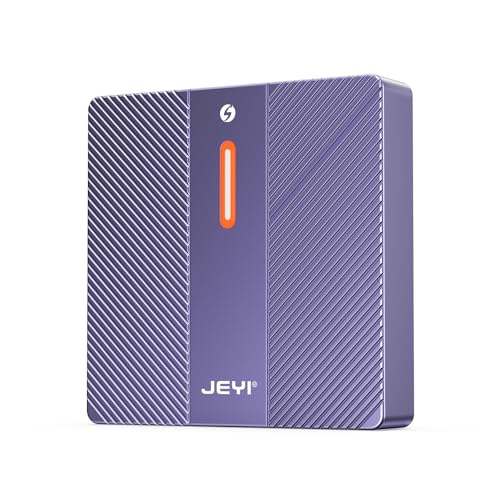
JEYI 4-Bay NVMe RAID Enclosure with Turbo Fan, Individual & RAID Modes

TERRAMASTER D1 SSD Pro 80Gbps M.2 NVMe SSD Enclosure (Diskless)

UGREEN 80Gbps M.2 NVMe SSD Enclosure with Cooling Fan

MOKiN 80Gbps M.2 NVMe SSD Enclosure with LCD Display, PCIe Gen5

UGREEN 80Gbps M.2 NVMe SSD Enclosure(SSD Not Included)

ACASIS 80Gbps M.2 NVMe SSD Enclosure, TB5 & USB4 V2 Compatible, 60W PD

ACASIS 80Gbps M.2 NVMe SSD Enclosure, Thunderbolt 5 & USB4 V2.0 Compatible

ACASIS 80Gbps M.2 NVMe SSD Enclosure, Thunderbolt 5 & USB4 V2.0 Compatible

MOREFINE 80Gbps M.2 NVMe SSD Enclosure with Cooling Fan, Aluminium Alloy Enclosure Compatible with Thunderbolt 5/4/3/USB4, Support PCIe M.2 SSD up to 8TB

Qwiizlab Fanless 80Gbps NVMe Enclosure with Aluminum Chassis, Compatible with Thunderbolt 5, Backward Compatible with Thunderbolt 4/3 and USB4, Support PCIe M.2 SSD up to 8TB (Silver)

Satechi DotDisk 80Gbps NVMe SSD Enclosure, Fast Data Transfer, Space Black

80Gbps M.2 NVMe SSD Enclosure with Cooling Fan Compatible with Thunderbolt 5/USB4 V2.0, Support B+M Key/M-Key NVMe 2280 SSD, Backward Compatible with USB 3.2/3.1/3.0, Tool-Free Installation Up to 8TB

ANYOYO 80Gbps M.2 NVMe SSD Enclosure Supports Up to 8TB Intelligent Temperature Control & Fan Cooling, Compatible with Thunderbolt 3/4/5/USB4, Backward Compatible with USB 3.2/3.1/3.0

ACASIS 40Gbps 4-Bay Hard Drive Enclosure, RAID Enclosure with Dual-Bay HDD Enclosure for 3.5/2.5" SATA HDD/SSD+Dual-Bay NVMe Enclosure, USB4 Hard Drive Dock Compatible with USB4, Thunderbolt 3/4/5

USB 4.0 (40Gbps) Type-C 8 Bay 2.5 Inch and 3.5 Inch SATA Hard Drive External Hard Drive Enclosure - SY-ENC50129
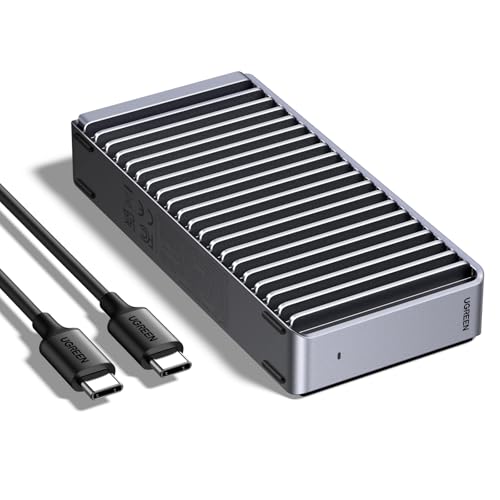
UGREEN 40Gbps M.2 NVMe Enclosure (SSD Not Included)

ACASIS 40Gbps M.2 NVMe SSD Enclosure with Aluminum Heat-dissipating fins

StarTech USB4 40Gbps M.2 NVMe SSD Enclosure (1USB4-NVME-ENCLOSURE)

MOKiN 40Gbps M.2 NVMe SSD Enclosure, Thunderbolt for M1 Pro/Max Mac

ANYOYO NVMe M.2 SSD Enclosure, 40Gbps NVMe Enclosure Up to 8TB SSD, Tool-Free Aluminum Case with Triple Fins Heat Dissipation, Compatible with Thunderbolt 3/4 & USB4/3.2/3.1/3.0/2.0 M1 M2 Pro/Max

40Gbps M.2 NVMe SSD Enclosure, ICY BOX M.2 Enclosure Support SSD M/B+M Key Size 2280/2260/2242/2230 Compatible with Thunderbolt 4/3/USB4/3.2/3.1, Tool-Free Aluminum Thunderbolt 4 Enclosure

Yottamaster M.2 NVMe SSD Enclosure 40Gbps, for Thunderbolt 4/USB4 Interface

ACASIS 40Gbps M.2 NVMe SSD Enclosure with Cooling Fan

ANYOYO NVMe M.2 SSD Enclosure, 40Gbps NVMe Enclosure Up to 8TB SSD, Tool-Free Aluminum Case with Triple Fins Heat Dissipation, Compatible with Thunderbolt 3/4 & USB4/3.2/3.1/3.0/2.0 M1 M2 Pro/Max
Buying guide
Read external-storage speed claims in the right order
External storage performance is a chain. Start with the workload and media, then make sure the enclosure and host are fast enough to carry that data without paying for bandwidth you cannot use.
Advertised Gbit/s is a link rate
A 10Gbps connection cannot deliver 1,250MB/s of normal file-copy throughput. Protocol overhead and controller behavior reduce the usable rate, so this calculator uses lower planning ceilings.
SATA SSDs top out long before USB4
A good SATA SSD is usually limited to roughly the mid-500MB/s range. Moving it from a solid 10Gbps enclosure to a 40Gbps enclosure does not create NVMe-class performance.
Single hard drives need capacity more than link speed
A single modern hard drive is far slower than a 10Gbps USB connection. Multi-drive arrays can aggregate enough throughput for the enclosure link to matter.
RAID changes both speed and usable capacity
RAID 0 can aggregate performance but has no redundancy. RAID 1 prioritizes mirroring. RAID 5, RAID 6 and RAID 10 add parity or mirroring overhead, so real writes do not scale linearly with drive count.
Thermals can lower sustained NVMe speed
Fast NVMe drives can heat the bridge and SSD during large transfers. A short benchmark may look excellent while a long copy slows down, so sustained cooling matters for creator and backup workloads.
Related Cloudzat tools
Continue the storage decision
Questions
Frequently asked questions
How much speed can I get from a 10Gbps enclosure?
A good 10Gbps storage path is commonly limited to roughly 900 to 1,000MB/s before the drive or workload becomes the next constraint.
Will an 80Gbps enclosure make every SSD faster?
No. The host must provide the faster link, and the SSD, bridge controller, cooling and workload must also be capable of using the additional bandwidth.
Why is a Gen5 SSD slow in an external enclosure?
The external link is often much slower than the SSD's internal PCIe capability. A 40Gbps path can become the bottleneck even when the SSD is capable of much higher sequential speed.
Does RAID 0 double speed with two drives?
It can increase sequential throughput substantially, but controller overhead, the enclosure link and the workload keep scaling from being perfectly linear.
Is Thunderbolt 5 always faster than USB4?
The exact host, enclosure implementation and storage device matter. Use the supported link rate and measured or stated controller limits rather than the connector name alone.