


UK BUYING GUIDE
High-endurance microSD cards are made for devices that overwrite the same footage all day, every day: dash cams, CCTV, body cams and some home monitoring cameras. The buying mistake most people make is chasing peak read speed instead of the things that matter in practice: sustained write endurance, the recorder’s capacity ceiling, and the warranty attached to the exact capacity they buy. Samsung, SanDisk and Kingston all sell current endurance cards in the UK market, but they are not identical in capacity range, included accessories, or warranty scope.
For most UK buyers, 128GB is the safest default starting point. It is large enough to avoid very short overwrite cycles in a typical dash cam or home security camera, but it is usually still within the comfort zone of modern devices that support microSDXC. If your recorder is older, fussy, or capped at microSDHC, then 32GB is the safer compatibility choice; if you want longer retention and your recorder accepts it, 256GB is the sensible step up.
Compatibility is mostly about the recorder, not the card label. These cards are all UHS-I microSD products, meant to be powered by the host device rather than UK mains, and the practical question is whether the device supports the target capacity and file system. Samsung’s current PRO Endurance line lists 32GB, 64GB, 128GB and 256GB; SanDisk’s High Endurance line goes to 512GB; SanDisk MAX Endurance and Kingston High Endurance both top out at 256GB. For simple camera use, buy the card family that matches the recorder first, then choose the capacity second.
Our recommendation
Default recommendation: buy a 128GB Samsung PRO Endurance if your recorder supports microSDXC and you are choosing for a dash cam, CCTV camera or body cam. It has the strongest headline endurance claims of the three families covered here, a 5-year limited warranty on the 128GB and 256GB cards, and the current Samsung page clearly positions it for always-on recording. The box also includes an SD adapter, which is useful for copying footage to a reader or laptop.
Budget choice: Kingston High-Endurance microSD 128GB. It is a plain, well-specified card with 32GB, 64GB, 128GB and 256GB capacities, 95MB/s read speed, 45MB/s write speed on the 128GB and 256GB versions, and a 3-year warranty. Kingston’s own page is explicit that it is built for surveillance cameras, dash cams and body cams, which makes it an easy value pick when you want a current endurance card without paying extra for Samsung’s longer warranty.
Specialist choice: SanDisk MAX Endurance 256GB if your camera writes continuously for long periods and supports 256GB microSDXC. SanDisk’s current UK product page rates it for up to 120,000 hours of recording, lists UHS-I, U3 and V30 support, and gives the 256GB model a 15-year limited warranty. That makes it the specialist pick when your priority is the longest warranty story in this group rather than the widest capacity range.
Endurance-rated microSD cards
Choose the exact model and configuration recommended below. These listings are from Amazon UK; bundles and capacities are identified on each card.

Samsung PRO Endurance 128GB microSDXC UHS-I U3 100MB/s Video Monitoring Memory Card with Adapter (MB-MJ128KA)
£79.97
Last verified 2026-11-28 13:29:28 UTC

Samsung PRO Endurance 256GB microSDXC UHS-I U3 100MB/s Video Monitoring Memory Card with Adapter (MB-MJ256KA)
£119.99
Last verified 2026-11-28 13:29:28 UTC
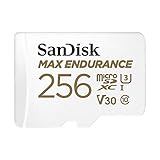
SANDISK MAX Endurance microSD Card + Adapter 256GB | V30, 4K UHD, C10, U3, Ideal for Home Security Cameras and Dash cams, Record up to 120,000 hours video
£115.08
Last verified 2026-11-28 12:04:14 UTC

SANDISK MAX Endurance microSD Card + Adapter 128GB | V30, 4K UHD, C10, U3, Ideal for Home Security Cameras and Dash cams, Record up to 60,000 hours video
£67.95
Last verified 2026-11-28 11:41:36 UTC
As an Amazon Associate, Cloudzat earns from qualifying purchases. Price and availability may change; Amazon checkout controls the purchase price.
What to buy for your needs
Start with the recorder’s storage ceiling, not the card brand
Before you compare Samsung, SanDisk or Kingston, check the device manual for its supported card type and maximum capacity. A microSD card can physically fit and still fail if the recorder only supports microSDHC, or if the firmware is picky about larger microSDXC cards. SanDisk’s product pages make the distinction clear: 32GB cards are microSDHC, while 64GB and above are microSDXC. Kingston’s spec sheet also separates FAT32 for SDHC from exFAT for SDXC.
For UK buyers, that means the best card is often the highest capacity your device explicitly supports reliably, not the highest capacity on the shelf. If the recorder says 32GB only, do not try to talk yourself into 128GB because it is a better deal on paper. If the recorder supports microSDXC and you want a sensible all-round capacity, 128GB is still the cleanest default.
Choose capacity by retention time, not instinct
Samsung’s current PRO Endurance page gives the clearest capacity-by-recording-time breakdown: 32GB is rated for up to 17,520 hours, 64GB for 35,040 hours, 128GB for 70,080 hours and 256GB for 140,160 hours, all based on Full HD content at 26Mbps. SanDisk’s High Endurance line quotes up to 2,500 hours at 32GB, 5,000 hours at 64GB, 10,000 hours at 128GB, 20,000 hours at 256GB and 40,000 hours at 512GB. SanDisk MAX Endurance quotes up to 15,000 hours at 32GB, 30,000 hours at 64GB, 60,000 hours at 128GB and 120,000 hours at 256GB. These figures use different assumptions, so they are not directly interchangeable, but they do show why 128GB is a sensible middle point rather than a random upsell.
Go smaller only when the device is limited or the job is light. A 32GB card is appropriate for older dash cams, simpler home cameras, or devices whose manuals cap storage low. Move to 256GB if your recorder supports it and you want longer gaps between overwrite cycles. Do not buy extra capacity just to chase a larger number; unused space does not improve reliability, and a recorder that does not support the capacity cannot benefit from it.
Read speed matters less than sustained write behaviour
All three card families sit in the same basic class for this sort of use: UHS-I, with video-recording-oriented ratings. Samsung quotes up to 100MB/s read and 40MB/s write. SanDisk High Endurance quotes up to 100MB/s read and 40MB/s write. Kingston quotes 95MB/s read and 45MB/s write on the 128GB and 256GB models, with 30MB/s write on 32GB and 64GB. For continuous Full HD video, any of these is adequate; the real difference is endurance design, not a headline benchmark.
That is why endurance cards are sold for surveillance and dash-cam duty rather than general file transfer. The value is in surviving repeated overwrite cycles, temperature swings and long recording sessions, not in winning a copy-speed contest. If your main use is moving photos, music or phone backups, a regular consumer microSD card is usually better value.
Check warranty scope at the exact capacity you want
Warranty is not the same across the line, and the capacity you choose can change the term. Samsung’s current PRO Endurance warranty is 5 years for 128GB and 256GB, 3 years for 64GB and 2 years for 32GB; the SD adapter has a separate 1-year warranty. SanDisk High Endurance is covered by a 2-year limited warranty. SanDisk MAX Endurance has capacity-specific warranty terms, with 15 years for 256GB, 10 years for 128GB, 5 years for 64GB and 3 years for 32GB. Kingston High-Endurance carries a 3-year warranty.
That means the safest editorial recommendation is not simply “buy Samsung” or “buy SanDisk”, but “buy the exact capacity that gives you the warranty and retention profile you need”. For many buyers, 128GB is the point at which Samsung’s warranty terms become especially attractive, while Kingston’s simpler 3-year warranty can be enough if you want a lower-commitment option. SanDisk MAX Endurance becomes the specialist choice when the longer warranty and longer quoted recording time are worth paying for in your use case.
Treat included accessories as useful, not decisive
Samsung’s current UK page states that an SD adapter is included. SanDisk High Endurance and MAX Endurance data sheets also list an adapter for use in full-size SD slots. That is convenient for copying video to a laptop, card reader or camera with a standard SD slot, but it does not change endurance, capacity support or compatibility with the recorder itself. The card is the storage medium; the adapter is only a convenience accessory.
Do not overvalue the adapter when comparing products. If your recorder uses microSD directly, the adapter is mainly useful at the point of transferring footage or reformatting the card. It is not a reason to choose a weaker endurance card, and it does not make an unsupported capacity work in a recorder that is capped lower.
Buy the card family that matches your use case
If you want the strongest all-round endurance story and your recorder supports 128GB microSDXC, Samsung PRO Endurance 128GB is the best default. It combines high quoted endurance, a 5-year warranty on the 128GB model and broad camera-focused positioning. If you want a simpler and usually cheaper mainstream endurance card, Kingston High-Endurance 128GB is the sensible budget buy. If your recorder is hard-working and you want the longest warranty and endurance story in the SanDisk range, MAX Endurance 256GB is the specialist choice.
SanDisk High Endurance sits neatly between those two poles. It is a current UK line, it reaches 512GB, and it is a good fit when you want a recognised endurance card without moving up to MAX Endurance. In practice, that makes it the easy fallback if Samsung is unavailable from a reputable seller or if you want a broad capacity ladder with straightforward specs.
Capacity, compatibility and ownership
What the current UK model names mean
For UK shoppers, the relevant current families are Samsung PRO Endurance, SanDisk High Endurance, SanDisk MAX Endurance and Kingston High-Endurance. Samsung’s current PRO Endurance lineup lists 32GB, 64GB, 128GB and 256GB model numbers. SanDisk High Endurance currently spans 32GB through 512GB. SanDisk MAX Endurance currently spans 32GB through 256GB. Kingston High-Endurance currently spans 32GB through 256GB. If a listing claims capacities outside those ranges, treat it cautiously unless the manufacturer’s own page shows the same thing.
Do not assume that a product name implies UK stock, and do not assume a shop listing is correct just because the family name sounds familiar. The editorial standard here is the current manufacturer specification page, not a reseller title. That matters because endurance cards are often sold in multiple regions, with different warranty terms and occasionally different included extras.
Voltage, power and file-system compatibility
These cards are not mains-powered products, so UK socket voltage is irrelevant. They are low-voltage storage devices powered by the recorder. Samsung’s data sheet shows SDR104 1.8V signalling in its bus notes, which is another reminder that this is host-device electronics rather than a mains appliance. The buying point is whether your recorder supports the capacity and file system that the card family expects.
Kingston’s datasheet explicitly notes FAT32 for SDHC and exFAT for SDXC. That is why older devices can be incompatible with larger cards even when the card is physically the right size. If your device manual is vague, the safest move is to stay with the highest capacity the manufacturer names explicitly, then format the card in the recorder before first use.
When to step up from the default pick
Step up to SanDisk MAX Endurance if your recorder is busy enough that the warranty term and quoted recording hours are more important than buying the cheapest current endurance card. The MAX line is also the easiest SanDisk option to justify if you want a 256GB card with a very long warranty term. Choose Samsung PRO Endurance if you want the strongest quoted lifetime in this group and the comfort of a 5-year limited warranty on the larger capacities. Choose Kingston if you prefer a straightforward spec sheet and a middle-ground warranty.
The one thing not to do is pay for a specialist endurance card when the device only records occasionally. If the recorder writes lightly, or the manufacturer recommends a lower-spec card, the extra endurance is wasted. Endurance cards earn their keep in overwrite-heavy devices; they are not a universal upgrade for every gadget that happens to accept microSD.
Which option should you choose?
Default pick: Samsung PRO Endurance 128GB
This is the best all-round choice for most UK buyers with a compatible recorder. Samsung’s current page says the PRO Endurance is designed for CCTV, dash cams and body cams, quotes up to 70,080 hours for the 128GB model, and gives that capacity a 5-year limited warranty. It also includes an SD adapter in the box. For most people, that combination is the most compelling balance of endurance, warranty and everyday usefulness.
Choose it if you want the strongest headline endurance claims among the current mainstream options and you know your recorder supports 128GB microSDXC. Skip it only if your recorder is limited to smaller cards or if you prefer a simpler, more readily substituted budget option.
Budget alternative: Kingston High-Endurance 128GB
Kingston’s High-Endurance card is the best value-minded option here. It comes in 32GB, 64GB, 128GB and 256GB capacities, is rated UHS-I U1, Class 10, A1, and offers 95MB/s read and 45MB/s write on the 128GB and 256GB cards. Kingston also backs it with a 3-year warranty and explicitly targets surveillance cameras, dash cams and body cams.
Buy Kingston if you want a current endurance card without paying for Samsung’s longer warranty story. It is the most straightforward no-nonsense recommendation when you are matching a camera that does not need the longest quoted lifespan on the market.
Specialist alternative: SanDisk MAX Endurance 256GB
SanDisk MAX Endurance is the specialist choice for demanding always-on recording. The current UK page rates it at up to 120,000 hours of recording time, up to 100MB/s read, up to 40MB/s write, UHS-I, U3 and V30, and a 15-year limited warranty on the 256GB model. That makes it the strongest SanDisk endurance option for buyers who prioritise long-term coverage over simple value.
Choose it when your recorder supports 256GB and you want the most ambitious SanDisk endurance card rather than a general-purpose microSD. Do not choose it simply because the number is larger; if your retention need is modest, the extra capacity and warranty length may not be worth the extra outlay.
NAS options on Amazon
Compare the NAS model, drive bays, included disks and supported applications before buying. Keep using your existing NAS if it already meets the guide’s requirements.
Checking current Amazon listings…
As an Amazon Associate, we earn from qualifying purchases. Prices and availability can change; Amazon’s checkout price applies.
Questions answered
What capacity should most UK dash-cam buyers choose?
For most buyers, 128GB is the cleanest starting point. It is large enough to avoid very short overwrite cycles but not so large that compatibility becomes awkward. If your recorder is older or has a low ceiling, use 32GB or 64GB instead; if your device supports 256GB and you want longer retention, step up.
Is Samsung PRO Endurance still the best endurance card?
On quoted endurance and warranty at the larger capacities, Samsung PRO Endurance is the strongest mainstream option in this guide. But “best” still depends on your recorder’s capacity support, whether you want the longest warranty, and how easy it is to buy from a reputable seller. Kingston or SanDisk can be the better practical choice in some cases.
Do I need U3 or V30 for a dash cam or CCTV camera?
Not always, but U3 and V30 are useful signs that the card is designed for sustained video recording rather than casual file storage. Samsung PRO Endurance and SanDisk MAX Endurance are rated for that class of use; Kingston’s High-Endurance card uses U1/Class 10 but still quotes write speeds and operating hours suitable for its intended workload.
Can I use these cards in a phone, tablet or games console?
Usually yes, if the device supports the capacity and file system, but that is not what these cards are optimised for. For phones, tablets and handheld consoles, a standard consumer microSD is usually better value unless you specifically want an endurance-rated card for repeated rewrites.
Is an SD adapter included, and does it matter?
Samsung’s current PRO Endurance page says an SD adapter is included, and SanDisk’s High Endurance and MAX Endurance data sheets also list an adapter for full-size SD slots. That is handy for copying footage, but it does not change endurance or make an unsupported recorder compatible.
Sources and further detail
- Samsung UK — PRO Endurance microSD card 128GB — Current UK PRO Endurance line, capacities, 100/40MB/s, 5-year warranty on 128GB/256GB, use cases and SD adapter included.
- Samsung Semiconductor data sheet — microSD Card PRO Endurance — Capacity lineup, endurance hours, 1.8V signalling note, UKCA certification and technical specification details.
- SanDisk UK — High Endurance microSD Card — Current UK High Endurance family, capacity range up to 512GB, 100/40MB/s, 2-year warranty and adapter-related specification.
- SanDisk UK — MAX Endurance microSD Card — Current UK MAX Endurance family, 32GB-256GB, 120,000 hours, U3/V30, 100/40MB/s and capacity-specific warranty terms.
- Kingston UK — High-Endurance microSD Memory Card — Current UK Kingston endurance line, 32GB-256GB capacities, 95/45MB/s on larger capacities, 3-year warranty and use-case positioning.