


BENCHMARK AND PLATFORM DIAGNOSIS
The 990 PRO reaches its headline speed only under suitable conditions. Diagnose PCIe generation, active lanes, slot topology, cooling, firmware, free space, benchmark settings and background workload before replacing it.
A slower result is not automatically a defective SSD
Samsung states that performance varies with firmware, hardware and configuration. Identify the host limit before comparing one number with the box.
Back up when slowness is paired with errors or disappearance
Ordinary performance tuning is appropriate only for a stable drive. I/O errors, critical warnings, blue screens or disconnects move the problem into data-protection and stability diagnosis.
990 PRO benchmark interpreter
Enter observed speed and platform details to identify the most likely bottleneck.
Observed speed and likely platform explanation
| Result pattern | Likely explanation | Check | Do not assume |
|---|---|---|---|
| About 3,000–3,500MB/s | PCIe 3.0 x4 limit | Magician interface and motherboard slot | Drive is fake |
| About 1,500–2,000MB/s | Two lanes or older interface | Negotiated link width | NAND failure |
| Fast first, then slower writes | Cache exhaustion or heat | Test size, temperature and free space | Immediate defect |
| Random pauses and errors | Health, driver or stability issue | SMART and event logs | Normal benchmark variance |
Current matching replacement and comparison offers

Samsung Internal SSD 990 2TB, Read/Write Speeds Up to 7,250/6,450 MB/s
New · Bare or cooling unverified · Amazon.com

SAMSUNG Samsung 990 PRO 2TB, 3-bit TLC V-NAND, M.2 (2280), NVMe 2.0, R/W(Max) 7,450MB/s/6,900MB/s, 1,400K/1,550K IOPS, 1200TBW, 5 Years Warranty
New · Bare or cooling unverified · SiliconValleySeller (SN# Recorded)

Samsung 990 PRO 2TB PCIe Gen 4.0 x4 (Maximum Transfer Rate 7,450MB/s) NVMe M.2 (2280) Internal SSD MZ-V9P2T0B-IT/EC
New · Bare or cooling unverified · All About Office

New · Heatsink · Risingstars(Genuine Pro Gaming/Eletronics/Beauty)

Crucial T500 PCIe Gen4 NVMe 2TB SSD, Up to 7,400MB/s, TLC NAND, Laptop & Desktop (PC) Compatible, for Creatives and Gamers, Solid State Drive, Includes 1Mo Adobe CC – CT2000T500SSD8
New · Bare or cooling unverified · SiliconValleySeller (SN# Recorded)

Samsung 990 PRO Heatsink Model, 2TB PS5 Operation Verified, PCIe 4.0 (Max Transfer Rate 7,450 MB/s), NVMe M.2 MZ-V9P2T0G-IT/EC
New · Heatsink · SiliconValleySeller (SN# Recorded)

Crucial T500 2TB PCIe Gen4 NVMe Gaming PS5 SSD with Heatsink, Up to 7,400MB/s, TLC NAND, PlayStation 5 Compatible, Laptop, & Desktop (PC), Solid State Drive, Includes 1Mo Adobe CC – CT2000T500SSD5
New · Heatsink · Blue Orbit Commerce Group

Samsung 2TB 990 PRO with Heatsink PCIe Gen4 NVMe M.2 2280 Up to 7450 MB/s, 6900 MB/s
New · Heatsink · SiliconValleySeller (SN# Recorded)
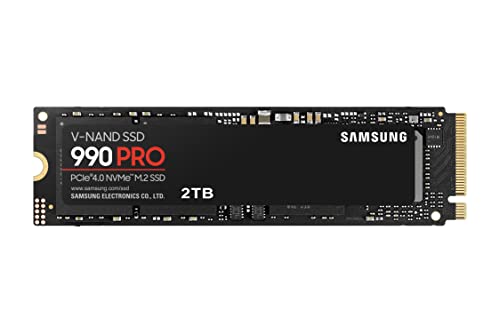
Samsung 990 PRO NVMe M.2 SSD, 2 TB, PCIe 4.0, 7,450 MB/s Read, 6,900 MB/s Write, Internal SSD, for Gaming and Video Editing, MZ-V9P2T0BW
New · Bare or cooling unverified · Stavvy Sales
Amazon prices and images are checked on a 24-hour cycle. Latest offer check: 2026-10-16 23:42:44 UTC. Price and availability may change; Amazon at purchase time controls.
Confirm the exact performance target
Samsung rates the 990 PRO 2TB up to 7,450MB/s sequential read and 6,900MB/s sequential write under its stated test conditions. 'Up to' is not a guarantee that every benchmark preset and platform will reproduce the maximum.
Use the same units and note test size, queue depth, data pattern, free space and whether Intelligent TurboWrite has room to operate.
- Record the benchmark version, profile, test size, interface generation, lane width, free space, temperature and background workload.
- Compare like-for-like results and change one variable at a time instead of chasing the box maximum with repeated stress tests.
Check negotiated PCIe generation and lanes
A PCIe 3.0 x4 host commonly caps sequential throughput around the mid-3,000MB/s range. A two-lane connection lowers the ceiling further even when the slot is marketed as Gen4.
Use Magician or a trusted hardware tool to read the negotiated link, then check the motherboard manual and CPU lane allocation.
- Record the benchmark version, profile, test size, interface generation, lane width, free space, temperature and background workload.
- Compare like-for-like results and change one variable at a time instead of chasing the box maximum with repeated stress tests.
Choose the correct M.2 slot
The fastest slot is often CPU-connected, while another may share chipset bandwidth with networking, SATA or other PCIe devices. Some slots operate differently depending on the installed processor.
Moving the SSD can improve the interface path, but verify boot order, heatsink fit and lane-sharing consequences first.
- Record the benchmark version, profile, test size, interface generation, lane width, free space, temperature and background workload.
- Compare like-for-like results and change one variable at a time instead of chasing the box maximum with repeated stress tests.
Use a controlled benchmark method
Close active games, file synchronization, antivirus scans and virtual machines. Use a known benchmark release and record its profile instead of comparing screenshots from unrelated tests.
Repeat only enough to confirm the result. Endless benchmarks generate heat and writes without improving diagnosis.
- Record the benchmark version, profile, test size, interface generation, lane width, free space, temperature and background workload.
- Compare like-for-like results and change one variable at a time instead of chasing the box maximum with repeated stress tests.
Understand cache and sustained writes
The 990 PRO uses Intelligent TurboWrite. A large transfer can begin near peak speed and slow after available cache is consumed, especially when the SSD is nearly full.
Measure the size and duration of the slowdown. Sustained behavior should not be compared directly with a short peak specification.
- Record the benchmark version, profile, test size, interface generation, lane width, free space, temperature and background workload.
- Compare like-for-like results and change one variable at a time instead of chasing the box maximum with repeated stress tests.
Free space and over-provisioning
Low free space can reduce the controller’s flexibility for garbage collection and dynamic cache. Move temporary data, maintain a backup and retest after the system is idle.
Over-provisioning is not a cure for hardware errors. Use it as workload tuning only after health and stability are confirmed.
- Record the benchmark version, profile, test size, interface generation, lane width, free space, temperature and background workload.
- Compare like-for-like results and change one variable at a time instead of chasing the box maximum with repeated stress tests.
Temperature and throttling
Log temperature during the test. A result that degrades as the drive heats and recovers after cooling supports a thermal explanation.
Verify the thermal pad, heatsink and airflow. Do not stack cooling solutions or bend the SSD under a cover.
- Record the benchmark version, profile, test size, interface generation, lane width, free space, temperature and background workload.
- Compare like-for-like results and change one variable at a time instead of chasing the box maximum with repeated stress tests.
Firmware and controller drivers
Samsung recommends current firmware and Magician. The platform also depends on BIOS, chipset and storage-controller behavior.
Do not install random NVMe drivers or change VMD/RAID mode solely to chase a benchmark number on a boot system.
- Record the benchmark version, profile, test size, interface generation, lane width, free space, temperature and background workload.
- Compare like-for-like results and change one variable at a time instead of chasing the box maximum with repeated stress tests.
Power plans and laptop behavior
Laptops and mini PCs may prioritize battery life and thermal limits. Test while connected to power with the manufacturer’s performance mode only when appropriate.
The integrated-heatsink model often does not fit laptops; use the system’s intended thermal plate and bare configuration.
- Record the benchmark version, profile, test size, interface generation, lane width, free space, temperature and background workload.
- Compare like-for-like results and change one variable at a time instead of chasing the box maximum with repeated stress tests.
Benchmark clues for authenticity
Implausible capacity, a controller identity inconsistent with Samsung, severe sustained collapse and failed Magician authentication together raise counterfeit concern.
A single 6,500MB/s read result does not. Many legitimate host configurations fall below the headline maximum.
- Record the benchmark version, profile, test size, interface generation, lane width, free space, temperature and background workload.
- Compare like-for-like results and change one variable at a time instead of chasing the box maximum with repeated stress tests.
When slowness is actually instability
Event-log errors, resets, blue screens, critical warnings and disappearance move the diagnosis beyond tuning. Back up and use the stability guide.
Do not keep stressing an unstable SSD to obtain a prettier chart.
- Record the benchmark version, profile, test size, interface generation, lane width, free space, temperature and background workload.
- Compare like-for-like results and change one variable at a time instead of chasing the box maximum with repeated stress tests.
Upgrade or keep the drive
A healthy 990 PRO on PCIe 3.0 remains usable but cannot deliver full Gen4 speed. Decide whether the platform will be upgraded before replacing it with another premium SSD.
Compare current prices and complete cooling costs. The best replacement is the one the host can use reliably.
- Record the benchmark version, profile, test size, interface generation, lane width, free space, temperature and background workload.
- Compare like-for-like results and change one variable at a time instead of chasing the box maximum with repeated stress tests.
Official references and methodology
Cloudzat separates confirmed manufacturer facts from diagnosis and marketplace inference. Prices appear only when this plugin’s dedicated catalogue accepts an eligible exact-family 2TB offer. A retailer title, low price, benchmark result or package image is never treated as proof of authenticity by itself.
Frequently asked questions
Why is my 990 PRO around 3,500MB/s?
Does low write speed mean the drive is fake?
Will the 990 PRO increase game FPS?
How much free space should I keep?
Should I enable full performance mode?
Can a chipset slot be slower?
Does Samsung Magician prove a 990 PRO is genuine?
Should I update Samsung Magician before diagnosing the SSD?
Does the 990 PRO 2TB warranty cover data recovery?
Can a PCIe 3.0 slot damage a 990 PRO?
Affiliate disclosure: Cloudzat may earn a commission from qualifying Amazon purchases. The price, condition, seller and availability shown at checkout control the transaction.