


DETECTION DECISION TREE
Samsung 990 PRO Not Detected
Diagnose the layer where detection stops: physical installation, BIOS/UEFI, storage controller, Windows device discovery, Disk Management or file-system visibility. Do not initialize or format a drive that contains needed data.
The correct fix depends on where the drive disappears
A drive absent from BIOS needs a different path from a new blank SSD visible in Disk Management.
Initialization can erase access to existing data
Initializing a truly new empty SSD is normal. If the drive previously held data, appears with an unexpected capacity, or suddenly became unallocated, stop before creating partitions or formatting.
990 PRO detection-stage router
Choose the last place where the SSD is visible and whether it contains important data.
Detection stage and safe next action
| Detection stage | Likely area | Safe next action | Avoid |
|---|---|---|---|
| Not in BIOS/UEFI | Slot, seating, lanes, firmware or hardware | Power down, reseat, check slot manual and BIOS | Formatting tools |
| BIOS sees it; Windows does not | Controller driver, VMD/RAID or OS discovery | Check Device Manager and controller mode | Casually changing storage mode |
| Device Manager sees it; Disk Management does not | Driver or storage stack | Refresh, rescan and review event logs | Third-party partition writes |
| Disk Management shows unallocated new drive | Normal first-use state | Initialize GPT and create a volume | Doing this to a drive with needed data |
Current matching replacement and comparison offers

Samsung Internal SSD 990 2TB, Read/Write Speeds Up to 7,250/6,450 MB/s
New · Bare or cooling unverified · Amazon.com

SAMSUNG Samsung 990 PRO 2TB, 3-bit TLC V-NAND, M.2 (2280), NVMe 2.0, R/W(Max) 7,450MB/s/6,900MB/s, 1,400K/1,550K IOPS, 1200TBW, 5 Years Warranty
New · Bare or cooling unverified · SiliconValleySeller (SN# Recorded)

Samsung 990 PRO 2TB PCIe Gen 4.0 x4 (Maximum Transfer Rate 7,450MB/s) NVMe M.2 (2280) Internal SSD MZ-V9P2T0B-IT/EC
New · Bare or cooling unverified · All About Office

New · Heatsink · Risingstars(Genuine Pro Gaming/Eletronics/Beauty)

Crucial T500 PCIe Gen4 NVMe 2TB SSD, Up to 7,400MB/s, TLC NAND, Laptop & Desktop (PC) Compatible, for Creatives and Gamers, Solid State Drive, Includes 1Mo Adobe CC – CT2000T500SSD8
New · Bare or cooling unverified · SiliconValleySeller (SN# Recorded)

Samsung 990 PRO Heatsink Model, 2TB PS5 Operation Verified, PCIe 4.0 (Max Transfer Rate 7,450 MB/s), NVMe M.2 MZ-V9P2T0G-IT/EC
New · Heatsink · SiliconValleySeller (SN# Recorded)

Crucial T500 2TB PCIe Gen4 NVMe Gaming PS5 SSD with Heatsink, Up to 7,400MB/s, TLC NAND, PlayStation 5 Compatible, Laptop, & Desktop (PC), Solid State Drive, Includes 1Mo Adobe CC – CT2000T500SSD5
New · Heatsink · Blue Orbit Commerce Group

Samsung 2TB 990 PRO with Heatsink PCIe Gen4 NVMe M.2 2280 Up to 7450 MB/s, 6900 MB/s
New · Heatsink · SiliconValleySeller (SN# Recorded)
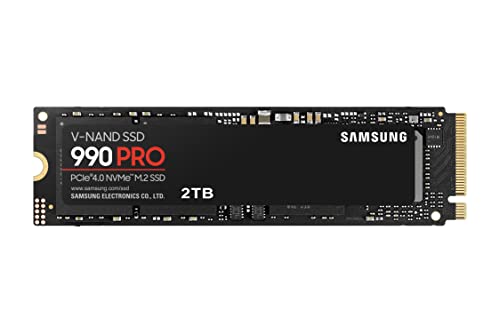
Samsung 990 PRO NVMe M.2 SSD, 2 TB, PCIe 4.0, 7,450 MB/s Read, 6,900 MB/s Write, Internal SSD, for Gaming and Video Editing, MZ-V9P2T0BW
New · Bare or cooling unverified · Stavvy Sales
Amazon prices and images are checked on a 24-hour cycle. Latest offer check: 2026-10-16 23:42:44 UTC. Price and availability may change; Amazon at purchase time controls.
Identify the last successful detection layer
Start in BIOS or UEFI. If the firmware does not list the SSD, Windows partition tools cannot repair that absence. Power down, remove AC power where appropriate and reseat the M.2 module according to the motherboard or system manual.
If BIOS sees the drive, move to Windows Device Manager and Disk Management. This sequence prevents the common mistake of searching for a Samsung driver when the real issue is a disabled slot, lane sharing or an uninitialized blank disk.
- Record the last detection layer, exact slot, controller mode, shown capacity and whether the SSD previously held important data.
- Change one hardware or firmware variable at a time; never initialize or format a previously used drive merely to make it appear.
Check M.2 slot type and lane sharing
The 990 PRO is an M.2 2280 PCIe NVMe SSD, not an M.2 SATA drive. Some motherboard slots accept only one protocol, operate through the chipset, or become disabled when particular SATA ports or PCIe slots are used.
Read the exact board manual. A slot physically accepting the module does not prove that it has four active PCIe lanes or is enabled with the current CPU.
- Record the last detection layer, exact slot, controller mode, shown capacity and whether the SSD previously held important data.
- Change one hardware or firmware variable at a time; never initialize or format a previously used drive merely to make it appear.
Reseat the SSD safely
Shut the system down fully. Remove the SSD, inspect the connector for contamination or damage, insert it at the specified angle and secure it without bending the board. Reinstall the motherboard thermal pad correctly.
Do not stack Samsung’s integrated heatsink under a motherboard M.2 cover. Mechanical pressure or poor contact can create intermittent detection and temperature problems.
- Record the last detection layer, exact slot, controller mode, shown capacity and whether the SSD previously held important data.
- Change one hardware or firmware variable at a time; never initialize or format a previously used drive merely to make it appear.
Use BIOS settings cautiously
Confirm the slot is enabled and the firmware is current enough for the platform. Note whether Intel VMD, RAID or a vendor storage-remapping option is active.
Do not disable VMD or change RAID to AHCI as a casual test on a Windows boot system. The operating system may no longer boot until the correct driver and transition procedure are prepared.
- Record the last detection layer, exact slot, controller mode, shown capacity and whether the SSD previously held important data.
- Change one hardware or firmware variable at a time; never initialize or format a previously used drive merely to make it appear.
Check Windows Device Manager
Look under Disk drives and Storage controllers. A device with an error code, repeated reconnects or an unexpected generic identity points toward the controller or hardware path.
Use Scan for hardware changes and review Windows Event Viewer for NVMe, disk or storport errors. Record events before rebooting repeatedly.
- Record the last detection layer, exact slot, controller mode, shown capacity and whether the SSD previously held important data.
- Change one hardware or firmware variable at a time; never initialize or format a previously used drive merely to make it appear.
Use Disk Management for a new blank drive
Microsoft documents Disk Management as the built-in tool for initializing disks, creating volumes, formatting and assigning drive letters. A new empty SSD can appear as Offline, Not Initialized or Unallocated.
For a modern Windows system, GPT is normally appropriate. Verify the disk number and capacity before writing anything; selecting the wrong disk is destructive.
- Record the last detection layer, exact slot, controller mode, shown capacity and whether the SSD previously held important data.
- Change one hardware or firmware variable at a time; never initialize or format a previously used drive merely to make it appear.
When a previously working drive becomes unallocated
Treat an unexpected RAW, unallocated or zero-capacity state as a data problem, not a normal setup task. Do not create a new volume to make the drive visible.
Capture SMART and controller information if the SSD remains stable, then decide between image-based recovery, specialist recovery and replacement according to data value.
- Record the last detection layer, exact slot, controller mode, shown capacity and whether the SSD previously held important data.
- Change one hardware or firmware variable at a time; never initialize or format a previously used drive merely to make it appear.
Adapters and enclosures add another failure layer
A PCIe adapter needs a suitable slot and may require BIOS bifurcation when it carries multiple SSDs. USB enclosures must support NVMe rather than only M.2 SATA and may hide Samsung Magician functions.
Test directly in a supported motherboard slot when possible before condemning the SSD.
- Record the last detection layer, exact slot, controller mode, shown capacity and whether the SSD previously held important data.
- Change one hardware or firmware variable at a time; never initialize or format a previously used drive merely to make it appear.
PS5 detection has a separate path
A PS5 requires a compatible M.2 NVMe SSD and effective cooling. Confirm the module is fully inserted and the complete heatsink assembly fits Sony’s dimensional limits.
The console formats the SSD during first setup. Do not move a data-bearing PC drive into the PS5 expecting its files to remain accessible.
- Record the last detection layer, exact slot, controller mode, shown capacity and whether the SSD previously held important data.
- Change one hardware or firmware variable at a time; never initialize or format a previously used drive merely to make it appear.
Use the current firmware authority appropriately
Samsung’s current 990 PRO firmware releases include fixes for intermittent non-recognition and blue-screen behavior. Check the existing Cloudzat firmware authority after the drive is stably visible.
Firmware is not the first fix for a drive absent from every system. Establish a reliable direct connection and protect data first.
- Record the last detection layer, exact slot, controller mode, shown capacity and whether the SSD previously held important data.
- Change one hardware or firmware variable at a time; never initialize or format a previously used drive merely to make it appear.
Decide when the SSD itself is suspect
If the 990 PRO is absent in multiple known-good NVMe slots, shows zero capacity or disconnects under light access, hardware failure becomes more likely. Preserve the purchase and serial information.
Do not run repeated heavy benchmarks on an unstable drive containing important data. Each reconnect can reduce the recovery window.
- Record the last detection layer, exact slot, controller mode, shown capacity and whether the SSD previously held important data.
- Change one hardware or firmware variable at a time; never initialize or format a previously used drive merely to make it appear.
Replacement and warranty route
For a new purchase, use the return window when installation and platform checks are complete. For an older drive, review Samsung’s five-year or 1,200TBW limit, seller authorization and proof of purchase.
The dedicated offer catalogue separates clear prices from buying-options listings and fallback searches, but checkout details remain controlling.
- Record the last detection layer, exact slot, controller mode, shown capacity and whether the SSD previously held important data.
- Change one hardware or firmware variable at a time; never initialize or format a previously used drive merely to make it appear.
Official references and methodology
Cloudzat separates confirmed manufacturer facts from diagnosis and marketplace inference. Prices appear only when this plugin’s dedicated catalogue accepts an eligible exact-family 2TB offer. A retailer title, low price, benchmark result or package image is never treated as proof of authenticity by itself.
Frequently asked questions
Does the 990 PRO need a special Windows driver?
Why does BIOS see the drive but File Explorer does not?
Should I initialize a 990 PRO that suddenly became unallocated?
Can Intel VMD hide the SSD from Samsung Magician?
Can an M.2 SATA slot use the 990 PRO?
What if the drive shows zero capacity?
Does Samsung Magician prove a 990 PRO is genuine?
Should I update Samsung Magician before diagnosing the SSD?
Does the 990 PRO 2TB warranty cover data recovery?
Can a PCIe 3.0 slot damage a 990 PRO?
Affiliate disclosure: Cloudzat may earn a commission from qualifying Amazon purchases. The price, condition, seller and availability shown at checkout control the transaction.