


Mechanical parts guide
Top picks
The scanners I would shortlist first
Creality CR-Scan Raptor
Best when fine edges, holes and reverse-engineering geometry matter.
See Amazon optionsEINSTAR 2
Strong for dark surfaces, larger parts and workshop scanning.
See Amazon options3DMakerpro Moose
Value-focused choice for controlled medium-object scanning.
See Amazon optionsBefore you buy
Match the scanner to the object
Object size
small precision components through medium workshop parts.
Surface
machined metal, cast surfaces, black plastic, painted components and mixed finishes.
Detail goal
Prioritize holes, bosses, edges, radii, mating surfaces and relative feature positions.
Output
Plan for reverse engineering, inspection references, CAD reconstruction, replacement parts and 3D printing.
Object checker
Which scanner should I start with?
Choose the closest description of your object and workflow. The result is a practical starting point, not a substitute for checking the exact model specifications.
Shopping options
Current 3D scanners for this use case
Compare the exact model and included items before checkout. Prices and availability can change on Amazon.
Creality CR-Scan Raptor
Mechanical parts and reverse engineering

Creality CR-Scan Raptor 3D Scanner, 60fps Blue Laser & NIR, 0.02mm Accuracy, 24-Bit Color, Scans 5-2000mm Objects, Anti-Shake Tracking for Windows macOS
Mechanical parts and reverse engineering
Seller: CREALITY FALCON Official
Creality Raptor 3D Scanner, 7 Parallel Lines & NIR Scanner for 3D Printing | 0.02mm Accuracy, Up to 60fps Scan Speed, Scan Bridge Support, Full-Color Scanning, Ideal for Reverse Engineering, Automotive
Mechanical parts and reverse engineering
Seller: Creality 3D HYZEINSTAR 2
Reverse engineering, dark surfaces and larger parts

EINSTAR 2 Wireless 3D Scanner, 17 Parallel Lines Blue Laser and VCSEL Infared Light Support 3D Scanning Small to Large Objects, Up to 90 FPS High Speed Scanning, Support 3mm, 6mm, 12mm Markers.
Reverse engineering, dark surfaces and larger parts
Seller: SHINING 3D TECHNOLOGY INC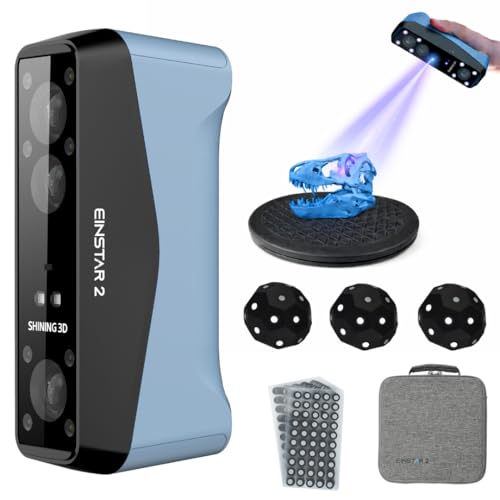
EINSTAR 2 Wireless Handheld 3D Scanner Hybrid | Full-Color Capture, Swappable Battery, EXStar Software
Reverse engineering, dark surfaces and larger parts
Seller: 3D UMAX - Authorized Shining3D Einscan Distributor3DMakerpro Moose
Medium objects and value-focused reverse engineering

3DMakerpro 3D Scanner Moose, Medium-Format 3D Scanners for Printing, Blue Led Light Source, Up to 0.03mm Accuracy, 24-Bit Full-Color Scanning
Medium objects and value-focused reverse engineering
Seller: 3DMakerpro Authorized Store
Moose Scanner, Blue Led Light Technology 3D Scanners for 3D Printing, Ideal for Small-Size Object Scanning, Up to 0.03mm Accuracy, True Color Texture Capture
Medium objects and value-focused reverse engineering
Seller: 3DMakerpro Authorized StoreBuying decision
Which scanner fits this job?
Start with the object, not the scanner. For mechanical parts, decide whether the difficult part of the job is fine detail, surface reflectivity, object size or mobility. The top pick on this page is the strongest general fit, the second recommendation covers a different workflow strength, and the third offers a useful alternative when budget or setup changes. If your project combines multiple object classes, use the chooser below and compare the scanning mode rather than buying from price alone.
At a glance
Compare the recommended scanners
Detailed guide
How to get a better scan for this use case
Why mechanical parts are difficult to scan well
Mechanical parts reward stable geometry, repeatable tracking and clean edges more than photorealistic texture. Typical targets include housings, brackets, pulleys, covers, gears, fixtures, castings and machine components. Those objects do not present one uniform scanning problem: the scanner may move from small precision components through medium workshop parts while also dealing with machined metal, cast surfaces, black plastic, painted components and mixed finishes. A useful buying decision therefore starts with the job you need to complete rather than the largest accuracy number printed on a specification sheet.
For this use case, preserve holes, bosses, edges, radii, mating surfaces and relative feature positions. If those features are lost, a visually smooth mesh can still be useless for reverse engineering, inspection references, CAD reconstruction, replacement parts and 3D printing. The best scanner is the one that can repeatedly hold tracking over the important geometry in a controlled bench or workshop setup where the part can be repositioned deliberately, not simply the model with the most aggressive marketing claim.
The specifications that matter most
Accuracy, resolution and capture volume describe different things. For mechanical parts, accuracy helps with the relationship between features, resolution affects the smallest surface changes that reach the mesh, and object range determines whether the scanner can cover small precision components through medium workshop parts without forcing an awkward working distance. Treat all three as a system rather than choosing from one headline number.
Light source is equally important because this page deals with machined metal, cast surfaces, black plastic, painted components and mixed finishes. Blue-laser and hybrid systems can behave differently from infrared structured-light scanners, especially when the target is dark or reflective. Software, tracking recovery, export options and the computer or standalone hardware required to process the scan can affect the result as much as the optical specification.
How to choose among the recommended scanners
The three recommendations on this page cover different priorities. Choose the first pick when the central goal is holes, bosses, edges, radii, mating surfaces and relative feature positions. Move toward the more portable option when your real limitation is a controlled bench or workshop setup where the part can be repositioned deliberately. Choose the value option when the object can be controlled, repositioned and prepared carefully enough that you can trade some workflow convenience for a lower purchase price.
Do not assume the same scanner must handle every part of a project. A broad scanner can capture the overall form of mechanical parts, while a smaller-detail scanner or direct caliper measurement may still be better for one mating feature. Combining tools is often more reliable than forcing a single mesh to carry every design decision.
Preparing mechanical parts before the first scan
Clean the part, remove oil, decide which faces define the important dimensions, and support it so you can capture hidden geometry without deforming it. Good preparation shortens scanning time because the software spends less effort trying to recover from avoidable movement, glare or missing geometry.
Before capture, decide which regions will define the final model. Mark them mentally or in a photo, then plan orientations that expose those areas. Keep the setup consistent between passes. For mechanical parts, a few minutes spent controlling the object and background usually saves far more time than trying to repair a badly aligned mesh later.
Markers, spray and difficult surfaces
Markers are especially useful on large smooth castings, cylinders and repeated features where tracking can drift. Markers are tracking aids, not a substitute for useful geometry. Keep them away from the precise edges or surface details you need to reconstruct.
A temporary matte spray is often worth using on polished, black or reflective metal when dimensional capture matters more than preserving the original appearance during the scan. Surface treatment should solve a specific capture problem. If the scanner already holds tracking and returns clean geometry, adding coating or extra markers only increases preparation and cleanup.
A capture workflow that produces cleaner geometry
Capture datum-rich areas first, maintain overlap, then rotate the part or scanner to expose recesses and underside geometry. Keep separate passes aligned to features that are mechanically meaningful. Watch the live tracking view rather than only the growing mesh; loss of correspondence is easier to correct immediately than after a long pass has been recorded.
Use enough overlap that each new region connects to geometry the software already understands. For mechanical parts, deliberately capture edges, holes or landmarks from more than one angle. When the object has a hidden face, plan a separate orientation and align it through shared geometry instead of stretching one pass into an impossible viewing angle.
Cleaning the scan without destroying useful detail
After capture, remove floating fragments and obvious background geometry first. Then inspect the regions that matter for holes, bosses, edges, radii, mating surfaces and relative feature positions. Heavy smoothing can make a mesh look professional while rounding exactly the edges or relief needed for reverse engineering, inspection references, CAD reconstruction, replacement parts and 3D printing. Keep an untouched copy of the raw or minimally processed scan before aggressive cleanup.
If alignment is weak, return to the source passes before sculpting over the error. A clean-looking mesh built on bad registration is difficult to trust. For repeatable projects, save the scanner settings, working distance and preparation method that produced the best result so later scans of similar mechanical parts do not start from zero.
From scan to CAD or a 3D-printable model
A scan mesh is not automatically an editable engineering model. For reverse engineering, inspection references, CAD reconstruction, replacement parts and 3D printing, decide whether you need a watertight mesh, a surface reference or rebuilt parametric CAD. Functional geometry such as holes, threads, planar faces and symmetry is often better recreated from the scan than accepted directly from millions of mesh triangles.
When the destination is 3D printing, repair non-manifold areas, check wall thickness and verify scale before slicing. When the destination is CAD, use the mesh as a reference and rebuild critical features around measured dimensions. This hybrid approach is especially important when holes, bosses, edges, radii, mating surfaces and relative feature positions determine fit.
Common mistakes and how to avoid them
Typical failures include treating mesh detail as dimensional accuracy, losing tracking on rotational symmetry, missing the back side of a flange, and converting a noisy mesh directly into CAD without rebuilding critical geometry. The fix is usually to improve capture conditions or divide the job into smaller controlled passes, not to increase smoothing after the fact.
Another mistake is treating every numeric specification as directly comparable across brands and modes. A scanner may quote excellent local accuracy in one mode while your actual mechanical parts workflow depends on tracking stability, scan volume, surface response and software. Use the recommendations as starting points, then validate the exact object class you expect to scan most often.
When a phone or photogrammetry may be enough
Photogrammetry and phones can work for coarse shape, but mechanical reverse engineering usually benefits from a dedicated scanner when tolerances and feature location matter.
Choose the simpler method when you mainly need visual documentation, approximate scale or a one-off reference. Move to a dedicated scanner when repeated projects, holes, bosses, edges, radii, mating surfaces and relative feature positions, difficult machined metal, cast surfaces, black plastic, painted components and mixed finishes or the need for reverse engineering, inspection references, CAD reconstruction, replacement parts and 3D printing makes failed captures expensive. The practical threshold is not whether a phone can make a 3D model; it is whether that model is dependable enough for your next step.
Buyer questions
Frequently asked questions
What is the best 3D scanner for mechanical parts?
For mechanical parts, Creality CR-Scan Raptor is the best all-round starting point because its laser mode suits edges, holes and tighter geometry. EINSTAR 2 is the stronger workshop choice for dark or larger components, while 3DMakerpro Moose is the value option for medium parts when you can control the setup and surface preparation.
How accurate should a scanner be for mechanical parts?
It depends on the output. If the scan is mainly for visualization, overall shape and stable tracking can matter more than the smallest stated accuracy figure. If holes, bosses, edges, radii, mating surfaces and relative feature positions control fit or CAD reconstruction, choose a scanner and workflow that preserve those features and confirm important dimensions with direct measurement.
Do I need scanning spray for mechanical parts?
A temporary matte spray is often worth using on polished, black or reflective metal when dimensional capture matters more than preserving the original appearance during the scan. Start without spray when the surface already scans cleanly, then introduce treatment only where reflections or low signal repeatedly break the capture.
Do I need markers when scanning mechanical parts?
Markers are especially useful on large smooth castings, cylinders and repeated features where tracking can drift. A scanner that tracks reliably from natural geometry does not need markers everywhere.
Can I turn the scan directly into a 3D print?
Often, but inspect the mesh first. Remove unwanted geometry, close holes, confirm scale and check wall thickness. For functional mechanical parts, rebuild or verify critical interfaces rather than assuming the raw mesh is print-ready.
Can I use the scan for CAD and reverse engineering?
Yes, but the mesh normally serves as a geometric reference rather than a finished parametric model. Rebuild planes, cylinders, holes, symmetry and other design features around the scan, especially where holes, bosses, edges, radii, mating surfaces and relative feature positions matter.
Is a phone good enough instead of a dedicated 3D scanner?
What should I check before buying a scanner?
Check the object-size range, surface behavior, required computer or standalone workflow, export formats, included accessories and the exact Amazon listing. Make sure you are buying the scanner itself rather than a case, turntable, marker kit, spray or other accessory.
Manufacturer references
Specifications can vary by scanning mode, software version and bundle. Confirm the exact model and included items before buying.