


UK BUYING GUIDE
EcoFlow’s official UK specs page separates the family cleanly: DELTA 3 Max is the standard model and DELTA 3 Max Plus is the higher-capability variant. The distinction matters because the standard unit is 2048Wh with 2400W continuous AC output, while the Plus is 2048Wh with 3000W continuous AC output; the marketing headline for the family should not be mistaken for the standard model’s actual continuous rating.
For UK buyers, both units are 230V products, but they are not identical in what they can support. The standard Max has 4800W surge, 500W solar input, and no extra-battery expansion path, while the Plus has 6000W surge, 1000W solar input, and expansion to up to 10kWh with two DELTA Pro 3 extra batteries. That means the Plus is the right choice only when you truly need the extra headroom or future growth.
If your need is mostly electronics backup, the smaller DELTA 3 Plus and RIVER 3 Plus are the more relevant alternatives. DELTA 3 Plus sits in a lighter 1024Wh, 1800W class with 1000W PV input, while RIVER 3 Plus is the compact UPS-style option at 286Wh and 600W output with fast switchover. Those are better matches when you do not need the mass or power envelope of the DELTA 3 Max family.
Our recommendation
Buy the standard EcoFlow DELTA 3 Max if you want the simplest high-capacity UK option in this family and you do not need battery expansion. It gives you 2048Wh, 2400W continuous output, 4800W surge, 500W solar input, and a 20.3kg form factor, which is enough for serious mixed-load backup without stepping into a larger modular system.
Buy the DELTA 3 Max Plus only if you can name the reason: higher continuous output, more solar input, or a genuine plan to expand later. The Plus is 2048Wh, 3000W continuous, 6000W surge, 1000W solar, 22.1kg, and expandable to up to 10kWh; that is a real upgrade, but it is not the default recommendation for every buyer.
Do not size the purchase around X-Boost alone. EcoFlow lists X-Boost separately from continuous AC output, at 3200W for the standard Max and 3900W for the Plus, so it is a compatibility aid rather than the normal rating you should plan around. If your appliance mix needs continuous power, the continuous AC figure is the number that matters.
EcoFlow DELTA 3 family
Compare the exact named model with the guide. Other DELTA 3 versions are alternatives, not the DELTA 3 Max itself.

EF ECOFLOW DELTA 3 Max Portable Power Station, 2048Wh LiFePO₄ Battery | 2400W X-Boost Output, Ultra-Fast 0–80% Charging in 51 mins, Solar Generator for Home Backup, Power Outages, RV & Outdoor Use
£1,199.00
Last verified 2026-11-28 08:53:37 UTC

EF ECOFLOW DELTA 3 Max Plus Portable Power Station, 2048Wh LiFePO₄ Battery | Expandable Capacity Up to 10kWh, 3000W AC Output, 0–80% Fast Charge in 47 min, 10ms UPS Backup, Solar Generator for Home
£1,399.00
Last verified 2026-11-28 08:53:37 UTC
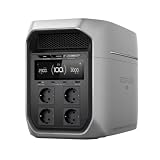
EcoFlow Delta 3 Max Plus Power Station 2048 Wh - 3000W LiFePO4 | Solar Generator with Dual PV, USV
£1,705.39
Last verified 2026-11-28 06:30:54 UTC

Ecoflow Delta 3 Plus Portable Power Station One Size
£980.06
Last verified 2026-11-28 08:15:49 UTC
As an Amazon Associate, Cloudzat earns from qualifying purchases. Price and availability may change; Amazon checkout controls the purchase price.
What to buy for your needs
Start with the continuous AC rating, not the headline family name
The most important correction is to keep the ratings separate. The standard DELTA 3 Max is 2400W continuous, while the Plus is 3000W continuous. The family marketing can make the line look like one 3000W product, but that is only true of the Plus; the standard model is lower, and that is the number you must use when checking whether your appliances will run.
Match the inverter to your actual appliance mix
If your load is routers, laptops, monitors, lights, charging, and a modest fridge or similar household items, the standard Max is usually enough. If you expect several heavier appliances at once, or you want more comfort margin for start-up surges, the Plus is safer because it gives you more continuous wattage and more surge headroom. That is the practical difference that matters more than the shared 2048Wh capacity.
Treat expansion as a real feature, not a generic promise
The standard DELTA 3 Max does not have the Plus’s expansion path, so it is the better choice if you want a closed, self-contained unit. The Plus can grow with extra batteries up to 10kWh, which makes sense if you are building toward longer outages or a larger backup setup. If you do not already know that you need expansion, do not pay for the option just because it exists.
Use 230V compatibility as a UK baseline, not a guarantee for every device
Both models are listed as 230V products for the UK market, so they are intended for standard UK mains use. That does not mean every appliance is automatically suitable: you still need to respect continuous wattage, surge demand, and the fact that a portable power station is an inverter with sockets, not a fixed household circuit.
Use runtime maths, then discount it for real-world losses
A useful estimate is to treat usable energy as about 85% of the rated capacity, then divide by the load. Example estimate at 85% conversion: 2048Wh × 0.85 ÷ 100W = about 17.4 hours. That is only a planning estimate; standby losses are variable, and actual runtime will shift with inverter overhead, temperature, battery condition, and how the appliance behaves over time.
Capacity, compatibility and ownership
Exact spec split for the two UK models
EcoFlow’s UK specs page gives the cleanest comparison. DELTA 3 Max: 2048Wh, 2400W AC output, 4800W surge, 3200W X-Boost, 500W solar charging, no extra-battery expansion. DELTA 3 Max Plus: 2048Wh, 3000W AC output, 6000W surge, 3900W X-Boost, 1000W solar charging, and up to 10kWh with two DELTA Pro 3 extra batteries.
Weight and portability
The standard unit is listed at approximately 20.3kg and the Plus at approximately 22.1kg. That difference is not huge, but it is real once you factor in storage, lifting, and moving the unit between rooms or vehicles. In practical terms, both are movable power stations rather than casually portable devices.
Why X-Boost should not drive the recommendation
EcoFlow lists X-Boost as a separate maximum output line, which is exactly why it should not be confused with continuous output. The standard Max’s 3200W X-Boost figure does not turn the unit into a 3200W continuous machine, and the Plus’s 3900W X-Boost does not make it a 3900W continuous machine either. Use X-Boost as a compatibility note, not as the basis for sizing every appliance in the house.
How the family fits into EcoFlow’s UK range
The Max family sits above the lighter DELTA 3 Plus and above the compact RIVER 3 Plus. That positioning is important: DELTA 3 Plus is a 1024Wh, 1800W unit with 1000W PV input, so it is better for lighter backup needs; RIVER 3 Plus is a 286Wh, 600W unit with <10 ms switchover, so it is a specialist for desk and networking backup rather than broader appliance support.
Which option should you choose?
Best default: EcoFlow DELTA 3 Max
Pick this if you want the cleanest all-round purchase in the family and you do not need battery expansion. It is the better default because it keeps the shared 2048Wh capacity but avoids paying for the Plus’s extra output and modular growth that many buyers will never use.
Best upgrade path: EcoFlow DELTA 3 Max Plus
Pick this if you know you need the stronger inverter, the larger solar input, or the ability to build up to 10kWh later. It is the right answer for users planning longer outages, larger appliance mixes, or a more ambitious backup setup that benefits from extra headroom.
Best compact alternative: EcoFlow RIVER 3 Plus
Pick this if your real problem is keeping low-wattage electronics alive cleanly and quietly. The RIVER 3 Plus is much smaller, much lighter, and designed around fast UPS-like switchover, so it is the more sensible choice for routers, desktop setups, and light home-office backup.
NAS options on Amazon
Compare the NAS model, drive bays, included disks and supported applications before buying. Keep using your existing NAS if it already meets the guide’s requirements.
Checking current Amazon listings…
As an Amazon Associate, we earn from qualifying purchases. Prices and availability can change; Amazon’s checkout price applies.
Questions answered
Is the standard model really 2400W and not 3000W?
Yes. EcoFlow’s UK specs page lists DELTA 3 Max at 2400W continuous AC output and DELTA 3 Max Plus at 3000W. The 3000W figure belongs to the Plus, not the standard model.
Does the standard DELTA 3 Max have extra-battery expansion?
No. The official specs list no extra-battery ports and no compatible extra battery for the standard Max, while the Plus is expandable to up to 10kWh.
Should I rely on X-Boost for all appliances?
No. X-Boost is listed separately from continuous AC output, so it should be treated as a limited compatibility feature, not as the universal rating for every appliance or every sustained load.
What is the best lower-cost or smaller alternative?
Use DELTA 3 Plus if you want a smaller but still capable EcoFlow option at 1024Wh and 1800W output. Use RIVER 3 Plus if you mainly need compact electronics backup, because its 286Wh capacity and 600W output make it the specialist choice for that job.
Sources and further detail
- EcoFlow UK official specs: DELTA 3 Max Plus Portable Power Station — Primary source for the exact UK spec split between DELTA 3 Max and DELTA 3 Max Plus, including capacity, continuous output, surge output, X-Boost, solar input, weight, 230V UK operation, and expansion limits.
- EcoFlow UK official product page: DELTA 3 Series Portable Power Station — Official source for DELTA 3 Plus as the smaller alternative, including its 1024Wh capacity, 1800W output, and 1000W PV input.
- EcoFlow UK official product page: RIVER 3 Plus Portable Power Station — Official source for RIVER 3 Plus as the compact backup alternative, including 286Wh capacity, 600W output, and fast UPS-style switchover.