


UK BUYING GUIDE
Buy the Anker SOLIX C1000 Gen 2 for a balanced mix of camping, device charging and short backup of household essentials. Its 1,024Wh battery and 2,000W continuous output make it our default UK choice. Choose the C2000 Gen 2 when longer runtime matters more than carrying weight, or the compact C300X AC when you mainly need laptops, phones, lights and camera equipment.
Capacity and output solve different problems. The C2000 Gen 2 has a 2,048Wh battery and 2,400W continuous output; the smaller C300X AC has 288Wh and a 300W AC limit. A larger battery extends runtime, while the output rating sets the load it can run. A 3,000W kettle exceeds both Gen 2 models' continuous ratings, so choose a lower-wattage kettle rather than relying on a peak-output headline. Real runtime is lower than battery watt-hours divided by load because conversion and idle power consume energy.
Buy the UK 230V version for British plug-in appliances. C300X AC and C300X DC are different purchases: the DC model has no household mains socket. The S2000 is another 2kWh-class choice for longer essential-device backup; our preferred larger all-rounder remains C2000 Gen 2, which also has a manufacturer-supported expansion battery. For fixed home circuits, use a professionally designed backup connection; never feed a wall socket from the station.
Our recommendation
For most UK buyers, the C1000 Gen 2 is the best default Anker SOLIX pick because it is the current 1kWh-class model, it offers 2,000W output, and it sits in the sweet spot between portability and practical appliance support. It is the model to reach for if you want a capable all-rounder for camping, road trips, occasional home backup, or running a sensible mix of everyday essentials without moving into bulky 2kWh territory.
Choose the C2000 Gen 2 when your needs are clearly larger: longer runtime, more simultaneous loads, heavier kitchen or workshop demands, or a more serious home-backup buffer. Its 2,048Wh capacity and 2,400W output make it the stronger choice when you do not want to compromise on endurance or appliance compatibility. If you need a smaller, lighter unit for phones, laptops, lights, camera gear, or short outings, the C300X is the right family to look at. If your priority is long runtime at lower output rather than the most compact system, the S2000 can still make sense, for essential-device backup rather than high-draw cooking appliances.
Anker SOLIX power stations
Choose a UK 230V station. Capacity, sustained output and socket type matter more than a headline peak figure.
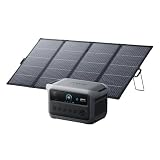
Anker SOLIX C2000 Gen 2 Portable Power Station 400W with Dual-Sided Solar | 2,400W (Peak 4,000W) Solar Generator, Full Charge in 58 Minutes, 2,048Wh LiFePO4 Battery, for Home Backup, Power Outages
£2,211.57
Last verified 2026-11-29 02:16:38 UTC

Anker SOLIX S2000, 2010Wh 1500W Power Station, 10ms UPS, Home Backup | LiFePO4 Battery, Peak 3000W, Up to 24-Hour Family Backup, 400W Solar Input, for Home, Outdoor & Emergencies
£849.00
23% off · Amazon reference price £1,099.00
Last verified 2026-11-29 08:20:36 UTC
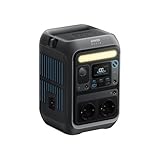
Anker SOLIX C300X Portable Power Station 288Wh | 600W
£319.16
Last verified 2026-11-28 19:03:08 UTC
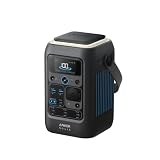
Anker SOLIX C300X DC Portable Power Station & Power Bank, 288Wh | 288Wh LiFePO4 Battery, 300W Solar Generator, for Camping, Outdoors, Travel & Emergency (No Wall Adapter Included)
£189.00
Last verified 2026-11-29 10:58:06 UTC
As an Amazon Associate, Cloudzat earns from qualifying purchases. Price and availability may change; Amazon checkout controls the purchase price.
What to buy for your needs
Start with the load, not the battery size
The most useful first question is not how many watt-hours you want, but what you want to power. A kettle, microwave, hair dryer, induction hob, or other high-draw appliance changes the decision completely compared with laptops, Wi-Fi, lighting, or a fridge cycling on and off. In practical terms, capacity governs how long you can run something, while inverter output governs whether you can run it at all.
That is why the C1000 Gen 2 and C2000 Gen 2 should be read as two different answers, not one larger-or-smaller version of the same idea. The C1000 Gen 2 gives you 1,024Wh and 2,000W; the C2000 Gen 2 gives you 2,048Wh and 2,400W. The second model is not just a bigger battery. It is a more capable platform for sustained use, especially if you want to keep more than one appliance running at once or avoid running out of headroom when a load surges.
Match the format to the kind of use you actually have
Portable power stations are often bought for two very different jobs: living out of a van or tent, and backing up selected household essentials. Those use cases overlap, but they do not need the same product. A compact 288Wh station is sensible when weight and convenience matter more than runtime. A 1kWh class station is the balanced choice for mixed portable and backup use. A 2kWh class station is better when endurance and output headroom matter more than easy carrying.
The C300X family is the obvious fit when you want a small battery for short trips, device charging, or lightweight outdoor work. The C1000 Gen 2 fits the middle ground. The C2000 Gen 2 moves you into longer sessions and more serious emergency use. The S2000 should be treated as a specialist long-runtime option rather than the default recommendation, because its role is narrower than the current Gen 2 mains-output models.
Treat compatibility as a separate decision from capacity
In the UK, a portable power station must still be compatible with your devices and with the kind of use you have in mind. If you need AC sockets for household plug-in appliances, choose an AC model. If you only need direct DC-style device charging and want to minimise size and complexity, a DC-only model may be enough. This is why it is important not to conflate the C300X AC and C300X DC variants.
Compatibility also includes the output limit, the number of sockets you actually need, and whether you are using the unit as a standalone portable battery or as part of a professionally installed home-backup setup. The larger Gen 2 models can make sense for emergency household use, but they are not a substitute for proper installation if you intend to feed home circuits or use them in a fixed backup arrangement.
Capacity, compatibility and ownership
Direct named recommendations
Best default choice: Anker SOLIX C1000 Gen 2. This is the most balanced current UK model for buyers who want one power station to do many jobs. Its 1,024Wh capacity and 2,000W output are enough for a wide range of common portable and backup scenarios without becoming cumbersome. It is the model we recommend to most first-time buyers if they want one sensible all-round unit.
Best larger-capacity choice: Anker SOLIX C2000 Gen 2. This is the better pick when runtime, appliance headroom, and backup resilience matter more than size. The UK listing shows 2,048Wh capacity, 2,400W continuous output, peak output up to 4,000W, and expansion support up to 4kWh. That combination makes it the strongest current option for buyers who know they need more than a 1kWh class unit.
Best compact choice: Anker SOLIX C300X. The UK range lists the C300X at 288Wh and 300W. That is ideal for light portable use, not for big appliances. Choose it when you care about easy carrying, simple charging of smaller devices, and occasional outdoor use. If you want the same class but no AC mains output, the C300X DC is the variant to consider instead of assuming the AC model and the DC model are interchangeable.
Special-case choice: Anker SOLIX S2000. This is only worth choosing when the use case is specifically long runtime at lower output, for small continuous loads such as networking, lights and device charging. It should not replace the C1000 Gen 2 as the default recommendation, because the newer Gen 2 model is the clearer all-round mainstream choice in the current UK lineup.
Capacity and output decisions
A simple way to choose is to think in three bands. Under 1kWh is for light duty. Around 1kWh is the balanced tier. Around 2kWh is for extended runtime and broader appliance support. If you stay in the light-duty band, do not buy more than you need just because the number is larger. Extra capacity only helps if you use it, and bigger systems are heavier and less convenient to move.
On the output side, the gap between 300W and 2,000W is enormous. The C300X can handle smaller electronics and modest loads, but it is not the right answer for kitchen appliances or most household backup roles. The C1000 Gen 2 is a true general-purpose station for many plug-in appliances and mixed loads. The C2000 Gen 2 is the more comfortable option when you want to stay away from the edge of the inverter’s capability and preserve more flexibility as your needs grow.
If you are comparing the C1000 Gen 2 with the older C1000, the Gen 2 is the current default reference. The UK collection lists the older C1000 at 1,056Wh and 1,800W, with a different capacity/output balance. For current buying guidance, that means the newer Gen 2 model should be the one used as the baseline unless you are specifically comparing legacy stock or refurbished inventory.
Compatibility, expansion, and UK usage notes
The UK market uses 230V mains, so buyers should think in terms of ordinary UK appliance compatibility and the inverter’s actual AC output capability. Do not assume every device that plugs into a wall socket is automatically appropriate for portable power use. High-startup appliances and continuous high-draw appliances need more careful checking than phones, laptops, routers, or LED lighting.
Expansion should only be considered where the manufacturer explicitly supports it. The C2000 Gen 2 UK page states that capacity can be expanded with the BP2000 (Gen 2) Expansion Battery, and that the expanded system can reach up to 4kWh. Do not assume expansion on models where the manufacturer does not state it. The C1000 Gen 2 product page shows solar bundles and AC charging information, but the current UK material you should rely on does not make the C2000-style expansion claim for the C1000 Gen 2.
For solar charging, the safest rule is to use the exact bundle or panel compatibility stated by the manufacturer for the specific model. Current UK listings show C1000 Gen 2 bundles with PS100, PS200, and a 400W portable solar panel option, and C2000 Gen 2 bundles with 200W, 2×200W, and 400W solar combinations. That is enough to confirm that panel pairing is model-specific, not universal.
Practical runtime guidance
Runtime depends on the actual watt draw, inverter overhead, and the way the load behaves over time. A battery’s watt-hour rating is not the same as hours of real-world use. A fridge cycling intermittently is very different from a heater drawing continuously. A laptop charging session is very different from a power tool under load. Always think in terms of the equipment you actually intend to run.
Losses also matter. AC conversion is not free, and the apparent runtime on paper will usually be higher than the runtime you see in real use. That is normal and should be expected. If a manufacturer headline mentions a specific backup duration, treat that as scenario-based guidance rather than a universal promise.
For that reason, the right buying approach is to choose enough margin above your minimum need. If you think 1kWh might be enough but your loads are variable, the C1000 Gen 2 is usually the better place to start than the C300X. If you know your use will be extended, the C2000 Gen 2 is usually the more comfortable long-run purchase than trying to stretch a smaller battery to its limits.
Which option should you choose?
Choose C1000 Gen 2 if…
You want the best all-round current UK Anker SOLIX portable power station. You need a balance of size, output, and portability. You may use it for camping, road trips, tool charging, router backup, or everyday household essentials. You want a current model rather than an older legacy C1000.
This is also the best starting point if you are not yet sure how often you will rely on the station. It is large enough to be useful, but not so large that it becomes awkward for frequent transport.
Choose C2000 Gen 2 if…
You already know you need more capacity. You want longer runtime and more output headroom. You may be planning for household backup, heavier appliance use, or longer off-grid sessions where the station cannot be recharged quickly. You are comfortable carrying a larger and heavier unit in exchange for more capability.
If you expect to add capacity later, this is the model with an official UK expansion path. That makes it the more future-oriented choice within the current portable line.
Choose C300X AC or DC if…
Your needs are light and you value compactness above all else. You are charging phones, tablets, cameras, laptops, lights, or small accessories. You want the portability of a smaller power station without paying for capacity you do not need. You understand that 300W is a very limited ceiling and that this is not a substitute for the larger Gen 2 models.
Pick AC if you want mains-style flexibility. Pick DC if you want the simpler non-AC variant and you know your devices fit that format.
Choose S2000 only if…
You need a 2kWh-class battery for long sessions with networking, lighting and other smaller loads. The S2000 may still fit a niche, but it should not be the default answer for most buyers looking at the current Anker SOLIX UK range.
If you are unsure, the safer and clearer recommendation is usually the C1000 Gen 2 for balanced use or the C2000 Gen 2 for larger, longer-running needs.
NAS options on Amazon
Compare the NAS model, drive bays, included disks and supported applications before buying. Keep using your existing NAS if it already meets the guide’s requirements.
Checking current Amazon listings…
As an Amazon Associate, we earn from qualifying purchases. Prices and availability can change; Amazon’s checkout price applies.
Questions answered
Is the C1000 Gen 2 now the default Anker SOLIX recommendation in the UK?
Yes. In the current UK range it is the clearest balanced all-rounder, with 1,024Wh capacity and 2,000W output, while the original C1000 has a different 1,056Wh battery and 1,800W output.
How different is the C2000 Gen 2 from the C1000 Gen 2?
The C2000 Gen 2 roughly doubles the battery capacity and increases output to 2,400W. That makes it better for longer runtime, heavier loads, and more serious backup use.
Is the C300X enough for a home backup setup?
Usually not for meaningful whole-home or heavy-appliance backup. It is best treated as a compact portable station for light loads and small devices.
Can I use these power stations with home wiring?
Only with the correct professional installation and safety provisions. A portable power station should not be treated as a simple plug-and-play replacement for proper home backup wiring.
Does runtime equal the watt-hours on the box?
No. Real runtime depends on the actual appliance draw, inverter losses, and how the load behaves over time.
Should I choose the S2000 over the C1000 Gen 2?
Choose it for longer backup of smaller essential devices. For most buyers, the C1000 Gen 2 is the clearer default choice.
Sources and further detail
- Anker SOLIX UK Portable Power Stations collection — Current UK lineup, current models, and official capacities/output for C1000 Gen 2, C2000 Gen 2, C300X, plus legacy C1000 visibility.
- Anker SOLIX UK C1000 Gen 2 product page — Official C1000 Gen 2 1,024Wh / 2,000W specification, 49-minute recharge claim, AC charging and bundled solar options.
- Anker SOLIX UK C1000 Gen2 overview page — Official C1000 Gen 2 product identity and recharge positioning.
- Anker SOLIX UK C2000 Gen 2 overview page — Official C2000 Gen 2 product identity and current UK positioning.
- Anker SOLIX UK C2000 Gen 2 product and expansion page — Official C2000 Gen 2 2,048Wh / 2,400W specification, peak output, expansion support up to 4kWh, and FAQ details.
- Anker SOLIX UK S2000 product page — Official UK S2000 existence and product positioning as a 2kWh-class portable power station.
- Anker SOLIX UK C300X product page — Official C300X 288Wh / 300W product listing and variant separation from other C300 models.
- Anker SOLIX UK C300 DC product page — Official C300 DC 288Wh / 300W product listing and DC-only variant existence.