


UK BUYING GUIDE
PLA is the easiest default filament for most FDM 3D printers. It prints at relatively low temperatures, does not usually need an enclosure, and is widely available in 1.75 mm spools, which is why it is the safest first purchase for most hobbyists. The practical catch is that PLA is a family of products rather than one identical material: standard PLA, matte PLA and PLA+ can behave differently, even when they all look similar on the box.
For a UK buyer, the useful questions are simple and concrete: does your printer take 1.75 mm or 2.85 mm filament; do you want a glossy, matte or speciality finish; do you care more about colour consistency or toughness; and do you need an ordinary spool or a refill format. Manufacturer pages and technical sheets for Prusament, Polymaker and eSUN show that PLA is broadly easy to print, but the exact formulation still matters for surface finish, handling and recommended settings.
The sensible buying rule is to match the filament to the job. Use standard PLA for general prints, matte PLA for display pieces where you want a softer appearance, and PLA+ when you want a bit more resistance to handling. If the part needs to survive high temperatures, outdoor exposure or repeated stress, move to a different material family instead of expecting PLA to do everything.
Our recommendation
Default recommendation: Prusament PLA, 1.75 mm, 1 kg spool. Prusament’s own material page describes it as easy to print and low-warping, and its technical sheet lists 1.75 ± 0.02 mm diameter, a 210 ± 10 °C nozzle range, a 40–60 °C bed and up to 200 mm/s print speed. That makes it a sensible default for UK buyers who want a conventional PLA with clear published settings and tight dimensional control.
If you already know you want a softer, less glossy finish, choose Polymaker Panchroma Matte PLA instead. Polymaker says this is the current name for the former PolyTerra PLA line, so older reviews may still use the old branding. It is the better pick when visual finish matters more than a shiny surface.
Choose eSUN PLA+ if your prints will be handled more often, clipped together, or used as light-duty functional parts. eSUN positions it as stronger and tougher than standard PLA, with smoother printing and reduced filament breakage. It is still PLA in the important sense that heat resistance remains limited, so it is not a substitute for a higher-temperature filament family.
Skip PLA entirely when the part must live in heat, sun or heavy mechanical stress. Prusament explicitly notes low-temperature resistance as a limitation, and its own guidance says parts begin to lose strength above about 60 °C. That is fine for figures, organisers and prototypes, but it is not the right material for hot cars, radiators, outdoor use or stressed brackets.
PLA filament options
Choose the filament diameter your printer takes, normally 1.75mm for the printers discussed here. Refill spools may need a compatible reusable spool.
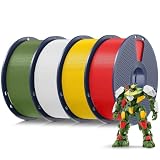
SUNLU 4KG PLA Filament 1.75mm, White+Red+Yellow+Olive Green | Dimensional Accuracy +/- 0.02mm, Neatly Wound 3D Printer Filament 1KG Spool (2.2lbs) Fits for Most FDM 3D Printers
£30.68
19% off · Amazon reference price £37.99
Last verified 2026-11-28 09:42:17 UTC

ELEGOO PLA 3D Printer Filament 1.75mm Grey 2KG, Easy to Use, Durable | Dimensional Accuracy +/- 0.02mm, 2pcs 1kg Spools(2.2lbs), Fit Most FDM 3D Printers, Vacuum-Sealed, No Clogging, Tangle‑Free
£21.23
15% off · Amazon reference price £24.98
Last verified 2026-11-28 09:42:17 UTC

ELEGOO PLA Basic Refill 3D Printer Filament 1.75mm Bundle 4KG, Easy Storage | Black/ White/ Red/ Cobalt Blue, Multicolours 3D Printer Filament No Spool, Dimensional Accuracy +/- 0.02mm, Vacuum-Sealed
£31.44
21% off · Amazon reference price £39.96
Last verified 2026-11-28 09:42:17 UTC

Creality Ender PLA 3D Printer Filament 1.75mm, 4 Packs 1KG Spool(2.2lbs), Dimensional Accuracy +/-0.03mm, Fits for Most FDM 3D Printers (Black+White+Red+Blue)
£32.29
19% off · Amazon reference price £39.99
Last verified 2026-11-28 09:30:23 UTC
As an Amazon Associate, Cloudzat earns from qualifying purchases. Price and availability may change; Amazon checkout controls the purchase price.
What to buy for your needs
Start with the print job, not the brand name
Most PLA buying mistakes start with colour choice instead of project choice. A better approach is to decide what the object needs to do. For display models, decorative items, desk gadgets and prototypes, a standard PLA is usually enough. For smoother-looking show pieces, a matte PLA can hide layer lines better. For parts that will be touched, assembled or gently flexed, a PLA+ type product is often the safer pick.
This is why a guide like this should not treat every PLA spool as interchangeable. The formulas, additives and finish choices are different, even when the base material is still polylactic acid. If you know the purpose first, you can choose a filament that fits that purpose instead of relying on generic “best filament” claims.
Match the diameter and spool format to your printer
Compatibility begins with filament diameter. The common hobby standard is 1.75 mm, and Prusament’s PLA technical sheet states that diameter clearly. Only buy 2.85 mm if your printer specifically requires it. A mismatched diameter is not a minor detail; it simply will not feed correctly on the wrong machine.
The format also matters. Most buyers will be best served by an ordinary spooled roll, because that is the easiest way to start printing with no extra accessories. Refill formats can make sense if you already have a compatible reusable spool or you have a strong preference for less packaging, but they are not the default choice for a first PLA purchase.
For UK buyers, there is no special mains-voltage issue because the filament itself is not a powered product. The practical compatibility questions are all about the printer’s feed path, nozzle setup and the filament diameter it expects.
Choose the finish before you compare price
PLA is often judged as if all finishes were the same, but finish is one of the biggest differences between current products. Standard PLA usually gives a familiar glossy or semi-gloss result. Matte PLA reduces sheen and can make larger models look cleaner straight off the bed. That matters for display pieces, architectural models and decorative prints where the surface appearance is as important as the dimensions.
Polymaker’s current Panchroma Matte line is the obvious finish-led choice in this guide. The company says it is the renamed version of PolyTerra PLA, so the core product family is not mysterious; the important change is the current naming and packaging. If you are buying for the look of the object, that rebrand matters more than an old review title.
If you care less about looks and more about day-to-day convenience, a standard conventional PLA is still the best baseline. The buying mistake to avoid is paying for a specialty finish when all you needed was a straightforward roll that prints cleanly.
Buy toughness only when toughness matters
PLA+ is worth paying attention to when the printed part will be handled, assembled or knocked about. eSUN describes its PLA+ as stronger than standard PLA, with reduced filament breakage and smoother, more reliable printing. That can be useful for workshop organisers, brackets inside the home, light enclosures and other modestly functional jobs.
Do not buy PLA+ just because it sounds like an upgrade. If the part is mainly visual, a matte PLA may be better. If the part needs the most consistent everyday behaviour, a high-quality standard PLA can be enough. PLA+ earns its place when you want a bit more margin before a part cracks, but you still want the convenience of PLA rather than a different material family.
It is also worth keeping expectations realistic. PLA+ is not a heat-resistant miracle filament. It is still limited by the underlying PLA chemistry, so it is a compromise material: more forgiving than basic PLA in some use cases, but not the right answer for hot or heavily stressed parts.
Use the published settings as a starting point, then test once
Published settings are useful because they are a reliable baseline, not because they eliminate calibration. Prusament lists a nozzle range of 210 ± 10 °C, a 40–60 °C bed and up to 200 mm/s print speed, while also saying an enclosure is not required. That is a helpful starting point for most PLA printers, especially if you want to avoid overcomplicating the first spool.
Polymaker also states that its matte PLA is intended for printing under typical PLA conditions on ordinary FFF/FDM printers. The practical implication is that you do not need a specialist machine to use these materials successfully. A standard hobby printer with a sane profile usually does the job.
Even so, every printer, nozzle and environment is slightly different. The smartest routine is to run a small test print, confirm first-layer adhesion and only then commit to a long job. That keeps the buying guide honest: the filament should be easy to use, but it still deserves a basic test before a full build.
Capacity, compatibility and ownership
What actually makes one PLA better than another
The most useful PLA traits are repeatability, feed consistency and fit for purpose. A good spool has stable diameter, feeds smoothly and behaves predictably across common print settings. Prusament’s tight diameter tolerance is relevant because variation in filament size affects extrusion consistency, especially on longer prints. That is one reason dimensional control matters more than vague claims about being “premium.”
Finish matters too. Matte PLA is not inherently better than glossy PLA, but it changes the visual result and can make some models look more refined. Tougher PLA variants are not a free upgrade either; they simply shift the balance toward handling and resistance to minor knocks. The best filament is the one that matches the job with the fewest compromises.
When to choose standard PLA over PLA+
Standard PLA is the right choice when you want the broadest compatibility and the least surprise. It is usually the easiest version of the material family to understand, and it is the best place to start if you are learning your printer or trying a new model for the first time.
PLA+ makes sense when durability matters a little more than appearance or absolute dimensional consistency. If the object will be picked up often, clipped into something else or used as a light functional part, the extra toughness can be worth it. If none of those apply, standard PLA is often the cleaner buy.
When a matte PLA is the better choice
A matte PLA is the best option when surface appearance matters most. It is especially useful for large visible surfaces, gifts, display models and pieces where shiny highlights would be distracting. Polymaker’s Panchroma Matte is the clearest current example of that approach in the sources used here.
The limit is that a matte finish does not automatically mean higher strength. Treat it as an aesthetic decision first and a mechanical decision second. If heat or stress is the real issue, a matte PLA is still the wrong material family.
Which option should you choose?
Default pick: Prusament PLA, 1.75 mm, 1 kg
Choose this if you want the safest all-round recommendation. Prusament’s published material page and technical datasheet make it easy to understand what you are buying: a conventional PLA with tight diameter control, ordinary PLA temperatures and no need for an enclosure.
It is the best editorial default for most UK hobbyists because it is clear, predictable and broadly compatible with typical consumer printers. If you want one spool that is unlikely to be awkward, this is the one to start with.
Specialist finish pick: Polymaker Panchroma Matte PLA, 1 kg
Choose this if the finish matters as much as the print itself. Polymaker says this is the current name for the old PolyTerra PLA line, which makes it easier to identify in current shops and listings.
This is the strongest choice when you want a less reflective surface and a more design-led result. It is not the most general answer, but it is the most relevant answer when the object is meant to be displayed.
Handling-focused pick: eSUN PLA+
Choose this if you want a more resilient PLA for parts that will be handled often. eSUN positions PLA+ as tougher than standard PLA and claims smoother, more reliable printing with reduced breakage.
It is a sensible choice for light functional use, but it should still be treated as PLA for temperature limits and general material expectations. The gain is convenience and a bit more toughness, not a complete change in what the material can do.
NAS options on Amazon
Compare the NAS model, drive bays, included disks and supported applications before buying. Keep using your existing NAS if it already meets the guide’s requirements.
Checking current Amazon listings…
As an Amazon Associate, we earn from qualifying purchases. Prices and availability can change; Amazon’s checkout price applies.
Questions answered
Is PLA the best filament for beginners?
Usually yes. It is the easiest mainstream FDM material to start with, and the official product pages used here describe PLA as straightforward to print under normal settings. That makes it the least risky first filament for most new users.
What diameter should I buy in the UK?
For most hobby printers, 1.75 mm is the correct size. Prusament’s technical sheet explicitly lists 1.75 mm for its PLA. Only buy a different diameter if your printer specifically requires it.
Can PLA be used for outdoor or hot parts?
Not as a default choice. Prusament states that PLA has low temperature resistance and that parts begin to lose mechanical strength above about 60 °C. If a part must survive heat, direct sun or heavy stress, pick a different filament family.
Do I need a special printer for matte PLA or PLA+?
No special printer is usually required. Polymaker says its matte PLA prints on ordinary FFF/FDM printers under typical PLA settings, and eSUN presents PLA+ as a straightforward PLA variant. A standard desktop FDM machine is normally enough.
Sources and further detail
- Prusament PLA — Current Prusament PLA page covering benefits, limitations, printer requirements and outdoor/temperature guidance.
- Prusament PLA technical datasheet — Official Prusament PLA specification with diameter tolerance, nozzle and bed temperatures, speed and bed types.
- How it's made | Prusament — Prusament manufacturing and tolerance context, including the company’s stated filament diameter control.
- Polymaker sustainability page — Confirms PolyTerra is now rebranded as Panchroma Matte and provides current product-family naming.
- Panchroma Matte PLA — Soft-Touch Finish | Polymaker — Current product page showing the matte PLA positioning, rebrand note and typical-printing guidance.
- eSUN PLA+ Filament product page — Current PLA+ product positioning, including stronger-than-standard-PLA claims and handling-focused description.