


United Kingdom · GBP
Best Mini PCs for Music Production UK
Choose a SER8 with 32GB for a balanced home music-production desk. Choose an NUC 14 Pro when its connections and your audio-interface setup fit better. Choose an AI X1 Pro-370 with 64GB for large sample libraries and heavier sessions. Test your interface driver, latency and plugins before relying on any Mini PC for recording.
Which model to choose
Beelink SER8, 32GB
Best balanced starting point for a home DAW and ordinary desktop work. Test your interface and a realistic session at the buffer size you use.

32 GB RAM · 500 GB SSD
£649.00Price checked 02.11.2026 11:58 UTCBuy on Amazon ↗Specifications and model details ↗ASUS NUC 14 Pro, 32GB
Best connectivity-led comparison for a known interface and peripheral setup. Verify the actual USB or Thunderbolt requirements of the device.
See model and buying options ↗MINISFORUM AI X1 Pro-370, 64GB
Best adaptable direction for larger sample libraries and simultaneous applications. More RAM helps capacity but cannot fix an unsupported audio driver.

64 GB RAM · 1000 GB SSD
£1,407.00Price checked 02.11.2026 20:08 UTCBuy on Amazon ↗Specifications and model details ↗Amazon prices and configurations
Ryzen 7 8745HS
Beelink SER8 Mini PC, AMD Ryzen 7 8745HS (8C/16T up to 4.9GHz), 32GB DDR5 500GB PCIe4.0 SSD Mini Gaming Computer Windows 11 Pro, 4K Triple Display, H…
32 GB RAM · 500 GB SSD
£649.00Price checked 02.11.2026 11:58 UTCBuy on Amazon ↗Ryzen AI 9 HX 370
MINISFORUM AI X1 Pro-370 Mini PC 64GB DDR5 1TB PCIe 4.0 SSD | AMD Ryzen AI 9 HX370 Up to 5.1GHz 12C/24T, Mini Desktop Computer ,Quad Display, Dual 2.…
64 GB RAM · 1000 GB SSD
£1,407.00Price checked 02.11.2026 20:08 UTCBuy on Amazon ↗
AMD Ryzen
MINISFORUM X1 Lite-255 MINI PC 32GB RAM 512GB SSD | AMD Ryzen 7 255 (8C/16T), AMD Radeon 780M,WiFi 6E+2.5GbE LAN, OCuLink eGPU, HDMI+DP+USB4 Triple D…
32 GB RAM · 512 GB SSD
£599.99Price checked 01.11.2026 11:40 UTCBuy on Amazon ↗
Ryzen 7 8845HS
GMKtec AMD Ryzen 7 Mini Gaming PC 8845HS(8C/16T, up to 5.1GHz) K8 Plus 32GB DDR5 RAM 1TB PCIE NVME SSD, Desktop PC Oculink/Dual NIC 2.5G/WIFI 6/BT5.2…
32 GB RAM · 1000 GB SSD
£789.96Price checked 01.11.2026 12:25 UTCBuy on Amazon ↗Ryzen AI 9 HX 370
MINISFORUM AI X1 Pro-370 Mini PC 32GB DDR5 1TB PCIe 4.0 SSD | AMD Ryzen AI 9 HX370 Up to 5.1GHz 12C/24T, Mini Desktop Computer ,Quad Display, Dual 2.…
32 GB RAM · 1000 GB SSD
£1,087.00Price checked 02.11.2026 20:08 UTCBuy on Amazon ↗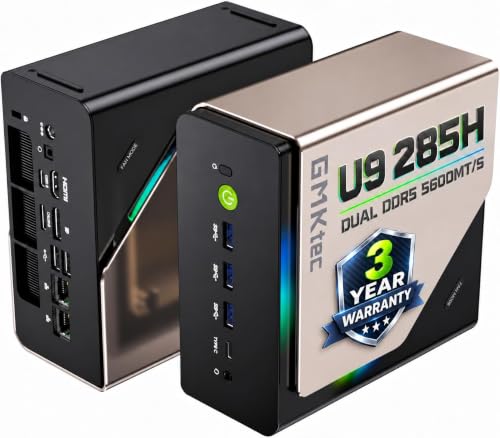
Core Ultra H
GMKtec EVO-T1 Mini PC AI Ultra 9 285H (up to 5.4GHz) 64GB DDR5 (32GB*2) 1TB PCIe 4.0 SSD Gaming Mini Computer, 3X M.2 Expansion Slots, Oculink, Quad …
64 GB RAM · 1000 GB SSD
£1,139.96Price checked 02.11.2026 19:55 UTCBuy on Amazon ↗
Intel Core
Thunderobot Gaming Mini PC RTX 5070 i9-14900HX 32GB DDR5 1TB SSD Win11 Pro | 32GB DDR5 5600 (up to 256GB), free M.2 Gen4 slot, HDMI 2.1, DP1.4 USB-C,…
32 GB RAM · 1000 GB SSD
£1,829.00Price checked 02.11.2026 14:46 UTCBuy on Amazon ↗
Core Ultra
ROG NUC 2025 Mini Gaming PC, Intel Core Ultra 7, GeForce RTX 5060, 96GB DDR5 Support, Thunderbolt 4, Triple Fan Cooling & ARGB Lighting (32GB DDR5+2T…
96 GB RAM · 2000 GB SSD
£1,879.20Price checked 02.11.2026 12:43 UTCBuy on Amazon ↗Buying guide
Choose the DAW session before the processor
The SER8 with 32GB is our first balanced comparison for a home studio. The NUC 14 Pro can be the better connection-led choice when its ports fit an established interface setup. The AI X1 Pro-370 with 64GB gives more capacity for large sample libraries and multitasking. Choose from your own session and interface requirements, including the recording buffer you expect to use.
A session with a few audio tracks is different from a large virtual-instrument arrangement. Long effect chains can be limited differently from many independent tracks. Use the DAW, plugins, sample libraries and recording buffer you actually need as the basis for choosing rather than counting CPU cores alone.
Interface drivers are part of the computer purchase
Check that the audio-interface manufacturer supports your operating system and intended connection. On Windows, use the appropriate supported audio driver for the device and DAW. A generic USB-C socket does not establish Thunderbolt compatibility, and the same connector shape does not make every interface interchangeable.
Test recording and playback with the real interface, not only the computer’s built-in audio. Listen for glitches and try a longer session at the buffer size you use for monitoring. If the system fails that test, identify driver, peripheral or workload causes before assuming that extra RAM or a higher CPU badge will solve it.
Memory, samples and fan placement
32GB is a practical starting comparison for a new mixed music desk. Large sample libraries and several creative applications can justify 64GB. Loading more instruments into memory is different from improving the latency of a processing chain. Check the actual memory use of your session and whether the chosen machine supports a later upgrade.
Use storage with enough capacity and speed for the libraries you keep active. Back up original recordings, sessions and required settings independently. Place the Mini PC so its fan is less likely to enter a microphone, while leaving airflow clear. Do not assume a quiet-looking metal case is fanless or that a short idle noise report describes a busy recording session.
Validate the studio before a critical recording
Open a representative project, play all tracks, record a useful take and export a mix. Test the MIDI controllers, storage devices and displays that remain connected. Keep a working software and driver configuration documented before making updates. A stable repeatable setup is more valuable for a session than an impressive isolated benchmark.
If one model is unavailable, preserve interface compatibility, required memory and the actual session capacity in the alternative. An inexpensive light-office PC is not automatically an equal replacement for a machine chosen for a large instrument library. Equally, do not pay for a high-end GPU when the audio workflow has no use for it. Put the budget into the bottleneck you can identify.
Choose capacity around a real project
Use a typical project as the starting point: its resolution, source format, number of layers or tracks, effects and delivery format. Opening the application is a much smaller task than finishing that project comfortably. For a new creative Mini PC, 32GB is a practical starting tier. Compare 64GB when you work with large projects, several creative applications or memory-heavy effects. More RAM helps avoid memory pressure, but it does not turn a weak graphics processor into a strong one.
Check the application version and its supported CPU, GPU and operating system. An integrated GPU shares system memory; a dedicated GPU has its own VRAM and different software support. Some effects and plugins require a specific backend. If a required renderer or plugin needs CUDA, choose an NVIDIA system instead of assuming that an AMD or Intel AI label provides the same feature. Match the computer to the work you already need to complete.
Separate the working copy from the backup
A fast internal SSD helps with applications, cache and active projects. A second drive can separate media or sample libraries, provided the exact computer has a suitable free slot. Check physical size, PCIe connection and cooling clearance before planning that expansion. More storage makes a working environment convenient, but it is not a backup when every copy is inside one machine. Keep original material and completed work on an independent device or trusted remote backup.
Choose ports for the actual peripherals: card reader, audio interface, external storage, calibrated display and network. USB-C describes a connector, so verify the supported data and video functions of each port. Fast networking becomes useful when the rest of the storage path can sustain it. A 10GbE port does not make a slow NAS or a single hard drive behave like a high-end local SSD. Include any dock or adapter in the total price.
Judge sustained work and support
A short export or small demo may hide thermal and memory limits. During setup, open a representative project, play or edit it, apply the effects you normally use and export or render a useful section. Keep the same application version and settings when comparing alternatives. Note responsiveness, fan behavior and memory use as well as completion time. A stable, comfortable working session matters more than one unusually favorable benchmark result.
For paid work, consider the cost of downtime and recovery. Keep licence details, project dependencies and a way to restore the machine. A system with replaceable RAM and storage offers a different ownership path from one with soldered memory. Buy a larger fixed-memory configuration only when its capacity solves a real need. Choose a conventional workstation when you need a replaceable discrete GPU, several expansion cards or cooling headroom that a compact chassis cannot provide.
Buying and support in the UK
Compare the complete UK purchase cost in pounds, including delivery and the parts needed to finish a barebone. Check whether a marketplace seller supplies the machine from UK stock or ships it internationally. That affects delivery, possible additional charges and the practical return route. Look for the correct UK mains lead and a clear description of the included operating-system licence. A compact case does not make an overseas support arrangement more convenient.
Keep the invoice, serial number and exact RAM and SSD configuration. For a business desk, ask who handles a hardware fault and how a replacement is arranged before buying several units. When the first model is unavailable, keep the required memory, graphics and ports in the alternative. Include a monitor, keyboard and independent backup in the budget where needed. Compare the finished, usable computer rather than a low barebone headline price.
Questions buyers ask
Which Mini PC should I compare for a home studio?
Start with a SER8 with 32GB, or an NUC 14 Pro when its connections fit your interface. Compare 64GB in an AI X1 Pro-370 for larger sample-based sessions.
Does more RAM reduce every audio-latency problem?
No. Driver support, processing load, buffer settings and peripherals also matter. More RAM helps when the session needs the capacity.
Can any USB-C port connect a Thunderbolt interface?
No. Confirm the required protocol, cable and supported computer connection with the interface manufacturer.
Specifications and software guidance
Ableton: computer specifications ↗Beelink SER8 ↗ASUS NUC 14 Pro ↗MINISFORUM AI X1 Pro-370 ↗Related Mini PC guides
Best Mini PCs for Video Editing UKBest Mini PCs for DaVinci Resolve UKBest Mini PCs for Premiere Pro UKBest Mini PCs for Photo Editing UKCompare Mini PC pricesAs an Amazon Associate, Cloudzat earns from qualifying purchases. Prices and availability can change.