


Capacity and value
Choose the right 990 PRO capacity by comparing usable space, DRAM, endurance, current price per usable terabyte and the cost of replacing a drive that becomes too small—not by capacity label alone.
The 2TB model is the broadest value choice, while 1TB and 4TB serve clearer edge cases
Choose 1TB for a focused boot or application drive, 2TB for the best balance of cost and headroom, and 4TB when a large game or media library would otherwise force another upgrade.
Capacity upgrades do not replace backup
A larger SSD can hold more data, but it still remains one device. Keep irreplaceable files on an independent backup rather than treating unused capacity as protection.
990 PRO capacity and headroom calculator
Enter live prices, current data and expected growth. The result compares the smallest safe capacity and the price paid for usable space.
990 PRO capacity comparison
| Specification | 1TB | 2TB | 4TB |
|---|---|---|---|
| Advertised capacity | 1,000GB | 2,000GB | 4,000GB |
| Approximate binary capacity before formatting | About 931GiB | About 1,863GiB | About 3,725GiB |
| DRAM | 1GB LPDDR4 | 2GB LPDDR4 | 4GB LPDDR4 |
| Warranty endurance limit | 600TBW | 1,200TBW | 2,400TBW |
| Headline sequential rating | Up to 7,450/6,900MB/s | Up to 7,450/6,900MB/s | Up to 7,450/6,900MB/s |
| Best fit | Boot drive or compact library | Mainstream gaming and creator system | Large game, media or project library |
Current exact-family offers

Samsung 990 PRO 1TB PCIe Gen 4.0 x4 (Maximum Transfer Rate 7,450MB/s) NVMe M.2 (2280) Internal SSD MZ-V9P1T0B-IT/EC
New · PCIe 4.0 x4 NVMe · Bare or not stated · Amazon Japan
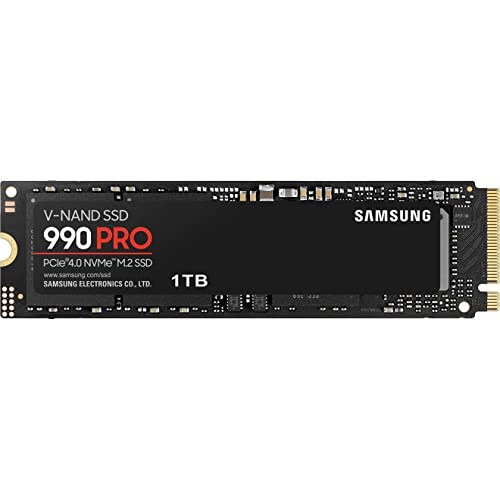
Samsung SSD 990 PRO 1TB, PCIe 4.0 M.2 2280, Up to 7,450 MB/s
New · PCIe 4.0 x4 NVMe · Bare or not stated · Amazon.com
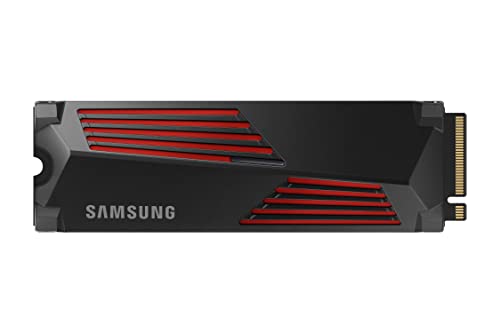
Samsung SSD 990 PRO with Heatsink 1TB, NVMe M.2, Up to 7,450MB/s
New · PCIe 4.0 x4 NVMe · Heatsink · Amazon.com

Samsung 990 Pro 1TB Gen4 NVMe SSD 7450MB/s 6900MB/s R/W 1550K/1200K IOPS 600TBW 1.5M Hrs MTBF for PS5 5yrs
New · PCIe 4.0 x4 NVMe · Bare or not stated · 305 Aero Supplies LLC

Samsung SSD 990 PRO 2TB, PCIe 4.0 M.2 2280, Up to 7,450 MB/s
New · PCIe 4.0 x4 NVMe · Bare or not stated · Amazon.com

SAMSUNG Samsung 990 PRO 2TB, 3-bit TLC V-NAND, M.2 (2280), NVMe 2.0, R/W(Max) 7,450MB/s/6,900MB/s, 1,400K/1,550K IOPS, 1200TBW, 5 Years Warranty
New · PCIe 4.0 x4 NVMe · Bare or not stated · SiliconValleySeller (SN# Recorded)

Samsung 990 PRO 2TB PCIe Gen 4.0 x4 (Maximum Transfer Rate 7,450MB/s) NVMe M.2 (2280) Internal SSD MZ-V9P2T0B-IT/EC
New · PCIe 4.0 x4 NVMe · Bare or not stated · All About Office

Samsung 990 PRO Heatsink Model, 2TB PS5 Operation Verified, PCIe 4.0 (Max Transfer Rate 7,450 MB/s), NVMe M.2 MZ-V9P2T0G-IT/EC
New · PCIe 4.0 x4 NVMe · Heatsink · SiliconValleySeller (SN# Recorded)

Samsung 2TB 990 PRO with Heatsink PCIe Gen4 NVMe M.2 2280 Up to 7450 MB/s, 6900 MB/s
New · PCIe 4.0 x4 NVMe · Heatsink · SiliconValleySeller (SN# Recorded)

Samsung 990 Pro M.2 4 Tb Pci Express 4.0 V-Nand TLC Nvme, W128825757 (4.0 V-Nand TLC Nvme)
New · PCIe 4.0 x4 NVMe · Heatsink · All About Office

Samsung 990 PRO 4TB PCIe Gen 4.0 x4 (Maximum Transfer Rate 7,450MB/s) NVMe M.2 (2280) Internal SSD MZ-V9P4T0B-IT/EC
New · PCIe 4.0 x4 NVMe · Bare or not stated · SiliconValleySeller (SN# Recorded)

Samsung SSD 990 PRO 4TB, PCIe 4.0 M.2 2280, Up to 7,450 MB/s
New · PCIe 4.0 x4 NVMe · Bare or not stated · Electronics Club
Amazon prices and images are checked on a 24-hour cycle. Latest offer check: 2026-10-16 23:47:49 UTC. Price and availability may change; Amazon at purchase time controls.
The three capacities share a platform but not the same ownership economics
Samsung positions the 990 PRO family as a PCIe 4.0 x4 NVMe line with the same headline sequential ceiling across 1TB, 2TB and 4TB. That makes capacity selection look simple, but the real decision changes with usable space, DRAM, write endurance, price per usable terabyte and how quickly your library grows.
The capacity label is therefore only the starting point. A 1TB model that must be replaced after one year can cost more than a 2TB purchase made once, while a 4TB model bought for a lightly used office PC can tie up money with little practical benefit.
- Compare ownership horizon, not just checkout price
- Use live price per usable capacity
Usable capacity is lower than the decimal label
SSD manufacturers state capacity in decimal gigabytes. Operating systems that display binary gibibytes show roughly 931GiB for 1TB, 1,863GiB for 2TB and 3,725GiB for 4TB before partitioning, recovery areas and file-system overhead.
Leave additional free space for updates, temporary files, game patches and the SSD controller’s normal housekeeping. A drive filled close to its limit gives you less flexibility and can make large updates or project exports harder to manage.
- Plan with binary capacity
- Keep practical free-space headroom
DRAM scales with capacity
Samsung lists 1GB of LPDDR4 on the 1TB model, 2GB on the 2TB model and 4GB on the 4TB model. All three are DRAM-equipped premium drives rather than DRAM-less designs.
More DRAM does not mean the 4TB model automatically doubles application speed. It supports the larger mapping requirements of the higher-capacity drive and helps preserve the product family’s responsive behavior across the range.
- All capacities retain dedicated DRAM
- Do not convert DRAM size directly into a speed multiplier
Endurance rises proportionally
The warranty endurance limit scales from 600TBW at 1TB to 1,200TBW at 2TB and 2,400TBW at 4TB. The warranty ends at five years or the applicable TBW limit, whichever occurs first.
For ordinary gaming and productivity, all three ratings are substantial. Heavy scratch-disk, cache, ingest or workstation use makes the higher-capacity endurance reserve more valuable because writes are distributed across a larger flash pool.
- Match TBW to write volume
- Warranty time and TBW are dual limits
When the 1TB 990 PRO makes sense
The 1TB version suits a dedicated Windows and applications drive, a smaller gaming system, a second fast workspace or a buyer with a strict budget. It also works when large files live on another SSD, NAS or external storage tier.
Its weakness is headroom. Modern game installs and updates can consume hundreds of gigabytes, and creative caches can grow unexpectedly. The 1TB model becomes poor value when you already know the current data set will exceed about three quarters of its practical capacity.
- Best for focused storage roles
- Avoid buying it when growth is already predictable
Why the 2TB model is the default recommendation
The 2TB version usually balances purchase cost, 1,200TBW endurance, 2GB DRAM and enough capacity for Windows, applications and a meaningful game or project library. It reduces the chance that a normal enthusiast PC needs another storage upgrade soon.
The 2TB model is not automatically the lowest price per terabyte on every day. Use the plugin’s dedicated catalogue to compare current bare and heatsink offers and calculate the premium over 1TB and discount relative to 4TB.
- Strong balance of capacity and cost
- Check bare-versus-heatsink pricing separately
When 4TB is worth the premium
The 4TB model is strongest for large Steam libraries, high-resolution media, local datasets, virtual machines and systems with only one practical M.2 slot. It can avoid the complexity of splitting projects across multiple volumes.
Buy it for a defined capacity need, not because it is the largest option. A second SSD may be preferable when you want workload separation, independent replacement cycles or a dedicated scratch volume.
- Useful when slots are limited
- Compare one 4TB drive with two smaller drives
Gaming libraries need growth allowance
A game library is not static. Major titles can exceed 100GB, shader caches and launchers consume additional space, and patches may need temporary working room. A capacity that is comfortable today can become cramped after a few seasonal releases.
For a gaming-first PC, add the current installed library, the games you intend to keep locally and at least one year of expected growth. The 2TB model often handles a curated library, while 4TB serves buyers who want many large titles available without constant deletion.
- Include updates and temporary space
- Do not size from game count alone
Creative work changes the calculation
Video editing, photography, 3D rendering and local AI workflows can create source files, proxies, caches, checkpoints and exports at the same time. The working set can therefore be much larger than the final deliverable.
Use 2TB when the 990 PRO is a fast active-project drive backed by larger storage. Choose 4TB when the machine must keep several active projects or datasets locally and the additional capacity reduces disruptive transfers.
- Size for the complete working set
- Keep archives and backups on separate storage
Bare and heatsink versions must remain separate
Each capacity can appear as a bare M.2 module or an integrated-heatsink model. The bare version normally fits under a motherboard’s own M.2 shield, while the Samsung heatsink version is intended for systems that need an integrated cooling solution, including compatible consoles.
Do not compare a discounted bare 1TB listing with a heatsink 2TB listing as though capacity were the only difference. Cooling configuration, condition, seller and warranty source must be normalized before judging price.
- Compare like cooling configurations
- Do not stack two heatsink systems
Price per terabyte is useful but incomplete
Divide current price by practical usable capacity to expose poor capacity premiums. Then add the cost of a future replacement, migration time and the value of keeping enough free space for normal use.
The lowest price per terabyte is not always the best purchase. A 4TB drive can be inefficient for a 400GB workload, while a slightly more expensive 2TB drive can be better than 1TB if it avoids an early replacement.
- Use cost per usable capacity
- Include upgrade and migration costs
A practical final decision
Choose the smallest capacity that fits the current data set, expected growth and a comfortable free-space reserve for the planned ownership period. Then compare live prices for the same cooling and condition category.
For most buyers starting from scratch, 2TB is the safest default. Choose 1TB with a narrow role and 4TB with a documented large-library or limited-slot requirement.
- 2TB is the general default
- Let workload and growth justify the exceptions
Official references and methodology
Cloudzat separates manufacturer specifications from buying analysis. Live offers appear only when this plugin’s dedicated catalogue accepts the exact family and capacity, rejects accessories and conflicting variants, and preserves condition and cooling distinctions. Prices are not invented when Amazon exposes only buying options.
Frequently asked questions
Is the 2TB 990 PRO faster than the 1TB model?
They share the same headline sequential rating, but capacity-specific random behavior, cache behavior and workload conditions can differ. The main 2TB advantage is capacity, DRAM and endurance headroom.
How much usable space does a 2TB 990 PRO provide?
A 2,000GB drive is roughly 1,863GiB before formatting, partitions and operating-system overhead.
Does the 4TB model have more DRAM?
Yes. Samsung lists 4GB LPDDR4 for 4TB, compared with 2GB for 2TB and 1GB for 1TB.
Which capacity is best for PS5?
2TB is the common balance, while 4TB suits a very large installed library. Use an effective heatsink and verify the exact console requirements.
Is 1TB enough for gaming?
It can be enough for a curated library, but modern large titles and updates can reduce free space quickly.
Is 4TB better than buying two 2TB drives?
One 4TB drive saves slots and simplifies volume management. Two 2TB drives can separate workloads and replacement cycles. Compare platform slots and current prices.
Does a larger capacity increase the warranty period?
No. The time limit remains five years, while the TBW limit scales with capacity.
Should I buy the heatsink version?
Choose it when the system needs an integrated cooler and has the physical clearance. Use the bare model under a suitable motherboard shield.
Why should I leave free space?
Free space supports updates, temporary files, project growth and normal SSD housekeeping.
Which capacity has the best price per terabyte?
It changes with live pricing. Use the calculator and compare equivalent cooling, condition and seller categories.
Affiliate disclosure: Cloudzat may earn a commission from qualifying Amazon purchases. The checkout page controls the final price, condition, seller, warranty and availability.