Key findings: a 1 TB NVMe SSD that sold for about $50 at the mid-2023 market bottom costs $90 to $110 in early 2026, roughly doubling in under a year after three years of steady declines. TrendForce projects NAND flash contract prices rising 33 to 38 percent quarter over quarter in Q1 2026, with enterprise SSD contracts up a record 53 to 58 percent. The cause is structural: AI data centers now absorb the majority of NAND output, 2026 production capacity is effectively sold out, and no meaningful new fab supply arrives before 2027. This report tracks the full price cycle from 2020 to 2026 and forecasts the rest of the year. All figures checked July 31, 2026.
Six years of SSD prices in one chart
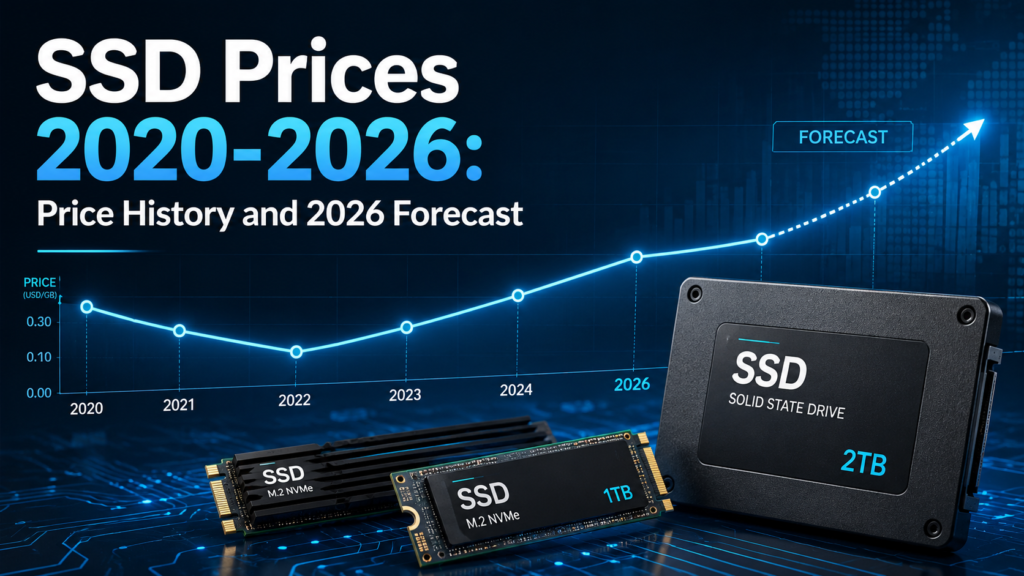
Consumer SSD pricing between 2020 and 2026 traces one of the most dramatic boom-bust-boom cycles in PC hardware history. Prices climbed through the pandemic and the 2021 Chia mining spike, collapsed by more than 60 percent into the 2023 oversupply trough, recovered modestly through 2024, softened again in mid-2025, and then broke violently upward when AI data center demand collided with fixed manufacturing capacity in late 2025.
LIVE SSD MARKET
SSD prices right now
Current new internal SSD offers from Cloudzat’s existing price catalogue, shown as a compact market snapshot beside the historical price data.
Prices and availability can change after the last catalogue check. Portable SSDs and non-new offers are excluded from this article snapshot.
2020 to 2021: pandemic demand and the Chia spike
The decade opened with SSDs as a premium component. In 2020 a 1 TB NVMe drive was a $100 to $130 purchase, and popular Gen4 models like the Sabrent Rocket held at $150 to $160 through the autumn. When the pandemic sent the world home, PC sales jumped 13 percent in a single year, the strongest growth in a decade, while factory closures and logistics chaos squeezed supply from the other side.
Then crypto arrived. The Chia cryptocurrency, which farms disk space instead of GPU cycles, briefly turned high-endurance SSDs into mining equipment in spring 2021 and pushed average consumer SSD pricing to roughly $0.14 per GB by July 2021, the peak of the cycle. The spike faded within months as Chia’s economics collapsed, but it marked the last time SSD prices would rise for nearly four years.
2022 to 2023: the crash to record lows
Manufacturers had expanded output expecting pandemic-level demand to continue. It did not. PC sales fell 16 percent in 2022, smartphone demand weakened simultaneously, and denser 3D NAND generations kept adding bits to every wafer. The result was one of the deepest oversupply gluts in memory industry history. By late 2022 a 1 TB Gen4 drive had fallen to $80, and the slide continued through 2023.
June 2023 was the bottom. Average consumer SSD pricing hit roughly $0.06 per GB, quality budget drives like the WD Black SN770 sold for about $0.05 per GB, and a 1 TB NVMe drive cost around $50. Tracker data puts the average Gen4 price near $38 per TB at the trough. The pain on the supply side was historic: Samsung’s semiconductor division posted its first quarterly loss in 14 years, and every major NAND maker announced production cuts. Buyers who filled their drive bays in 2023 caught the best storage prices ever recorded, and prices that, on current evidence, may not return.
2024 to 2025: recovery, relapse, and the break
The production cuts worked. Contract prices recovered through 2024 and retail followed, with 1 TB drives drifting back toward $65. But demand remained soft, and by mid-2025 the recovery had stalled: consumer 1 TB drives were again available near $45, tempting buyers to assume the old cycle would repeat and prices would keep falling.
Instead, the market broke. In the second half of 2025, AI data center buildouts turned from a DRAM story into a storage story. Enterprise SSD contract prices rose 40 to 50 percent in Q4 2025 alone. SK Hynix announced in October 2025 that its entire 2026 memory output was already spoken for. DRAM prices, a leading indicator for NAND, ended Q3 2025 up 172 percent year over year. By December, the question was no longer whether consumer SSDs would get more expensive, but how fast.
2026: the AI squeeze
The 2026 shortage is not a normal cycle. Memory makers have shifted wafer capacity, cleanroom space and engineering effort toward High Bandwidth Memory for AI accelerators, and toward the high-margin enterprise SSDs that AI server racks consume at 10 to 50 times the rate of traditional servers. Enterprise SSDs now account for roughly 60 percent of global NAND output, overtaking client SSDs and smartphones as the largest application segment for the first time. Micron told investors it can satisfy only 55 to 60 percent of its major customers’ demand. Phison, whose controllers ship in a large share of consumer drives, has said 2026 NAND capacity is effectively sold out industry-wide.
The consumer market is absorbing the downstream shock. TrendForce projects overall NAND contract prices up 33 to 38 percent quarter over quarter in Q1 2026, client SSD contracts up more than 40 percent, and enterprise SSD contracts up a record 53 to 58 percent, with some NAND wafer categories spiking as much as 50 percent in a single month. At retail, 1 TB consumer drives roughly doubled from about $45 in late 2025 to near $90 in early 2026, with premium models like Samsung’s 990 Pro 1 TB listing at $199.99 in March 2026 against $80 street pricing in November 2023. Tracker data shows the average Gen4 price climbing from its $38 per TB 2023 low to a $75 to $76 per TB plateau that has held since early 2026. The 4 TB and 8 TB segments have risen fastest per gigabyte, because big drives consume the most NAND and attract enterprise crossover buyers.
The costs are flowing through the whole PC industry. Dell, Lenovo, HP and HPE announced server price increases of about 15 percent around the turn of the year; Dell added a further 17 percent on March 30, 2026, and Cisco raised compute prices on March 7. HP has reported that memory now represents about 35 percent of a PC’s bill of materials after costs doubled in a single quarter. Micron’s Crucial brand announced its exit from the consumer SSD market to focus capacity on enterprise demand, removing one of the segment’s most aggressive price competitors.
1 TB NVMe pricing by year
Forecast: the rest of 2026
Every structural indicator points the same direction for the remainder of 2026. Supply cannot respond quickly: new fabs cost tens of billions of dollars and take years, so no significant fresh NAND capacity arrives before 2027, with meaningful volume more likely in 2028. Demand will not blink first: hyperscaler AI budgets are committed, and specialized categories that share production lines, such as NOR flash and SLC NAND, posted cumulative contract increases above 100 percent in the first half of 2026 alone, evidence that the squeeze is spreading rather than easing.
Our base case for H2 2026: consumer SSD prices hold at or modestly above the current plateau, with the Gen4 average staying in the $75 to $90 per TB band and 1 TB drives ranging $90 to $120 depending on tier. Retail will stay volatile week to week, and July 2026 has already shown small pullbacks as retailers test demand, but the floor has reset. A bear case of renewed declines would require an AI capex slowdown that nothing in current order books suggests. The bull case for buyers to fear is another leg up in Q4 2026 if enterprise stockpiling accelerates ahead of 2027 allocations. A return to 2023 or 2024 pricing is not credible within the next 12 to 18 months, and the long-term price floor has likely reset above where buyers remember it.
What buyers should do
Buy the capacity you need now rather than waiting for a dip that the supply picture cannot deliver, but resist over-provisioning at surge prices: the 4 TB and 8 TB tiers carry the worst per-gigabyte premiums of this cycle. Watch weekly rather than monthly, since retailer inventory of older stock still produces short-lived deals. For bulk storage, weigh whether hard drives or cloud object storage cover the workload, because NAND is where the shortage lives. Businesses should treat framework agreements and forward purchases as insurance, with component lead times already stretching past 20 weeks in constrained categories.
Methodology and sources
Price history reflects US retail pricing for mainstream TLC NVMe drives compiled from retailer listings, deal archives and price trackers, cross-referenced with TrendForce contract price data and manufacturer disclosures. Chart figures are representative mid-year averages rather than single-day spot prices; 2025 shows the mid-year low that preceded the Q4 surge. Key sources: TrendForce quarterly NAND and DRAM projections, Tom’s Hardware price tracking, manufacturer earnings disclosures from Micron, Samsung and SK Hynix, and vendor pricing announcements from Dell, Cisco, HP and Lenovo. All figures checked July 31, 2026. This page is updated as contract data for each new quarter is published; cite it as “Cloudzat SSD Price History, July 2026.”