


CYBER MONDAY 2026
Current Amazon offers for Cyber Monday shoppers

Black Friday Deal
N5 Mini PC Ryzen 3 5400U Small Desktop Computer 8GB DDR4 RAM 256GB NVMe SSD | Micro Compact PC Triple 4K HDMI DP USB-C WiFi 5 BT5.0 Home Office Business Streaming
−20% · Amazon reference price: CA$359.99
Verified 2026-11-27 13:59:53 UTC

Black Friday Deal
GEEKOM A5 2027 Edition Mini PC, AMD Ryzen 7 7730U, 16GB RAM, 512GB NVMe SSD | (Beats 7430U), Wi-Fi 6, BT 5.4, 15W Low Power, Quad 8K Display, Business Mini PC, Office & Video Editing, 3-Year Support
−19% · Amazon reference price: CA$759.00
Verified 2026-11-27 16:01:17 UTC

Black Friday Deal
KAMRUI P2 Mini PC, AMD Ryzen 5425U (Beats 5400U/3501U, Up to 4.1GHz), Mini PC Win11 PRO 8GB RAM 256GB SSD, Mini Desktop Computer HDMI+Triple 4K UHD,WiFi 6, for Business,School,Office,Home
−18% · Amazon reference price: CA$428.99
Verified 2026-11-27 15:41:45 UTC

Black Friday Deal
KAMRUI Pinova P1 Mini PC W-11 Pro,Mini PC AMD Ryzen 4300U(Up to 3.7 GHz,Βeats 3300U/N150/N95),Triple 4K@60Hz Display/USB 3.2/Type-C/HDMI/WiFi/BT Home Office (GB, 8, TB, 1)
−18% · Amazon reference price: CA$523.94
Verified 2026-11-27 15:38:11 UTC
Black Friday Deal
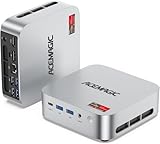
ACEMAGIC Ryzen 7 H255 Mini PC, Zen4, USB4, 2.5G LAN, WiFi6E, Win11 Pro | 16GB LPDDR5 6400MT/s, 512GB PCIe4.0 SSD, 8K@60Hz, Dual M.2 Slots, Soldered Non-Upgradable Memory
−15% · Amazon reference price: CA$749.99
Verified 2026-11-27 13:11:20 UTC

Black Friday Deal
BOSGAME P3 Plus Mini PC, AMD Ryzen 7 7840HS 16GB DDR5 RAM 1TB NVMe SSD | AMD Radeon 780M Graphics | Triple 4K Display | Wi-Fi 6E | Compact Desktop Computer for Gaming, Work & Home
−12% · Amazon reference price: CA$859.99
Verified 2026-11-27 16:01:17 UTC
Each card shows its last successful local Amazon check. Black Friday badges remain Black Friday badges until Amazon reports a different promotion. Reference prices and savings appear only when supplied by Amazon; the checkout price applies. As an Amazon Associate, Cloudzat earns from qualifying purchases.
Our recommendation
Choose UM870 Slim 32GB/1TB as a balanced Ryzen mini PC, UM760 Plus for a leaner office system, and UM890 Pro when its stronger expansion options are useful. Compare Beelink SER8 for a similar compact desktop role. Prefer the exact CPU, memory and storage configuration over broad claims that an older Ryzen model beats every newer entry-level PC.
For Cyber Monday 2026, start with MINISFORUM UM870 Slim in a complete 32GB/1TB configuration for a balanced Ryzen mini PC. UM760 Plus is the leaner office comparison, while UM890 Pro is worth the step up when its expansion options, including OCuLink, have a specific job. Beelink SER8 is another useful Radeon 780M-class desktop alternative. Older Ryzen 3500U or 5400U boxes belong in a lower-cost light-office comparison rather than being treated as equivalent to these newer systems.
The processor’s full name matters more than the word Ryzen or the largest number in the title. Different generations can combine very different CPU cores, graphics and memory platforms. For ordinary multitasking, a complete 32GB system with a useful SSD is a good balance. For gaming, integrated Radeon graphics can suit modest settings and lighter games, but they do not replace a discrete RTX desktop when demanding titles or GPU-heavy applications are the goal.
For Canadian buyers, UM870 Slim or a configured Beelink SER8 is a useful modern Ryzen starting point. An inexpensive Ryzen 3500U or 5400U box remains a lighter-office alternative, not the same graphics and CPU platform. Prefer a Canadian package and service route, and choose a larger discrete-GPU desktop when demanding games or CUDA software are the actual goal.
Which option should you buy?
| Choose | Best use | Reason to pass |
|---|---|---|
| MINISFORUM UM870 Slim | Balanced 32GB everyday system | Barebone and configured packages differ |
| MINISFORUM UM760 Plus | Modern office and lighter multitasking | Less CPU capacity than higher-tier models |
| MINISFORUM UM890 Pro | Expansion-focused Ryzen mini PC | External GPU equipment costs extra |
| Beelink SER8 | Compact Radeon 780M desktop | CPU and memory variant must match |
| GMKtec G3 Plus N150 | Light low-power appliance | Different CPU and graphics class |
Choose the actual Ryzen generation
UM870 Slim uses Ryzen 7 8745H, while UM760 Plus uses Ryzen 5 7640HS and UM890 Pro uses Ryzen 9 8945HS. Those full processor names are more informative than a generic Ryzen 7 versus Ryzen 9 comparison across unrelated years. A newer architecture, the integrated graphics and the cooling arrangement can matter more than the broad tier label. For a busy office desktop, the balanced complete system is usually more useful than a flagship processor paired with too little memory or a cramped drive.
Older Ryzen 3500U, 4300U or 5400U mini PCs may still serve light office work, but they should be compared as their own class. A search title that mentions N100 or N150 to claim superiority does not turn the product into one of those Intel machines. Similarly, a modern-sounding product name cannot change the processor generation inside. We would choose the newer complete Ryzen configuration for a longer-term busy desktop and consider older hardware only when its actual capabilities and support suit a modest job.
Integrated graphics have a useful but limited role
Radeon 780M-class integrated graphics are useful for a compact desk that mixes normal applications with lighter games or modest graphical work. They share the memory subsystem with the CPU, making the supported memory layout relevant. A well-configured two-module system can be a more appropriate choice than a minimum-memory configuration when graphics are part of the workload. Exact game settings and performance depend on the system, so a 4K display output should not be confused with demanding 4K gaming capability.
A discrete-GPU tower is the more appropriate comparison for heavy rendering, demanding games or a software stack that specifically requires NVIDIA CUDA. A mini PC can remain attractive for its size, but adding external graphics changes the total system. An OCuLink or USB4 connection does not include the GPU, enclosure or power supply. The resulting installation can occupy more space and cost more than expected. Choose external expansion because it serves an existing workflow, not as a vague promise that a small PC can later become anything.
UM890 Pro expansion should solve a real need
UM890 Pro is worth comparing when OCuLink and the rest of its connection layout fit a planned external-GPU or expansion project. It is not the automatic default for a browser-and-documents machine. UM870 Slim with 32GB and a 1TB SSD is a more balanced starting point for many desks, and UM760 Plus covers a lighter office role. The complete package, including operating system and regional power supply, is the unit of comparison rather than the barebone entry option.
For a small home lab, networking and storage may matter more than the extra graphics or processor tier. A machine with the required Ethernet connection and supported internal drive space can be the better server even when another model has a stronger headline CPU. For an always-on automation host, an N-series mini PC or Home Assistant Green may be sufficient and simpler. The Ryzen system earns its place when several services, heavier multitasking or more demanding desktop work actually use the additional capacity.
Choose installed memory before the headline processor
For an everyday office PC, 16GB is the useful starting point when a browser, documents and video calls run together. A machine with 8GB can still handle a lighter routine, but a small saving can disappear when memory pressure makes the owner close applications constantly. For heavier multitasking, development tools or several virtual machines, 32GB is the more comfortable target. Capacity does not turn a low-power four-core processor into a workstation, so the memory and CPU class need to suit the same workload.
Socketed SO-DIMM memory and soldered LPDDR memory create different upgrade paths. A soldered configuration should be bought at the capacity needed for the machine’s intended life. With a two-slot system, a matched pair can provide the intended memory-channel arrangement and bandwidth for integrated graphics. DDR4 and DDR5 are physically and electrically different; neither is a universal replacement for the other. A listing’s installed capacity, module layout and supported upgrade ceiling are separate facts, and the highest number mentioned in a family advertisement may not describe the selected configuration.
An SSD and a complete system are worth budgeting for
A 500GB or 512GB SSD is a practical starting point for Windows, office applications and a modest personal library. A 1TB drive is more useful when projects, local media or several development environments will live on the machine. Tiny eMMC configurations can be appropriate for a narrowly defined appliance, but they leave less room for application growth and operating-system updates. For a normal desktop, we would generally choose a replaceable SSD over a minimal fixed-storage configuration when the complete purchase remains sensible.
Barebone mini PCs usually need memory, storage and an operating system added to the particular package; the exact included components determine the comparison. A configured 32GB/1TB unit is therefore not directly comparable with an empty kit’s headline cost. Internal expansion also depends on the actual board: an M.2 connector can differ in length and interface, and a second slot may have different capabilities from the first. External USB storage is useful for a backup or media library, but it does not provide the same tidy installation as a supported internal drive.
Match the monitor and network connections
For two ordinary office monitors, two suitable display outputs simplify the desk. A USB-C connector is not enough evidence by itself: it can provide data only, display output, power input or a combination depending on the PC. A dock cannot create an unsupported display mode merely by adding more sockets. The advertised number of displays also says little about the simultaneous resolution and refresh rate. A buyer with a high-refresh monitor should choose a configuration whose actual output supports that requirement rather than relying on a generic 4K label.
Gigabit Ethernet is sufficient for ordinary broadband and many office tasks. A 2.5GbE port becomes useful for a compatible NAS, switch and workload, particularly large local file transfers. Two network ports can serve a lab or gateway project, but they do not automatically make a mini PC a well-supported router appliance. For a conventional desktop, one dependable wired link is often more valuable than an elaborate port count. For an always-on server, a stable wired connection also avoids depending on wireless placement and interference for household services.
Small size does not make every system silent
A fanless mini PC removes fan noise, which is useful beside a microphone, in a bedroom or for a light always-on service. It still produces heat and needs an installation position that allows its enclosure to release that heat. A compact actively cooled Ryzen system can sustain a different workload, but its fan may become audible under long builds, rendering or games. A brief turbo frequency does not describe the noise or performance of an hour-long task. Choose the cooling style for the work and room rather than treating silence as a free feature.
Processor base power is not the power drawn by the complete PC at the wall. Memory, storage, networking, the power supply and the workload all contribute. For an always-on system, a measured average 10W would amount to 87.6kWh over a year; 20W would amount to 175.2kWh. Those are arithmetic examples, not measurements of the recommended models. They explain why a modest automation host can be a better fit than a powerful desktop kept running for a tiny service. A monitor and external drives add their own consumption.
Buy the configuration and support route together
A complete mini PC should include the specified memory, storage, appropriate power supply and any advertised operating-system licence. A case, mounting bracket, dock or barebone listing can appear in the same search results without being an equivalent purchase. Regional versions can also differ in the supplied mains lead and service channel. For a work machine, a clear local return route can be worth more than a small reduction on an import with uncertain handling. A familiar family name does not establish that every seller supplies the same configuration or warranty.
Keep recovery practical once the machine is installed. A current backup of documents or server configuration belongs on another device or service, not only on a second partition of the same SSD. Driver and BIOS packages need to match the exact model and hardware revision; a near-identical product name does not make firmware interchangeable. For a desktop, a recoverable operating-system installation reduces downtime. For a home server, configuration backups and documented storage connections make replacing a failed small PC much less disruptive than rebuilding every service from memory.
Questions answered
Is a barebone mini PC ready to use?
Not necessarily. A barebone package can omit memory, storage and an operating system, so it needs those components before it becomes the same purchase as a configured desktop. Compare the exact included items and the complete cost rather than a family page’s lowest entry option.
Is 32GB always better than 16GB?
It is useful when applications, development tools or virtual machines need the extra space. A light office workload can be comfortable with 16GB. More memory does not remove a processor bottleneck or provide the same capability as dedicated GPU memory.
Can I use any USB-C dock?
The PC’s particular USB-C port must support the functions the dock needs. A data-only connection does not automatically carry a display signal or accept power. Match the supported monitor modes and power arrangement rather than treating the connector shape as a complete specification.
Will a mini PC be silent?
Only a fanless design removes fan noise. Actively cooled systems can become audible under sustained work, and fanless systems still need room to release heat. Choose the cooling style for the room and workload instead of assuming every small computer behaves the same way.
Can I upgrade the memory later?
Only when the exact model has replaceable memory and supports the intended modules. Soldered LPDDR configurations are normally fixed at purchase. SO-DIMM systems still have generation, layout and capacity limits, so the motherboard’s supported arrangement matters.
Does a small PC need a separate backup?
Yes. A failed SSD or accidental deletion can affect a mini PC just like a larger desktop. Keep documents or service configuration on another device or backup service as well. A second partition on the same internal drive is not an independent copy.