


Black Friday 2026 · Our buying decision
UGREEN DXP6800 Ultra Black Friday 2026 Deals
Black Friday offers
Shop the latest matching Amazon offers below. A Black Friday label appears only on a promotion verified by Amazon.
Black Friday Deal
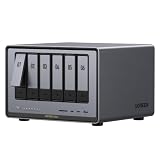
UGREEN NAS DXP6800 Ultra 6-Bay for Teams, Small Businesses File Server | Intel 120U 10-Core CPU, 8GB DDR5, Built-in 128GB SSD, 2x 10GbE, 2x M.2 NVMe Slots, 2xThunderbolt 4, 8K HDMI, Diskless
−20% · Amazon · List Price: $1,449.99
Verified 2026-11-23 06:53:18 UTC
No fresh priced listing is available right now. Check the matching Amazon results below.
Search AmazonA DXP6800 Ultra Black Friday reduction is most interesting for buyers moving beyond four bays.
Our recommendation is the Ultra for a growing shared library with a genuine fast-network need; choose the older DXP6800 Pro when its lower complete-system cost matters more than the processor update.
Choose six useful bays before paying for unused extras
The reviewed Ultra specification combines an Intel Core 5 120U, six SATA bays, two M.2 slots and 8GB DDR5, with a published memory ceiling of 96GB. Dual 10GbE and Thunderbolt 4 connections support demanding workflows, but neither supplied RAM nor advertised maximum drive capacity should be confused with a fully populated storage system. Drives are a separate purchase unless the exact offer states otherwise.
Current matching Amazon listings
Current local Amazon listings in USD. Only confirmed public campaign data earns a Black Friday badge; savings use the reference price for that exact listing. Model, quantity, included parts and regional version remain explicit.
As an Amazon Associate, Cloudzat earns from qualifying purchases. Amazon provides the final price and availability. A live listing is not automatically a Black Friday discount.
Matching product · exact contents shown
Black Friday Deal
UGREEN NAS DXP6800 Ultra 6-Bay for Teams, Small Businesses File Server | Intel 120U 10-Core CPU, 8GB DDR5, Built-in 128GB SSD, 2x 10GbE, 2x M.2 NVMe Slots, 2xThunderbolt 4, 8K HDMI, Diskless
−20% · Amazon · List Price: $1,449.99
Verified 2026-11-23 06:53:18 UTC
No matching live listing is available right now. Use the product search below to see current Amazon results.
The configuration we would buy
| Decision | Recommendation |
|---|---|
| Best fit | Our recommendation is the Ultra for a growing shared library with a genuine fast-network need; choose the older DXP6800 Pro when its lower complete-system cost matters more than the processor update. |
| Final verdict | Our final choice is DXP6800 Ultra with sensible drives for an expanding six-bay workload. Stay with four bays when the required protected capacity comfortably fits there. Step up to eight only when its additional slots avoid a near-term rebuild. The best Black Friday basket solves the capacity problem while leaving enough money to restore the data if the NAS itself fails. |
Our preferred purchase
For normal file sharing we would start with the supplied memory and suitable CMR NAS drives. A larger memory configuration becomes worthwhile when running known services or supporting a workload that actually consumes it. Buying the maximum supported RAM simply because it is possible can cost more than the saving on the enclosure, without changing the speed of an ordinary disk-limited backup.
The DXP6800 Pro is a legitimate alternative, not an unwanted search result to hide. Our decision is to buy Ultra when its newer platform or a small final-price difference makes sense, and buy Pro when the saving funds a better set of drives or backup. We would not transfer an Ultra discount to a Pro card, or treat a third-party RAM listing mentioning both names as a complete NAS.
The setup worth paying for
Six equal-capacity drives create several layout options. For illustration, six 8TB drives provide 48TB of raw labelled capacity; a single-parity arrangement has approximately five drives’ worth before filesystem overhead, while double parity has approximately four. That arithmetic is a planning example, not a claim that this enclosure includes six drives or that any layout replaces an independent backup.
A creator transferring large projects daily can justify a suitable 10GbE workstation connection. A household making unattended overnight backups may not. We would fund the missing part of the actual transfer path, not buy a premium switch and several adapters merely because the NAS exposes fast ports. Individual throughput still depends on storage, software and the client.
Our buying verdict
Our final choice is DXP6800 Ultra with sensible drives for an expanding six-bay workload. Stay with four bays when the required protected capacity comfortably fits there. Step up to eight only when its additional slots avoid a near-term rebuild. The best Black Friday basket solves the capacity problem while leaving enough money to restore the data if the NAS itself fails.
What earns a place in our Black Friday basket
Our buying order is the enclosure that fits the job, enough suitable storage, and an independent backup destination. We would remove an optional memory upgrade or oversized switch before removing the backup. A discounted chassis can be a good purchase, but it is not a complete system unless the selected offer explicitly includes the required drives. The exact package name matters more than the product photograph.
The reference price and percentage shown above come from the current Amazon observation when available. They describe that listing's stated comparison, not our own long-term price-history claim. Our recommendation is based on the final price for the usable configuration. A smaller advertised reduction can be the better purchase when it applies to the right memory, storage and seller package.
The capacity we would pay for
We would size storage around the files that must remain online, the expected additions and room for working copies. Buying only enough space for today's archive can force an early replacement. Buying the largest possible drives without a realistic use also ties up budget that could protect the data elsewhere. Our preference is a useful margin above the known working library, followed by a supported expansion route.
Raw capacity is the sum printed on the drive boxes; protected usable capacity is smaller. Mirroring, parity, formatting, snapshots and reserved space all affect the result. We would not choose a package by adding every SATA and M.2 capacity into one large headline. Separate pools with different jobs should be evaluated separately, especially when the fast working area and the large archive use different storage media.
Protection is part of the purchase
For important files, our minimum practical recommendation is the NAS plus another recoverable copy that does not disappear with the same machine. That could be a separate backup device or a suitable remote service. The appropriate choice depends on how much data must be restored and how quickly. A second folder inside the same storage pool is not that independent copy.
RAID can keep a system available after certain drive failures, but it cannot guarantee recovery from deletion, corruption, theft or every administrative mistake. Snapshots are valuable for supported recovery scenarios, yet they should not become the only recovery layer. We would fund a modest complete protection setup before buying a premium CPU for a file server that rarely uses it. That is a concrete purchasing priority, not an optional finishing touch.
Networking without buying unused speed
A fast NAS port is useful only along a capable path. The workstation adapter, switch, cables, protocol, drives and workload all contribute to the result. For scheduled household backups, we would keep a functioning existing network unless the transfer window is a genuine problem. For daily creator transfers, the matching client connection and shared network can justify a larger investment.
We would avoid purchasing several network adapters merely because the NAS has multiple ports. Multiple-client capacity, failover and a properly supported multichannel configuration are different benefits. A single ordinary transfer does not automatically use the sum of every port. The recommended complete setup should solve the actual transfer pattern: one workstation, several simultaneous users or unattended overnight backups.
Where we would spend the upgrade budget
For a capacity problem, buy the appropriate drives. For a network bottleneck, buy the missing network link. For a memory-constrained workload, buy the supported memory configuration. We would not use Black Friday to add every optional component at once. It becomes difficult to tell which purchase improved the experience, and the complete basket can erase the saving on the original NAS.
SSD cache is particularly easy to overbuy. It may help a suitable workload, but a large sequential backup is not automatically transformed by an expensive cache device. An SSD working pool and an SSD cache are different roles. We would assign the role first, then choose capacity, endurance and compatibility for it. Published desktop peak speeds alone are not a sufficient reason to buy a premium drive for a constrained NAS slot.
The complete package and ongoing ownership
Our preferred offer is new stock with the exact model and capacity stated, the appropriate local power equipment and a clear seller. A package that omits storage may still be the right choice when drives are already available; it should simply be compared as a diskless purchase. Likewise, a preorder can be reasonable for a planned project, but it is not our recommendation for an urgent replacement needed this week.
We would also account for placement and continuous operation. Mechanical drives, fans and heat make a desk installation different from a cupboard or equipment room. A faster processor can add capability without being the most economical always-on choice. The best-value NAS is the one whose everyday ownership matches the workload, rather than the one with the longest specification list at the moment of purchase.
When the live price changes
The cards lead with fresh local observations, and expired prices or unavailable offers are removed rather than treated as valid bargains. A model recommendation is not a claim that every seller or configuration deserves purchase at any price. If a matching offer disappears, the tagged Amazon search is a fallback for availability; it is not presented as a verified discounted listing.
Our decision remains to buy the configuration described in the verdict and avoid paying extra for features with no assigned job. Where a fresh Black Friday badge exists, it is shown with its applicable price. Where only a current ordinary listing is verified, the page says so. A price reduction without a campaign badge can still be useful, but we do not manufacture an event label or call an offer a historical low without evidence.
Black Friday dates and offer eligibility
Black Friday falls on 27 November 2026. Manufacturer and marketplace campaigns have different schedules, stock and eligibility. A calendar date does not establish a discount on the recommended configuration.
Direct answers before buying
Does a large percentage make this the best deal?
No. We would buy the recommended configuration at a sensible complete price before a less suitable product with a larger percentage. The reference price shown belongs to Amazon's current comparison for that exact offer; it is not a promise of the lowest price ever recorded. Quantity, included parts and eligibility can change the value. A Prime-only offer is also a different purchase condition from an unrestricted price. Our choice remains the useful package, and we would not pay for an unwanted membership or extra item solely to make the headline saving appear larger.
What should I do if the recommended listing is unavailable?
Use the clearly identified alternative in the buying verdict, or wait when that alternative does not meet the same need. We would not replace an exact model with an accessory or a materially smaller configuration just to display a purchase button. The Amazon search fallback is available for checking current availability but is not itself a confirmed discounted product. If the suitable replacement costs substantially more or changes the workflow, keeping the existing setup is often the better decision. The purpose of this guide is a useful purchase, not a purchase at any cost.
Would you buy a larger bundle just because its discount is bigger?
No. Our default is the smallest complete package that comfortably serves the intended work. Additional capacity or accessories earn their place only when they avoid a foreseeable second purchase or save repeated effort. A bundle can be convenient without being cheaper than its useful components. We would compare the delivered total of the recommended configuration and leave out extras that have no role. This is particularly important when a low headline price covers an accessory rather than the main product. The exact item and included quantity shown in the card determine what the price actually buys.
Is a manufacturer promotion the same as an Amazon offer?
No. A manufacturer campaign can establish that a product is being promoted directly, but its discount cannot be copied onto a different Amazon listing. The cards use the local marketplace observation for the displayed item, including any available reference price and public campaign evidence. Our editorial recommendation and the live offer are separate: the recommendation describes the useful purchase, while the card describes the currently observed seller package. If either changes, a previously attractive percentage is not a reason to buy a different configuration. We do not invent historical price records or claim firsthand testing.
Related buying guides
Sources and research notes
Researched on 23 November 2026 using manufacturer documentation and local Amazon observations. Editorial recommendations, without claims of hands-on testing. Prices expire after 24 hours; public promotion badges after one hour or the offer end. No unsupported historic-low claims.